


-
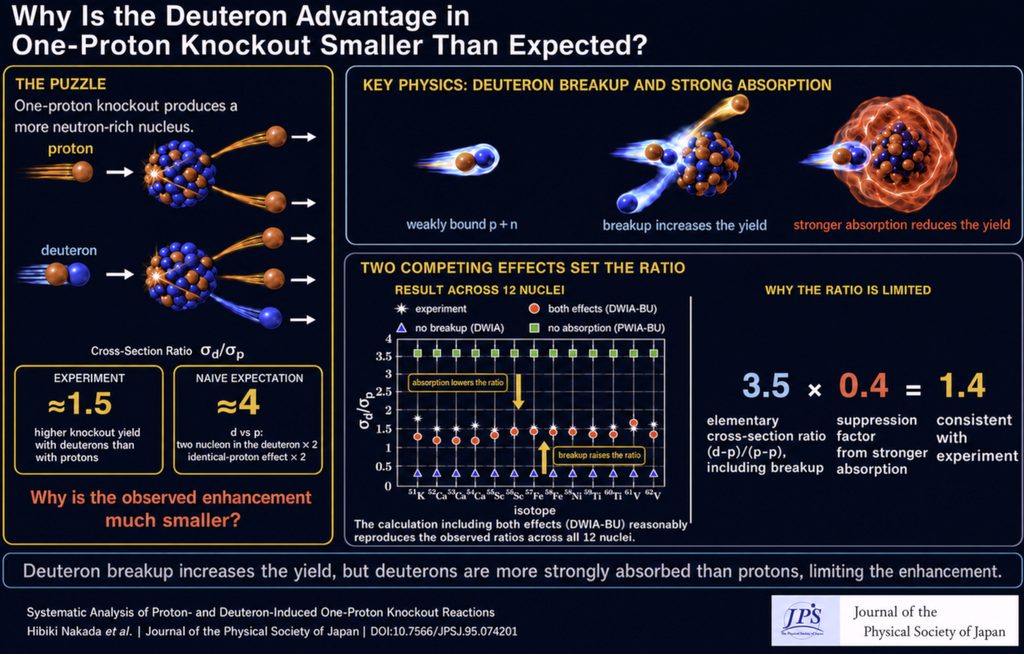
Why Is the Deuteron Advantage in One-Proton Knockout Smaller Than Expected?
2026-9-24
Deuteron breakup enhances one-proton knockout, whereas stronger nuclear absorption suppresses it. This explains why the measured deuteron/proton cross-section ratio is about 1.5, much lower than the naive expectation of 4.
Nuclear physics
-

Revealing Electronic Quantum Behavior Masked by Nuclear Heat
2026-9-7
The initial slope method is used to reveal intrinsic electronic specific heat by eliminating the overwhelming nuclear contributions during low-temperature calorimetry, opening a new window into quantum materials.
Measurement, instrumentation, and techniques
Structure and mechanical and thermal properties in condensed matter
Superconductivity
-
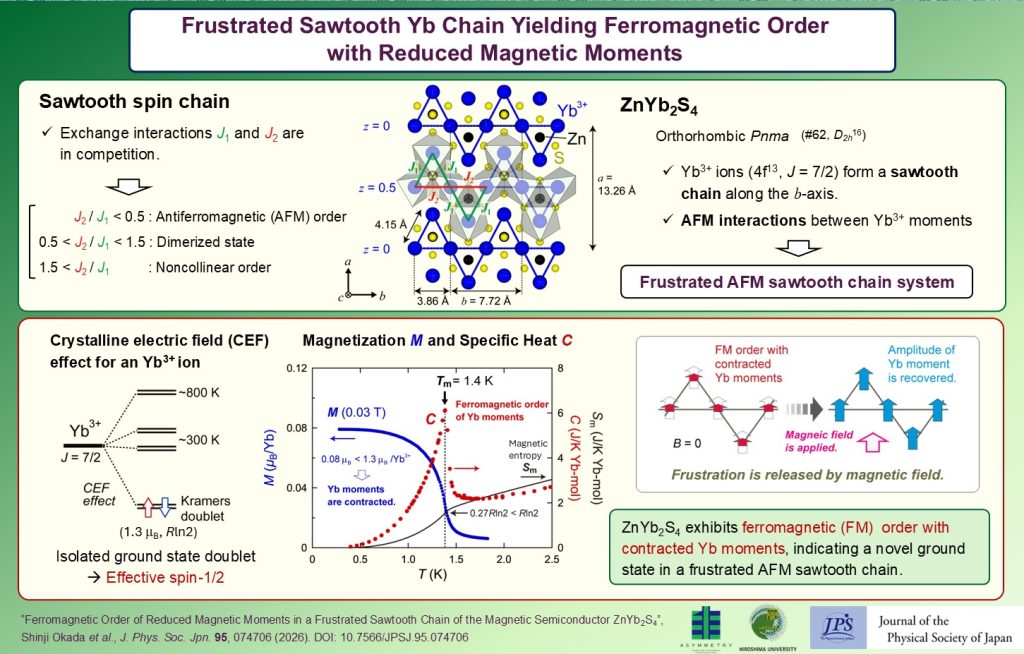
Frustrated Sawtooth Yb Chain Yielding Ferromagnetic Order with Reduced Magnetic Moments
2026-9-1
The ytterbium-based semiconductor ZnYb2S4 exhibits ferromagnetic order with contracted Yb moments, representing a novel quantum ground state attributed to competing exchange interactions in an effective spin-1/2 frustrated sawtooth chain.
Magnetic properties in condensed matter
-
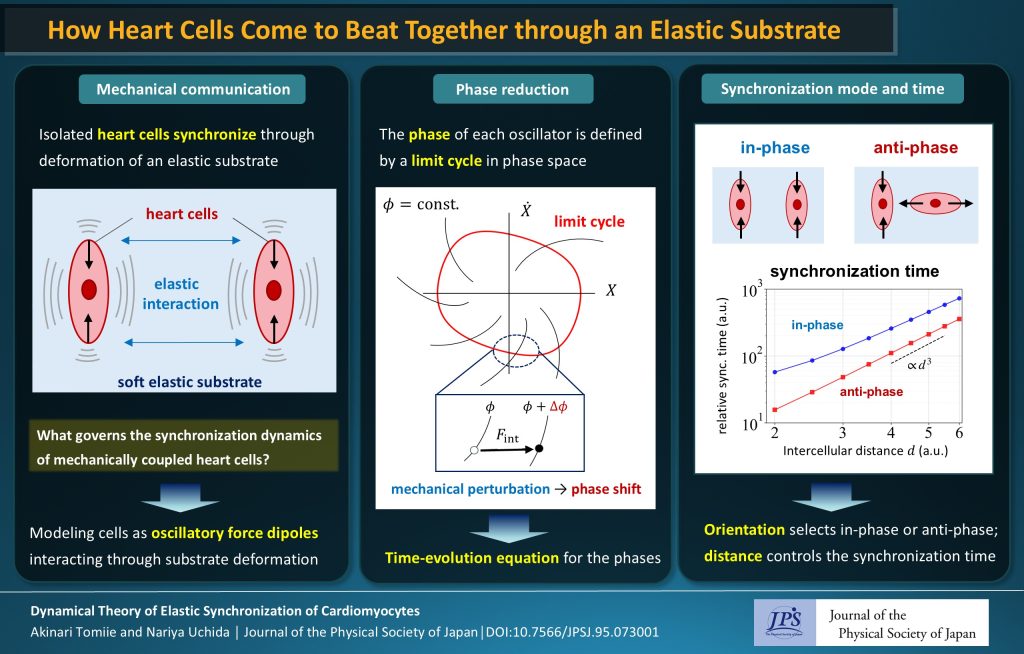
How Heart Cells Come to Beat Together through an Elastic Substrate
2026-8-24
Two isolated cardiomyocytes (heart muscle cells) can synchronize through deformations of a soft substrate. A dynamical theory explains geometry-dependent phase-locking and synchronization time.
Cross-disciplinary physics and related areas of science and technology
Statistical physics and thermodynamics
-
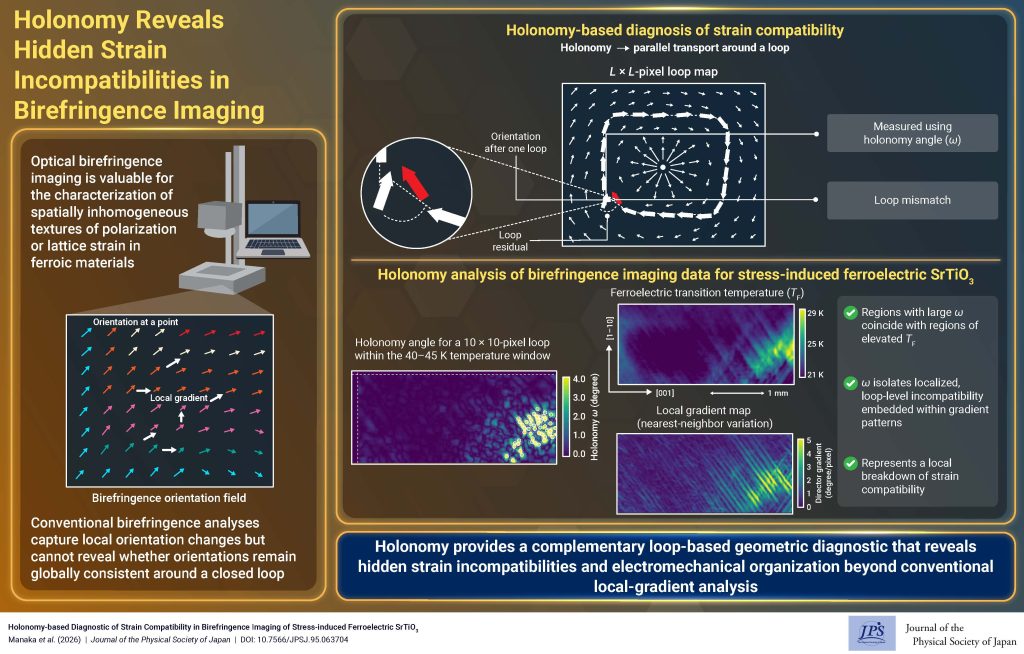
Holonomy Reveals Hidden Strain Incompatibilities in Birefringence Imaging
2026-8-17
Holonomy measures how local optical directions fail to return to their original orientation after a closed loop, revealing hidden electromechanical structures in stress-induced ferroelectric SrTiO3.
Dielectric, optical, and other properties in condensed matter
Measurement, instrumentation, and techniques
-
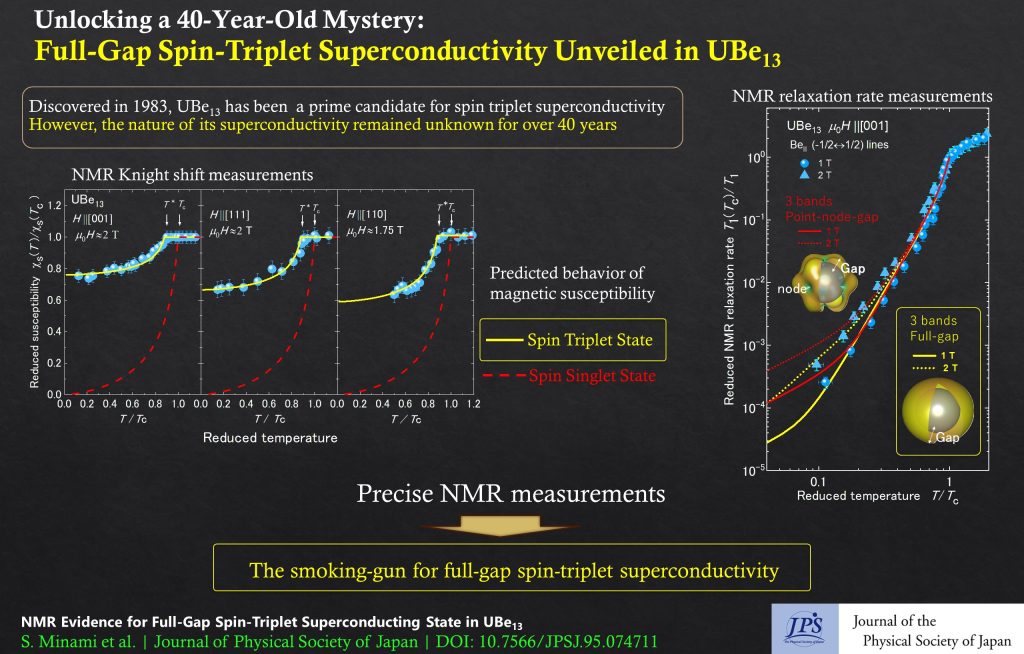
Unlocking a 40-Year-Old Mystery: Full-gap Spin-Triplet Superconductivity Unveiled in UBe13
2026-8-12
Recent precise NMR measurements on the heavy-fermion superconductor UBe13 provided “smoking-gun” evidence for a fully-gapped spin-triplet superconducting state, opening a new chapter in the field.
Magnetic properties in condensed matter
Superconductivity
-
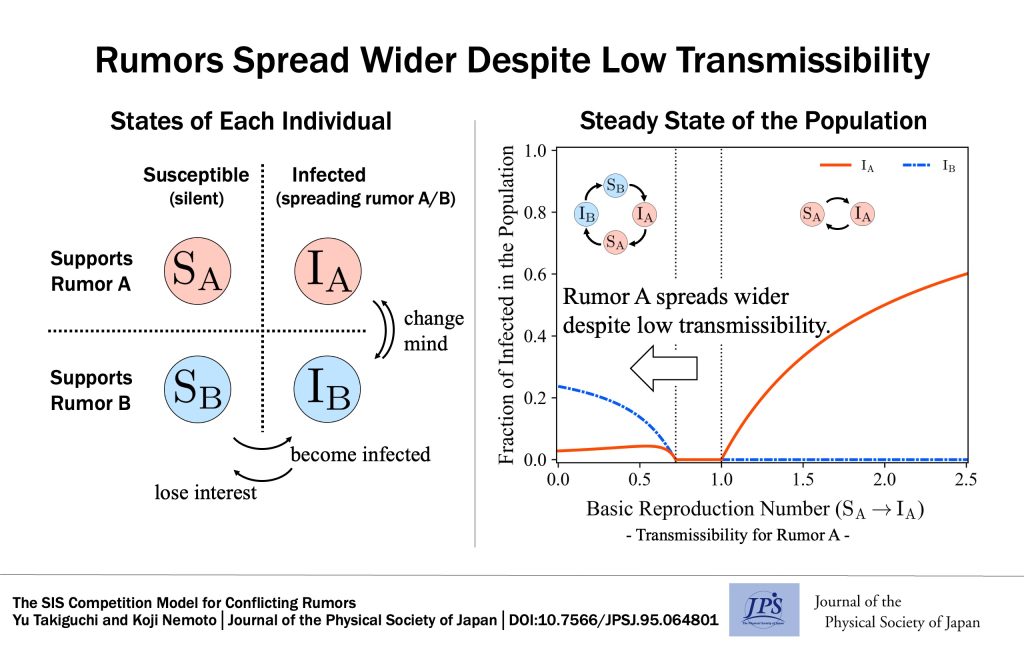
Rumors Spread Wider Despite Low Transmissibility
2026-8-7
This study proposes an SIS competition model that integrates rumor spread and opinion changes. This analysis reveals novel mechanisms for conflicting rumor coexistence, thus demonstrating that rumors paradoxically survive through low transmissibility.
Cross-disciplinary physics and related areas of science and technology
-
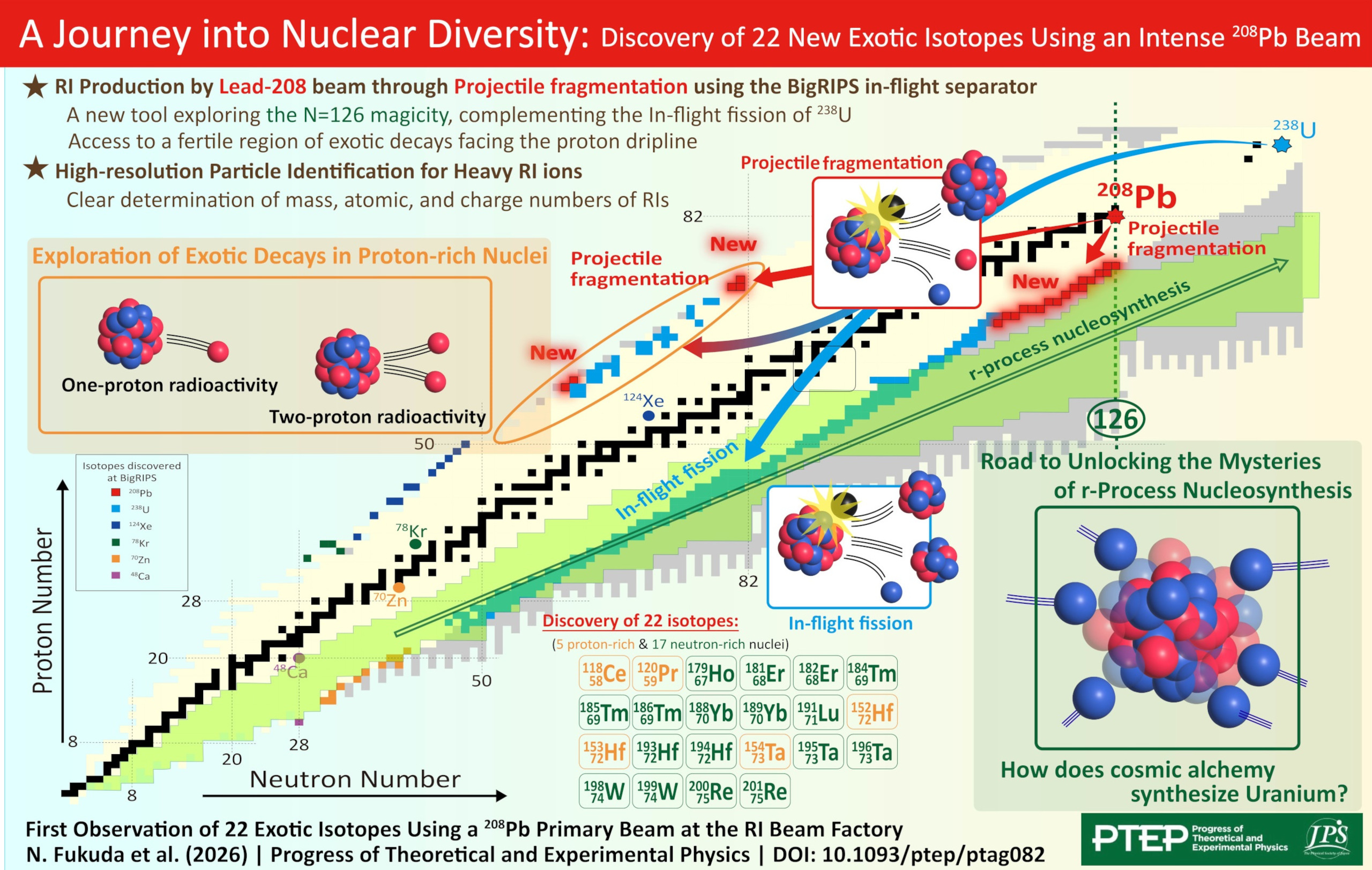
A Journey into Nuclear Diversity: Discovery of 22 New Exotic Isotopes Using an Intense 208Pb Beam
2026-8-3
Using a newly developed intense 208Pb beam at the RIKEN RI Beam Factory (RIBF), we discovered 22 new proton- and neutron-rich isotopes, which significantly expand the nuclear chart.
Nuclear physics
-
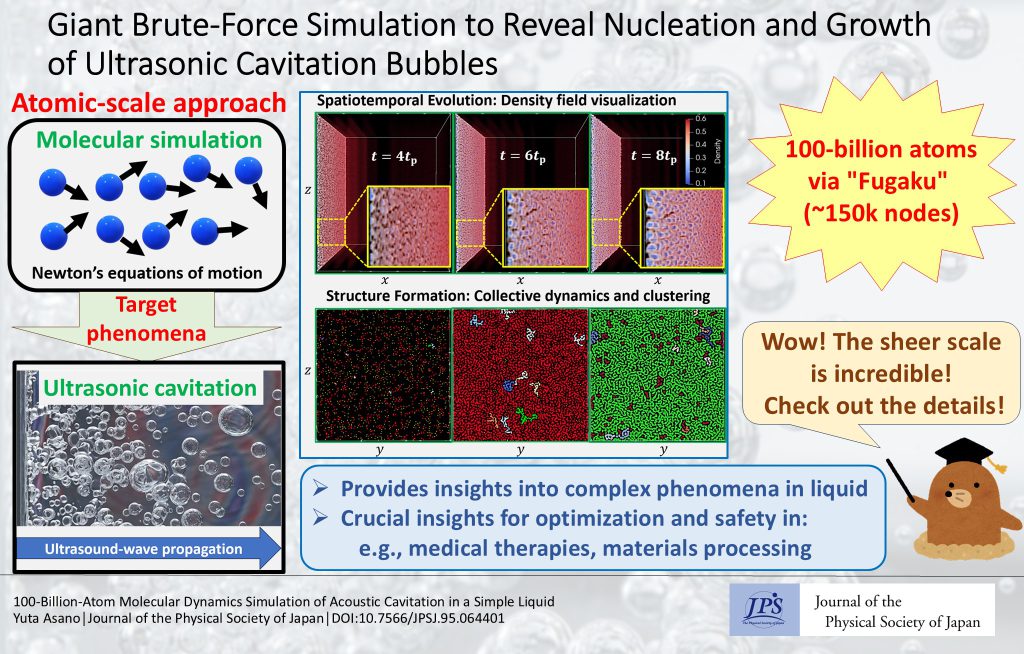
Giant Brute-Force Simulation to Reveal Nucleation and Growth of Ultrasonic Cavitation Bubbles
2026-7-27
This study reveals the early-stage dynamics of ultrasonic cavitation using a record 100-billion-atom simulation to capture bubble nucleation, growth, clustering, and periodic splitting under nonequilibrium conditions.
Electromagnetism, optics, acoustics, heat transfer, and classical and fluid mechanics
Statistical physics and thermodynamics
-
PICKUP
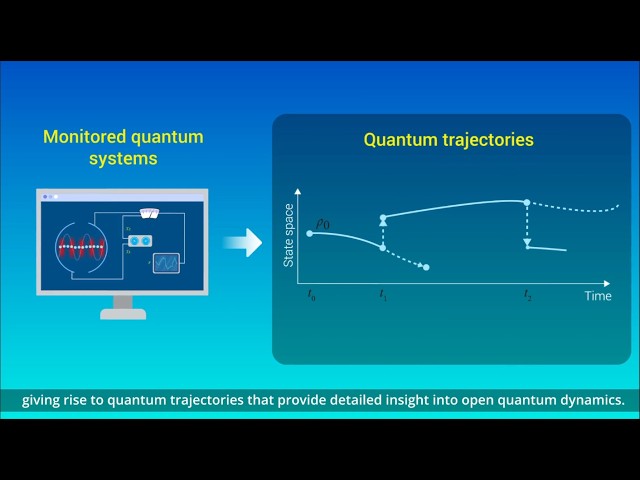
Monitored Quantum Systems and Quantum Trajectories
2026-7-21
This review in Progress of Theoretical and Experimental Physics introduces monitored quantum systems and quantum trajectories, emphasizing their spectral properties, typical behaviors such as ergodicity and purification, and measurement-induced phases.
Mathematical methods, classical and quantum physics, relativity, gravitation, numerical simulation, computational modeling
Statistical physics and thermodynamics