

Ultra Purification Unveils the Intrinsic Nature in Spin-Triplet Superconductor UTe2
© The Physical Society of Japan
This article is on
Large Reduction in the a-axis Knight Shift on UTe2 with Tc = 2.1 K
J. Phys. Soc. Jpn.
92,
063701
(2023)
.
Microscopic spin-susceptibility measurements in ultra-pure UTe2 samples reveal that superconducting symmetry is analogous to the superfluidity of the 3He B-phase and that U deficiency has a significant impact on superconducting properties.
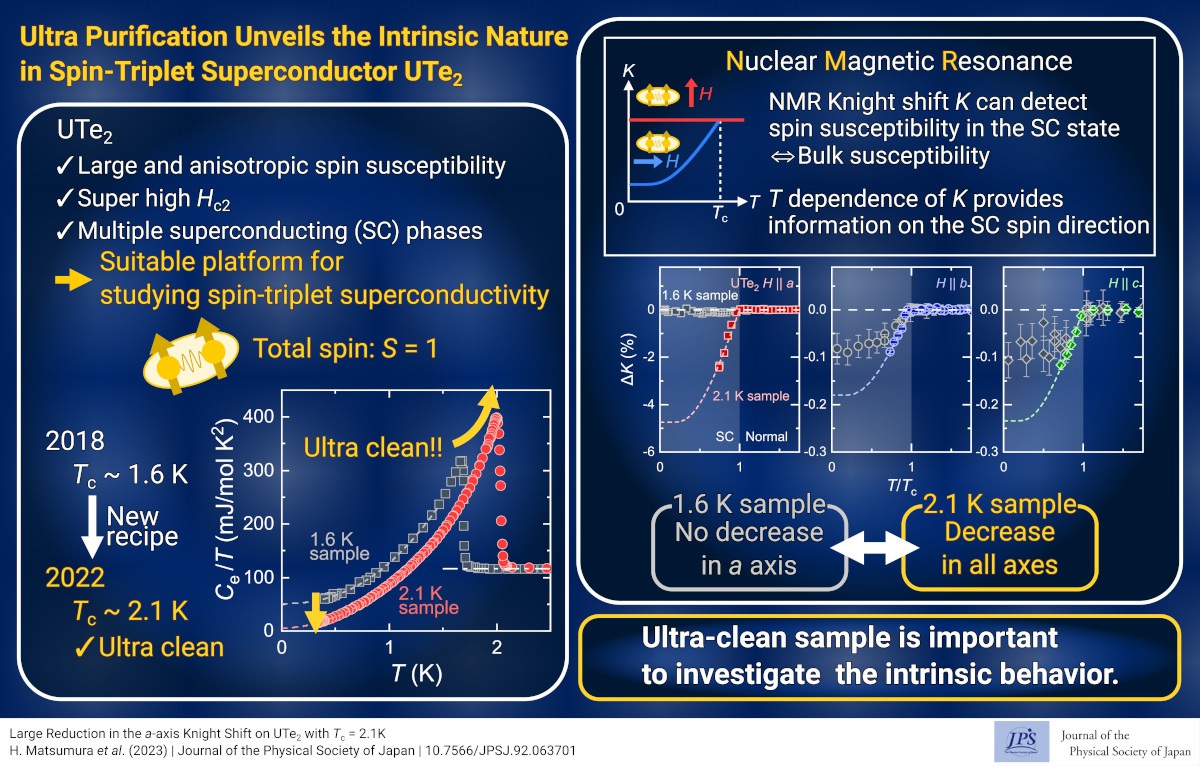
Superconductivity is a coherent quantum-mechanical state formed by electron pairs. Superconducting order parameters can be described using combinations of spin and orbital states. Although there are no spin degrees of freedom in the spin-singlet superconducting state, unique properties such as multiple superconducting states and spin rotation of a superconducting pair are expected in the spin-triplet superconducting state, owing to the presence of spin degrees of freedom. However, almost all discovered superconductors belong to the spin-singlet superconductors, with only a few spin-triplet superconductors reported thus far.
In 2018, superconductivity in UTe2 was discovered. UTe2 was initially classified as a spin-triplet superconductor owing to similarities with U-based ferromagnetic superconductors with spin-triplet pairing. In fact, characteristic features of the spin-triplet superconductor, such as an extremely large upper critical field Hc2 and superconducting multiple phases, were observed in UTe2. In NMR measurements, our group obtained various results confirming the spin-triplet state.
In 2022, a significant improvement in sample quality was achieved by changing the synthesis method from chemical-vapor-transport to molten-salt flux method. The new samples showed an increase in Tc from 1.6 to 2.1 K. The residual specific heat coefficient at T → 0, which was approximately half of the normal-state value in the 1.6 K sample, was nearly zero in the 2.1 K sample, indicating the ultra-pure nature of the 2.1 K sample.
To elucidate the intrinsic superconducting symmetry of UTe2, we performed NMR measurements on the 2.1 K sample. Because of the Meissner effect, bulk magnetization measurements cannot be used to determine spin susceptibility in the superconducting state; hence, NMR measurements are the only technique used. The results of NMR measurements for magnetic fields along three crystal axes revealed that the spin susceptibility in the a axis, which did not decrease in the 1.6 K samples, decreased significantly in the 2.1 K samples. However, the spin susceptibility in the b and caxes remained approximately the same as that in the 1.6 K samples. The results in the 2.1 K sample suggest that the possible superconducting state is the spin-triplet Au state, which is the same pairing state as the superfluidity 3He B-phase. This superconducting state is a strong candidate for the topological superconductor, in which the Majorana surface state is anticipated.
Our findings highlight the importance of ultra-pure samples for investigating the essential behavior of superconductivity.
(written by H. Matsumura on behalf of all authors.)
Large Reduction in the a-axis Knight Shift on UTe2 with Tc = 2.1 K
J. Phys. Soc. Jpn.
92,
063701
(2023)
.
Share this topic


Fields
Related Articles
-
Revealing Electronic Quantum Behavior Masked by Nuclear Heat
Measurement, instrumentation, and techniques
Structure and mechanical and thermal properties in condensed matter
Superconductivity
2026-9-7
The initial slope method is used to reveal intrinsic electronic specific heat by eliminating the overwhelming nuclear contributions during low-temperature calorimetry, opening a new window into quantum materials.
-
Frustrated Sawtooth Yb Chain Yielding Ferromagnetic Order with Reduced Magnetic Moments
Magnetic properties in condensed matter
2026-9-1
The ytterbium-based semiconductor ZnYb2S4 exhibits ferromagnetic order with contracted Yb moments, representing a novel quantum ground state attributed to competing exchange interactions in an effective spin-1/2 frustrated sawtooth chain.
-
Unlocking a 40-Year-Old Mystery: Full-gap Spin-Triplet Superconductivity Unveiled in UBe13
Magnetic properties in condensed matter
Superconductivity
2026-8-12
Recent precise NMR measurements on the heavy-fermion superconductor UBe13 provided “smoking-gun” evidence for a fully-gapped spin-triplet superconducting state, opening a new chapter in the field.
-
Peculiar Magnet Pointing Against an Applied Magnetic Field
Cross-disciplinary physics and related areas of science and technology
Magnetic properties in condensed matter
2026-7-1
TbNiC2 exhibits negative magnetization. A new mechanism, based on the coupling between the charge density wave and the antiferromagnetic order, is proposed to account for this peculiar phenomenon.
-
Magnetic-Field Driven Switching of Multipolar Order in an f-Electron System
Magnetic properties in condensed matter
2026-5-22
This study investigates high-rank multipole physics in f-electron systems, providing the first clear experimental evidence for field-induced switching of ferro-quadrupole order in a non-Kramer ion system, along with a new conceptual framework