

Unveiling the Nodal Topology of the Spin-Triplet Superconductor Candidate UTe2
© The Physical Society of Japan
This article is on
Nodal Superconductivity of UTe2 Probed by Field-Angle-Resolved Specific Heat on a Crystal with Tc = 2.1 K
J. Phys. Soc. Jpn.
95,
034709
(2026)
.
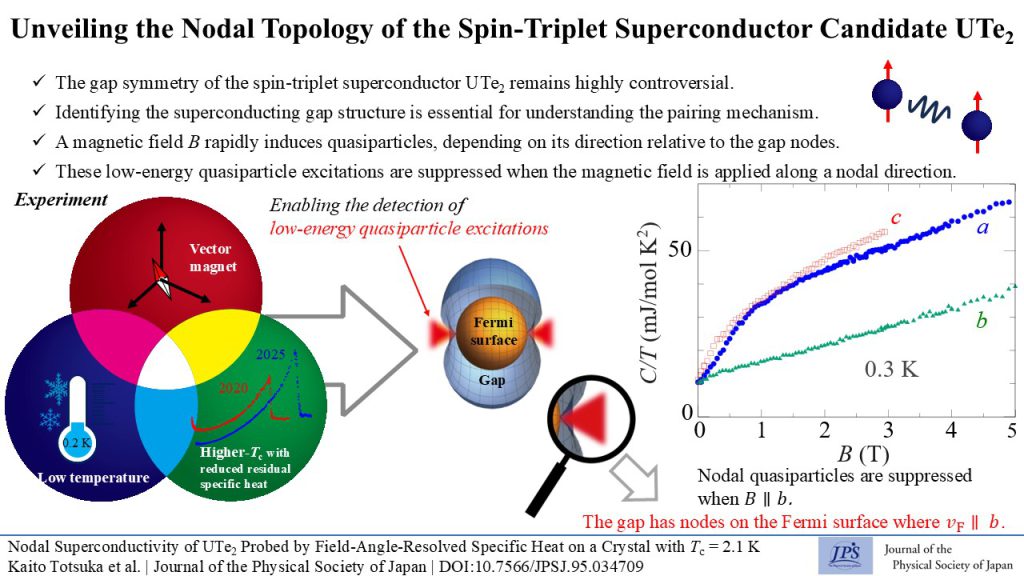
Using high-quality UTe2 (Tc = 2.1 K), we identify its nodal gap structure. Field-angle‑resolved specific‑heat reveals a b-axis singularity, supporting spin-triplet superconductivity with nodes along the b axis.
Superconductivity is a remarkable quantum phenomenon in which electrons form paired bound states, known as Cooper pairs, leading to zero electrical resistance. Bardeen–Cooper–Schrieffer (BCS) theory has long provided the microscopic foundation for conventional superconductivity, describing Cooper pairs with antiparallel electron spins: spin‑singlet pairing. This theory explains a wide range of superconducting materials. By contrast, electrons may also pair with parallel spins, forming a spin‑triplet state. Spin‑triplet superconductivity can host exotic physical properties, such as unusually high upper critical fields and novel types of pairing interaction, owing to its remaining spin degrees of freedom. Because experimentally confirmed examples are extremely scarce, identifying the mechanism that stabilizes spin‑triplet superconductivity is a major challenge in contemporary condensed matter physics.
Among the promising candidates, the uranium‑based compound UTe2 has attracted significant attention. It exhibits highly unconventional properties, including reentrant superconductivity under strong magnetic fields and exceptionally high upper critical fields, that are difficult to reconcile with spin‑singlet pairing. Since its discovery in 2018, extensive research has been devoted to clarifying its superconducting characteristics. However, early experiments were often performed on samples with relatively low transition temperatures (Tc ~ 1.6 K), where the effects of impurities and sample dependence remained a concern. A major breakthrough occurred in 2022 with the achievement of high-quality single crystals with Tc = 2.1 K, making it possible to investigate the intrinsic mechanism of its superconductivity.
A key to understanding this mechanism is determining the superconducting gap structure, which reflects the symmetry of the pairing interaction. In many unconventional superconductors, the gap vanishes at specific points or lines on the Fermi surface, known as “nodes.” These nodes induce low‑energy quasiparticle excitations, which can be sensitively detected through specific-heat measurements. In particular, when a magnetic field is applied, the quasiparticle density of states rapidly increases depending on the field direction relative to the nodes because of the Volovik effect (the Doppler energy shift). In this study, high-precision field-angle‑resolved specific-heat measurements were performed using a high-quality crystal with Tc = 2.1 K.
The most striking finding is a profound anisotropy in the field dependence of the specific heat. While the specific heat increases rapidly for fields along the a and c axes, a hallmark of nodal quasiparticle excitations, it exhibits a striking linear dependence only when the field is applied along the b axis. This suppression of the rapid increase suggests that the Fermi velocity of the nodal quasiparticles is aligned predominantly with the b axis, which minimizes the Volovik effect for this specific direction. Furthermore, although the field-angle dependence displays a complex behavior, it can be consistently explained within the b-axis node scenario by considering the characteristic anisotropy of Hc2 and the Fermi surface geometry of UTe2. These results provide crucial constraints on the gap symmetry and advance the ongoing efforts to uncover the nature of spin-triplet superconductivity in this fascinating compound.
(written by K. Totsuka on behalf of all authors.)
Nodal Superconductivity of UTe2 Probed by Field-Angle-Resolved Specific Heat on a Crystal with Tc = 2.1 K
J. Phys. Soc. Jpn.
95,
034709
(2026)
.
Share this topic


Fields
Related Articles
-
The Thermal Einstein–de Haas Effect: Theoretical Prediction and Observability in Chiral Carbon Nanotubes
Cross-disciplinary physics and related areas of science and technology
Structure and mechanical and thermal properties in condensed matter
2026-6-22
Although the Einstein–de Haas (EdH) effect describes material rotation in a magnetic field, a thermal EdH effect, driven by a temperature gradient, remains unobserved. Recently, chiral carbon nanotubes were theoretically proposed as promising candidates to observe it.
-
Negative Apparent Viscosity in Liquid Crystals
Cross-disciplinary physics and related areas of science and technology
Electromagnetism, optics, acoustics, heat transfer, and classical and fluid mechanics
Structure and mechanical and thermal properties in condensed matter
2026-6-8
Electrically driven liquid-crystal turbulence generates self-sustained flow and negative apparent viscosity. The fluorinated, chemically robust nematic PPDFB shows a substantially larger negative-viscosity effect than Schiff-base nematics.
-
Role of the Diffusion Layer in Energy Devices
Cross-disciplinary physics and related areas of science and technology
Structure and mechanical and thermal properties in condensed matter
2026-5-1
In many energy devices, electron transfer occurs between ions dissolved in the electrolyte and the electrodes. For keep current flowing, new ions must be supplied continuously to the electrode surface from the bulk region. The diffusion layer’s role in diffusive mass transfer was clarified using the rotating disk electrode method.
-
Creation of Chiral Phonons−How Lattice Chirality Imparts Angular Momentum to Phonons?
Structure and mechanical and thermal properties in condensed matter
2026-3-2
Chiral crystals host phonons with intrinsic angular momentum, whose quantization and energy splitting reflect the lattice chirality and reveal the microscopic features of interatomic interactions.
-
Do Superconductors Dream of Tsunamis?
— A Cross-disciplinary Journey of Solitons —
Mathematical methods, classical and quantum physics, relativity, gravitation, numerical simulation, computational modeling
Superconductivity
2026-2-10
Tsunami-like solitons propagating over rocky-desert-like disordered backgrounds have been identified in a novel soliton equation derived from the theory of parity-mixed superconductivity.