

Negative Apparent Viscosity in Liquid Crystals
© The Physical Society of Japan
This article is on
J. Phys. Soc. Jpn.
95,
054601
(2026)
.
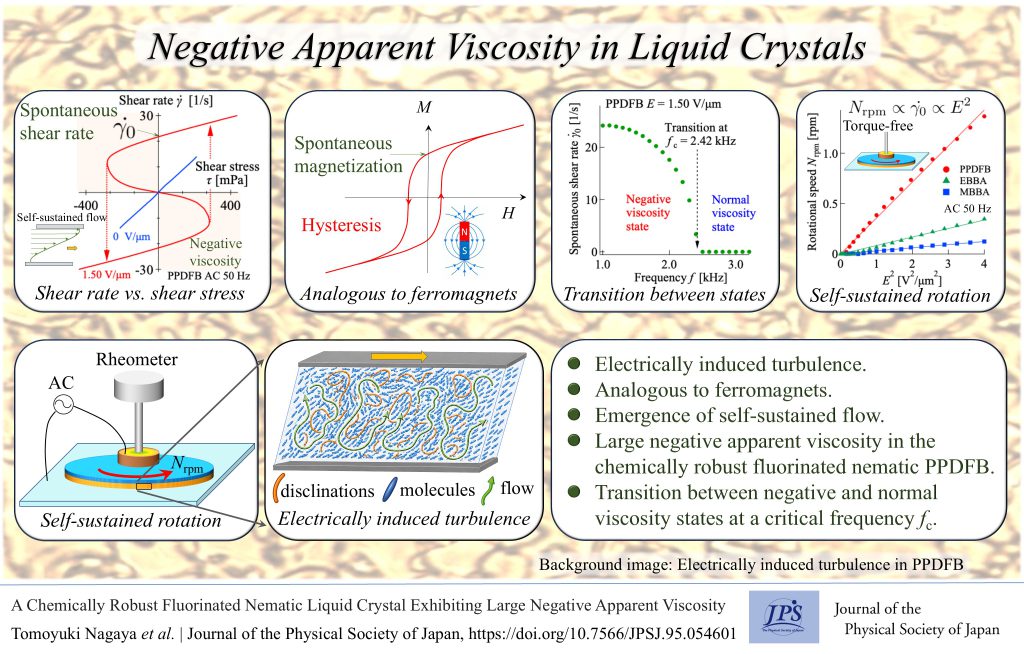
Viscosity is generally understood as resistance to flow. When a liquid is sheared, it produces a stress that opposes the imposed motion, and mechanical energy is dissipated as heat. However, in systems that are continuously driven by an external energy source, part of the supplied energy can be converted into organized mechanical motion. Such a system can then generate a self-sustained flow, rather than simply resist externally imposed motion. This counterintuitive behavior is known as negative apparent viscosity.
This phenomenon was first observed in the nematic liquid crystal MBBA and was later reported in its close homolog EBBA. MBBA is a classic room-temperature nematic liquid crystal, whereas EBBA differs from MBBA by an additional CH2 unit. These materials contain a Schiff-base (imine C=N) linkage that is easily broken by water molecules, resulting in poor chemical stability. To avoid this problem, we use PPDFB, which is a chemically stable, fluorinated tricyclic nematic liquid crystal that was developed for display applications and is therefore well suited for studies of negative apparent viscosity.
Nematic liquid crystals flow similarly to ordinary liquids; however, their rod-like molecules tend to align along a common direction called the director. An applied electric field couples the director to the fluid flow through dielectric and conductivity anisotropies. When a sufficiently strong AC electric field is applied at 50 Hz, this coupling produces electrohydrodynamic turbulence with many disclinations, or topological defects in the director field. Negative apparent viscosity appears in this turbulent state.
The negative-viscosity state is characterized by the relationship between the shear rate and shear stress. When the shear stress is controlled, the shear rate exhibits hysteresis, which resembles the response of an order parameter to an external field in ferroic materials such as ferromagnets. In contrast, when the shear rate is controlled, the shear stress follows a continuous S-shaped curve through the origin, with no direct counterpart in ordinary ferroic hysteresis curves.
Importantly, a nonzero shear rate can occur even when the applied shear stress is zero. Analogous to spontaneous magnetization, this is known as the spontaneous shear rate, which appears as a self-sustained rotation of the upper plate in a rheometer. The rotational speed is proportional to the square of the electric field. In contrast, in terms of frequency dependence, the rotational speed gradually decreases at higher frequencies and vanishes at a threshold frequency, marking a transition to the normal-viscosity state.
These negative apparent viscosity features are common to MBBA, EBBA, and PPDFB. However, PPDFB exhibits a significantly larger negative apparent viscosity than MBBA and EBBA. Its chemical robustness and strong negative-viscosity response make PPDFB an excellent platform for studying negative apparent viscosity.
The magnitude of the negative apparent viscosity is related to the space charges that are generated by director distortions, particularly near disclinations. These charges experience forces from the external electric field and drive the fluid flow, leading to turbulence in which a mean flow emerges under strong electric fields. Although turbulence also occurs in ordinary isotropic fluids, turbulence in liquid crystals is unique because it can convert electrical energy into macroscopic mechanical motion.
(Written by Tomoyuki Nagaya on behalf of all authors)
J. Phys. Soc. Jpn.
95,
054601
(2026)
.
Share this topic


Fields
Related Articles
-
Topological Defects as Seeds of Phase Separation: Insights from a Minimal Lattice Model
Cross-disciplinary physics and related areas of science and technology
Statistical physics and thermodynamics
2026-7-13
A minimal lattice model revealed that topological defects with winding number +1 serve as nucleation sites for phase separation in active matter systems.
-
A Deep Dive Into AI-Driven Materials Science
Cross-disciplinary physics and related areas of science and technology
2026-7-6
This review from the Journal of the Physical Society of Japan examines how artificial intelligence overcomes traditional materials science bottlenecks, highlighting the shift from intuition-based discovery to data-driven innovation.
-
Peculiar Magnet Pointing Against an Applied Magnetic Field
Cross-disciplinary physics and related areas of science and technology
Magnetic properties in condensed matter
2026-7-1
TbNiC2 exhibits negative magnetization. A new mechanism, based on the coupling between the charge density wave and the antiferromagnetic order, is proposed to account for this peculiar phenomenon.
-
The Thermal Einstein–de Haas Effect: Theoretical Prediction and Observability in Chiral Carbon Nanotubes
Cross-disciplinary physics and related areas of science and technology
Structure and mechanical and thermal properties in condensed matter
2026-6-22
Although the Einstein–de Haas (EdH) effect describes material rotation in a magnetic field, a thermal EdH effect, driven by a temperature gradient, remains unobserved. Recently, chiral carbon nanotubes were theoretically proposed as promising candidates to observe it.
-
Verification of Magnetic Structure Observation at the Atomic Scale
Atomic and molecular physics
Cross-disciplinary physics and related areas of science and technology
Nuclear physics
2026-6-2
Magnetic neutron scattering holography (MNH) were performed on a Fe0.08Co0.92 single crystal. The resulting holograms provided the first experimental evidence that MNH is sensitive to magnetic signals.