

The Thermal Einstein–de Haas Effect: Theoretical Prediction and Observability in Chiral Carbon Nanotubes
© The Physical Society of Japan
This article is on
Thermal Einstein–de Haas Effect Induced by Chiral Phonons in Carbon Nanotubes
(JPSJ Editors' Choice)
J. Phys. Soc. Jpn.
95,
033801
(2026)
.
Although the Einstein–de Haas (EdH) effect describes material rotation in a magnetic field, a thermal EdH effect, driven by a temperature gradient, remains unobserved. Recently, chiral carbon nanotubes were theoretically proposed as promising candidates to observe it.
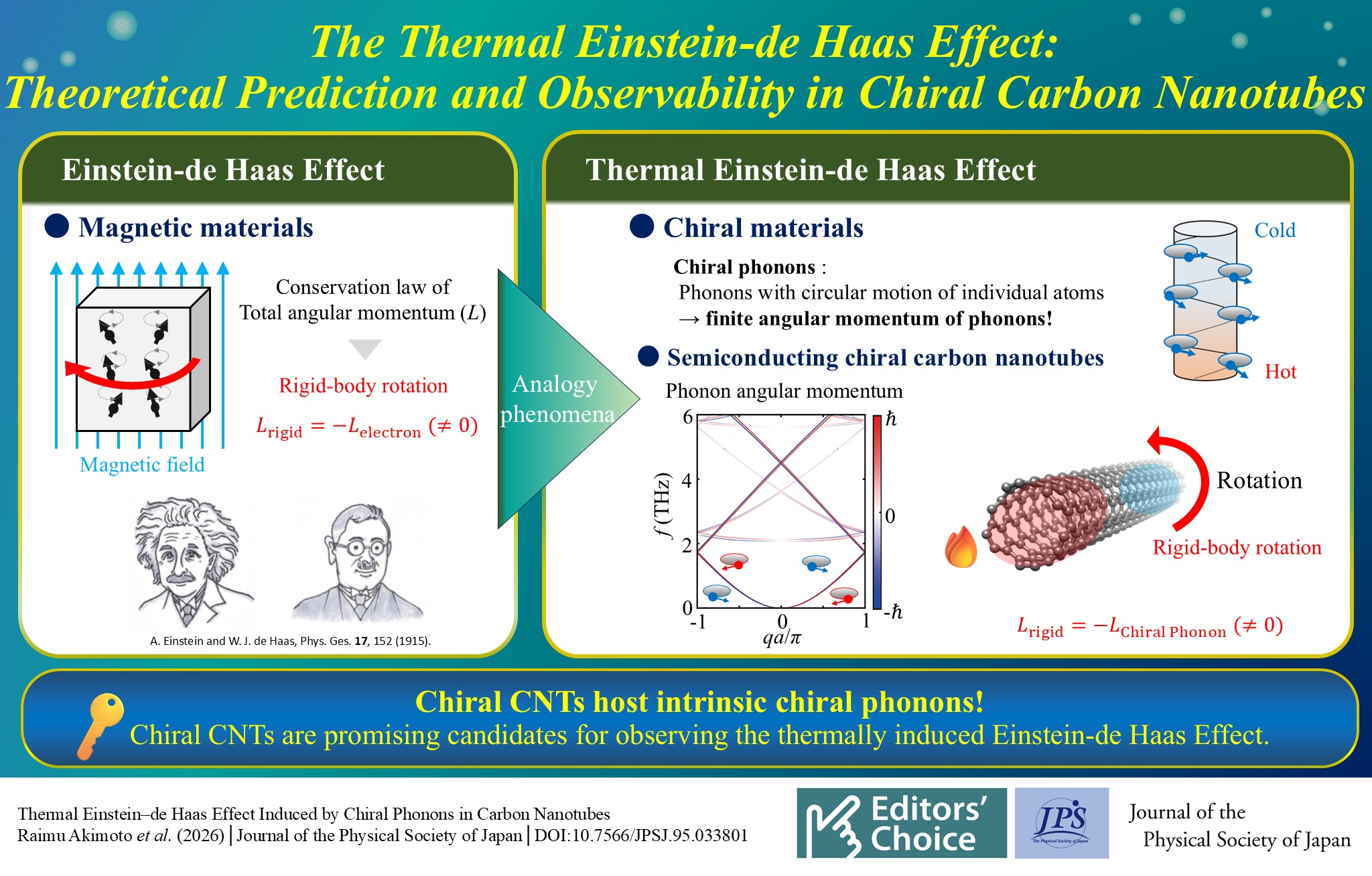
The development of functional materials by thermal management is expected to be a crucial technology for solving modern societal problems, such as the efficient use of energy. Recently, chiral materials, in which atoms are arranged in a helical pattern, have been studied as new functional materials because they exhibit unique lattice vibrations with circular motion of atoms, called “chiral phonons.” When a temperature gradient is applied to chiral materials, the angular momentum caused by the chiral phonons induces macroscopic mechanical rotation by conserving the total angular momentum. This phenomenon, the thermal Einstein–de Haas (EdH) effect, has recently garnered attention as a novel functional property made possible by thermal management.
The conventional EdH effect, which was the subject of the only experiment Einstein performed, occurs when a magnetic field is applied to magnetic materials. This is well known as an important experiment that directly proved the conservation of angular momentum in materials. By contrast, the thermal EdH effect has not yet been clearly observed in experiments. The main reason for this is that no suitable chiral materials have been proposed for its observation.
Carbon nanotubes (CNTs), which are one-dimensional cylindrical structures, are broadly classified into three distinct structural types (zigzag, armchair, and chiral). The phonon properties of achiral CNTs, namely zigzag and armchair CNTs, have been investigated extensively. In this letter, it is demonstrated theoretically that chiral CNTs possess chiral phonons, such as transverse acoustic phonon modes and certain optical phonon modes, which are split into two branches carrying opposite signs of angular momentum. In addition, it is revealed that angular momentum is most efficiently generated in small-diameter nanotubes with intermediate chiral angles.
The crystal structure of chiral materials has a specific handedness based on its helical twist (right and left handedness). Generally, controlling this handedness in standard inorganic crystals is extremely difficult. However, recent research on CNTs has led to major advances in chiral separation technology. Methods for controlling the length and diameter of CNTs are also well established. Owing to such technological advances, experimental observation of the thermal EdH effect using chiral CNTs is expected.
(Written by Raimu Akimoto, Hiroyasu Matsuura, and Takahiro Yamamoto.)
Thermal Einstein–de Haas Effect Induced by Chiral Phonons in Carbon Nanotubes
(JPSJ Editors' Choice)
J. Phys. Soc. Jpn.
95,
033801
(2026)
.
Share this topic


Fields
Related Articles
-
Rumors Spread Wider Despite Low Transmissibility
Cross-disciplinary physics and related areas of science and technology
2026-8-7
This study proposes an SIS competition model that integrates rumor spread and opinion changes. This analysis reveals novel mechanisms for conflicting rumor coexistence, thus demonstrating that rumors paradoxically survive through low transmissibility.
-
Topological Defects as Seeds of Phase Separation: Insights from a Minimal Lattice Model
Cross-disciplinary physics and related areas of science and technology
Statistical physics and thermodynamics
2026-7-13
A minimal lattice model revealed that topological defects with winding number +1 serve as nucleation sites for phase separation in active matter systems.
-
A Deep Dive Into AI-Driven Materials Science
Cross-disciplinary physics and related areas of science and technology
2026-7-6
This review from the Journal of the Physical Society of Japan examines how artificial intelligence overcomes traditional materials science bottlenecks, highlighting the shift from intuition-based discovery to data-driven innovation.
-
Peculiar Magnet Pointing Against an Applied Magnetic Field
Cross-disciplinary physics and related areas of science and technology
Magnetic properties in condensed matter
2026-7-1
TbNiC2 exhibits negative magnetization. A new mechanism, based on the coupling between the charge density wave and the antiferromagnetic order, is proposed to account for this peculiar phenomenon.
-
Negative Apparent Viscosity in Liquid Crystals
Cross-disciplinary physics and related areas of science and technology
Electromagnetism, optics, acoustics, heat transfer, and classical and fluid mechanics
Structure and mechanical and thermal properties in condensed matter
2026-6-8
Electrically driven liquid-crystal turbulence generates self-sustained flow and negative apparent viscosity. The fluorinated, chemically robust nematic PPDFB shows a substantially larger negative-viscosity effect than Schiff-base nematics.