

Peculiar Magnet Pointing Against an Applied Magnetic Field
© The Physical Society of Japan
This article is on
Negative Magnetization Phenomenon in TbNiC2
J. Phys. Soc. Jpn.
95,
053703
(2026)
.
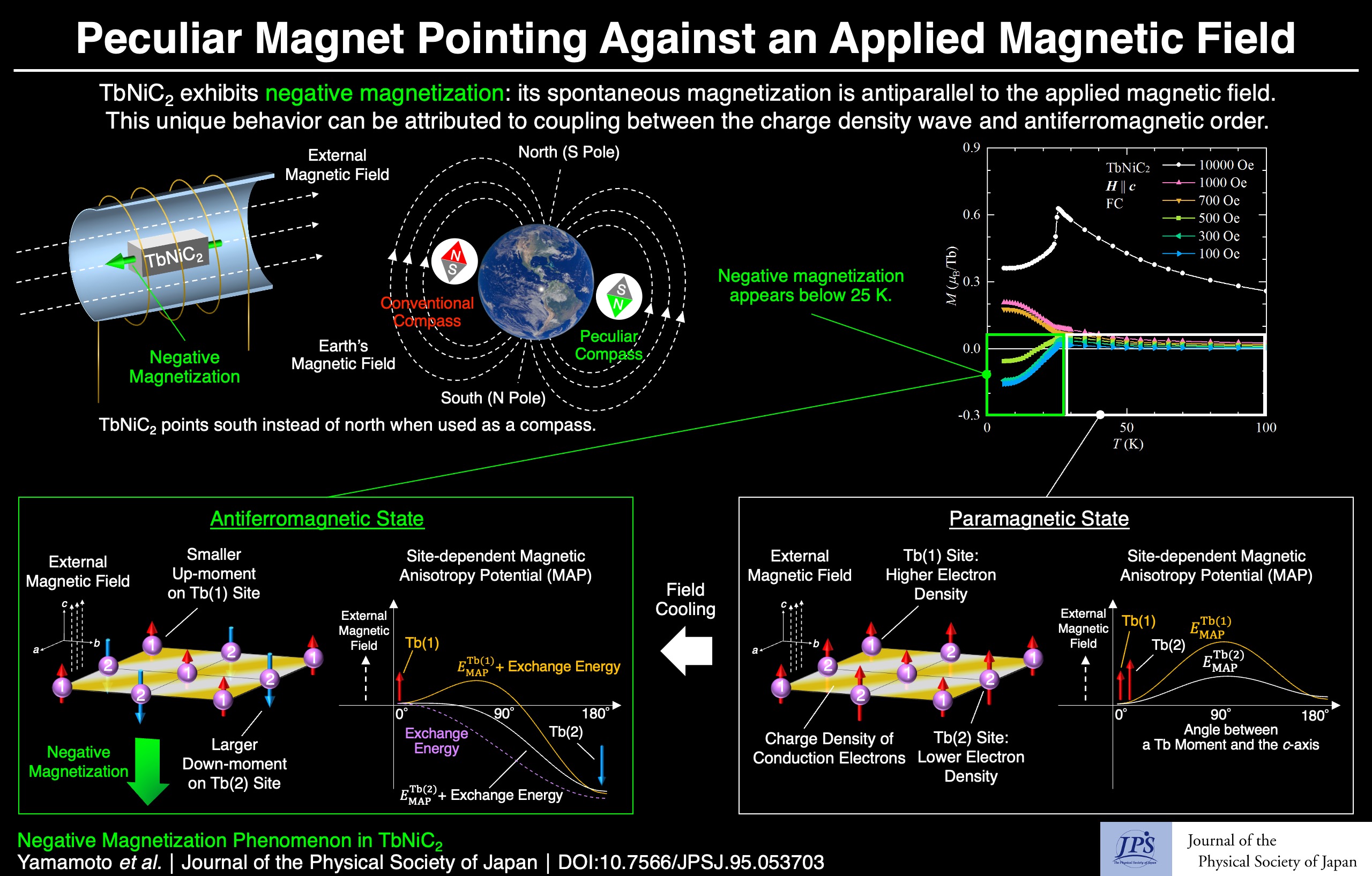
TbNiC2 exhibits negative magnetization. A new mechanism, based on the coupling between the charge density wave and the antiferromagnetic order, is proposed to account for this peculiar phenomenon.
Ferromagnetism is the spontaneous alignment of magnetic moments in the same direction, even in the absence of an external magnetic field. This alignment results in a finite spontaneous magnetization within each magnetic domain. When a ferromagnet is cooled from the paramagnetic state in an external magnetic field, the field selects the preferred direction of magnetization, allowing the material to acquire a finite macroscopic magnetization.
Usually, the spontaneous magnetization is parallel to the applied magnetic field owing to the Zeeman energy gain. However, in some materials, it is antiparallel to the applied magnetic field, as though a compass needle pointed south against the Earth’s magnetic field. This phenomenon is known as “negative magnetization.”
Negative magnetization, which emerges only by cooling while applying low magnetic fields along the magnetic easy axis, was detected for TbNiC2 below the antiferromagnetic (AFM) transition temperature of 25 K.
The spontaneous and negative magnetization of TbNiC2 below 25 K can be attributed to the coexistence of AFM order and a charge density wave (CDW) with the same propagation vector. CDW is the spatial modulation of the charge density of conduction electrons accompanied by periodic lattice distortion. In TbNiC2, the CDW develops in the paramagnetic region and modulates the local environment around the Tb sites, resulting in different crystalline electric fields (CEF) at each Tb site. This site-dependent modulation is expected to produce variations in the magnitude of the magnetic moment of Tb and the crystalline magnetic anisotropy energy at each Tb site.
With this in mind, we developed a model to introduce a site-dependent magnetic anisotropy potential (MAP) at each Tb site, defined as the sum of the crystalline magnetic anisotropy energy and the Zeeman energy. The MAP acts as a potential barrier the Tb magnetic moment must overcome when its direction is reversed by the AFM order. Using this phenomenological model, a mechanism for the emergence of negative magnetization in TbNiC2 is proposed.
This negative-magnetization mechanism, driven by the coupling between the CDW and AFM order, is distinct from previously proposed mechanisms, such as the simple Néel’s mechanism. The identification of this negative-magnetization mechanism is significant because it represents a novel phenomenon arising from the interplay between two distinct orders, namely, the coupling of the CDW to the magnetic order and superconductivity. This finding is expected to pave the way for next-generation device applications based on the control of magnetism through the charge degrees of freedom.
(Written by Masataka Yamamoto on behalf of the authors.)
Negative Magnetization Phenomenon in TbNiC2
J. Phys. Soc. Jpn.
95,
053703
(2026)
.
Share this topic


Fields
Related Articles
-
Frustrated Sawtooth Yb Chain Yielding Ferromagnetic Order with Reduced Magnetic Moments
Magnetic properties in condensed matter
2026-9-1
The ytterbium-based semiconductor ZnYb2S4 exhibits ferromagnetic order with contracted Yb moments, representing a novel quantum ground state attributed to competing exchange interactions in an effective spin-1/2 frustrated sawtooth chain.
-
How Heart Cells Come to Beat Together through an Elastic Substrate
Cross-disciplinary physics and related areas of science and technology
Statistical physics and thermodynamics
2026-8-24
Two isolated cardiomyocytes (heart muscle cells) can synchronize through deformations of a soft substrate. A dynamical theory explains geometry-dependent phase-locking and synchronization time.
-
Unlocking a 40-Year-Old Mystery: Full-gap Spin-Triplet Superconductivity Unveiled in UBe13
Magnetic properties in condensed matter
Superconductivity
2026-8-12
Recent precise NMR measurements on the heavy-fermion superconductor UBe13 provided “smoking-gun” evidence for a fully-gapped spin-triplet superconducting state, opening a new chapter in the field.
-
Rumors Spread Wider Despite Low Transmissibility
Cross-disciplinary physics and related areas of science and technology
2026-8-7
This study proposes an SIS competition model that integrates rumor spread and opinion changes. This analysis reveals novel mechanisms for conflicting rumor coexistence, thus demonstrating that rumors paradoxically survive through low transmissibility.
-
Topological Defects as Seeds of Phase Separation: Insights from a Minimal Lattice Model
Cross-disciplinary physics and related areas of science and technology
Statistical physics and thermodynamics
2026-7-13
A minimal lattice model revealed that topological defects with winding number +1 serve as nucleation sites for phase separation in active matter systems.