

Direct Observation of Piezoelectricity from Electric Toroidal Quadrupole Order
© The Physical Society of Japan
This article is on
Direct Observation of Piezoelectricity from Electric Toroidal Quadrupole-driven Parity Breaking in Cd2Re2O7
(JPSJ Editors' Choice)
J. Phys. Soc. Jpn.
95,
063601
(2026)
.
This study reports the direct observation of piezoelectricity in the spin-orbit-coupled metal Cd2Re2O7. The findings reveal how electric toroidal quadrupole order drives successive inversion-symmetry-breaking transitions and anisotropic electromechanical responses.
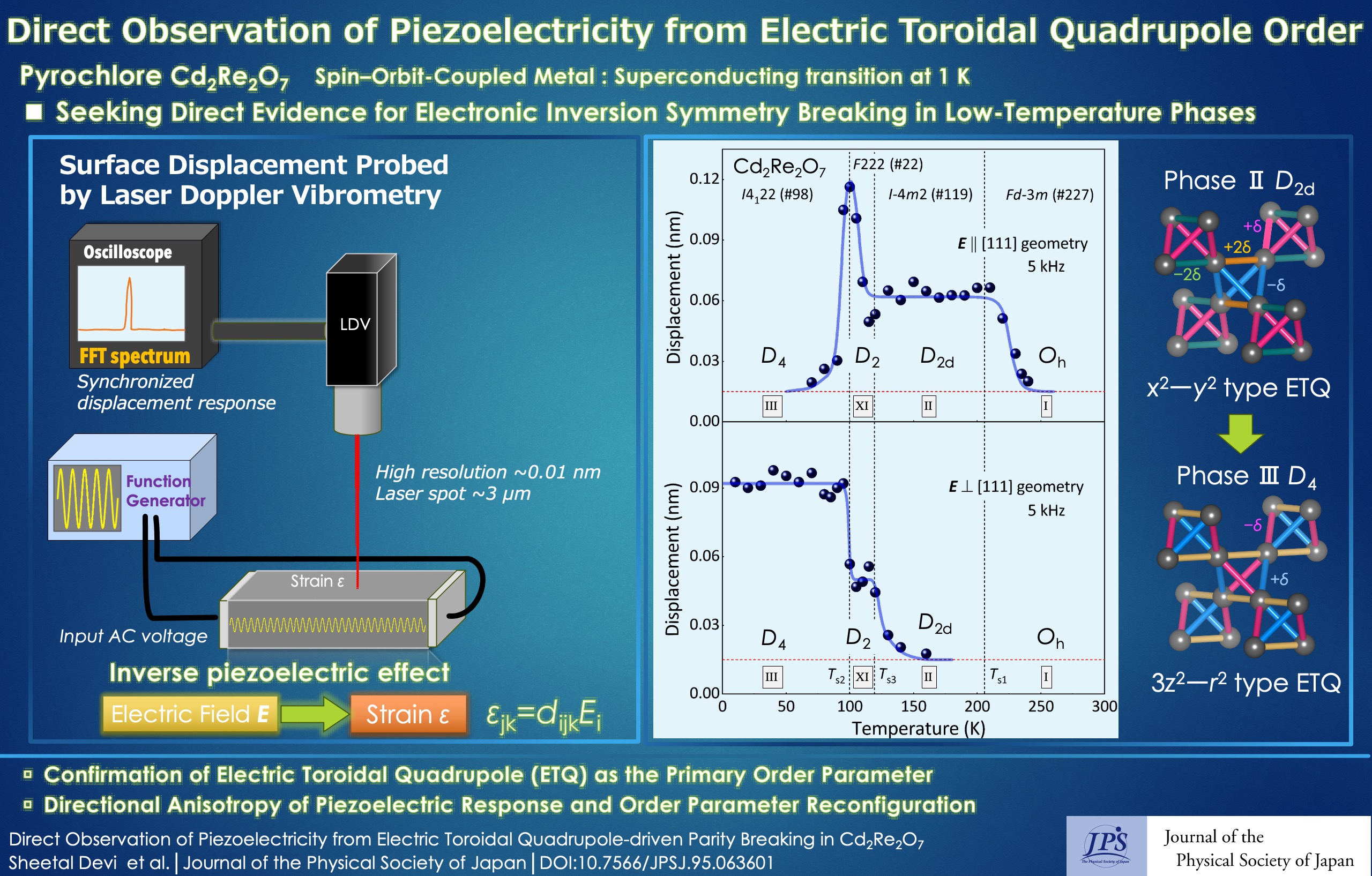
The piezoelectric effect is a cross-correlation phenomenon governed by crystal symmetry. It is active in 20 point groups, excluding the point group O, and is permitted in all inversion symmetry breaking (ISB) point groups. Studies have shown that electric dipoles, octupoles, and toroidal quadrupoles (ETQs) can function as active multipoles for the piezoelectric effect.
Cd2Re2O7 is a fascinating material known as a spin–orbit-coupled metal. At room temperature, Cd2Re2O7 exists in a centrosymmetric cubic pyrochlore structure (Phase I, point group Oh). However, upon cooling, Cd2Re2O7 undergoes an ISB phase transition to Phase II (point group D2d) at 205 K, followed by successive transitions to Phase XI (point group D2) at 120 K and Phase III (point group D4) at 100 K before eventually exhibiting superconductivity at 1 K. Unlike standard phase transitions driven by atomic shifts, the ISB in this metal is believed to be primarily electronic in origin. The phenomenon is driven by an odd-parity multipolar order parameter known as an ETQ and thus provides an example of an electronic nematic state.
In this study, a laser Doppler vibrometer with high sensitivity was used to detect the extremely subtle structural changes associated with this electronic order by measuring nanometer‑scale surface displacements induced by an AC electric field. The results revealed that a finite piezoelectric response emerges only below the ISB transition. This confirms that the ETQ order breaks the crystal’s inversion symmetry.
However, the pronounced directional anisotropy of the piezoelectric response was also a striking discovery. Two configurations were compared, including an electric field E applied in parallel (E //) and perpendicular (E ⊥) to the axis [111]. Specifically, for E // [111], the response peaked in Phases II and XI but vanished in Phase III. Conversely, for E ⊥ [111], the response was suppressed in Phase II, emerged in Phase XI, and became substantial in Phase III. This behavior is explained by a reconfiguration of the ETQ order parameter within the two‑component Eu representation. Specifically, Phase II is dominated by an x2–y2-type ETQ, while Phase III involves a shift to a 3z2–r2-type ETQ. This internal “rotation” of the electronic order parameter changes the components of the piezoelectric tensor and thus causes the observed enhancement or cancellation of the signal depending on the field geometry.
Overall, these results establish piezoelectricity as a direct and symmetry-sensitive tool for mapping complex electronic orders in quantum materials.
(Written by Kazuyuki Matsuhira on behalf of all authors.)
Direct Observation of Piezoelectricity from Electric Toroidal Quadrupole-driven Parity Breaking in Cd2Re2O7
(JPSJ Editors' Choice)
J. Phys. Soc. Jpn.
95,
063601
(2026)
.
Share this topic


Fields
Related Articles
-
Revealing Electronic Quantum Behavior Masked by Nuclear Heat
Measurement, instrumentation, and techniques
Structure and mechanical and thermal properties in condensed matter
Superconductivity
2026-9-7
The initial slope method is used to reveal intrinsic electronic specific heat by eliminating the overwhelming nuclear contributions during low-temperature calorimetry, opening a new window into quantum materials.
-
The Thermal Einstein–de Haas Effect: Theoretical Prediction and Observability in Chiral Carbon Nanotubes
Cross-disciplinary physics and related areas of science and technology
Structure and mechanical and thermal properties in condensed matter
2026-6-22
Although the Einstein–de Haas (EdH) effect describes material rotation in a magnetic field, a thermal EdH effect, driven by a temperature gradient, remains unobserved. Recently, chiral carbon nanotubes were theoretically proposed as promising candidates to observe it.
-
Negative Apparent Viscosity in Liquid Crystals
Cross-disciplinary physics and related areas of science and technology
Electromagnetism, optics, acoustics, heat transfer, and classical and fluid mechanics
Structure and mechanical and thermal properties in condensed matter
2026-6-8
Electrically driven liquid-crystal turbulence generates self-sustained flow and negative apparent viscosity. The fluorinated, chemically robust nematic PPDFB shows a substantially larger negative-viscosity effect than Schiff-base nematics.
-
Role of the Diffusion Layer in Energy Devices
Cross-disciplinary physics and related areas of science and technology
Structure and mechanical and thermal properties in condensed matter
2026-5-1
In many energy devices, electron transfer occurs between ions dissolved in the electrolyte and the electrodes. For keep current flowing, new ions must be supplied continuously to the electrode surface from the bulk region. The diffusion layer’s role in diffusive mass transfer was clarified using the rotating disk electrode method.
-
Unveiling the Nodal Topology of the Spin-Triplet Superconductor Candidate UTe2
Structure and mechanical and thermal properties in condensed matter
Superconductivity
2026-4-13
Using high-quality UTe2 (Tc = 2.1 K), we identify its nodal gap structure. Field-angle‑resolved specific‑heat reveals a b-axis singularity, supporting spin-triplet superconductivity with nodes along the b axis.