

Why Is the Deuteron Advantage in One-Proton Knockout Smaller Than Expected?
© The Physical Society of Japan
This article is on
Systematic Analysis of Proton- and Deuteron-Induced One-Proton Knockout Reactions
(JPSJ Editors' Choice)
J. Phys. Soc. Jpn.
95,
074201
(2026)
.
Deuteron breakup enhances one-proton knockout, whereas stronger nuclear absorption suppresses it. This explains why the measured deuteron/proton cross-section ratio is about 1.5, much lower than the naive expectation of 4.
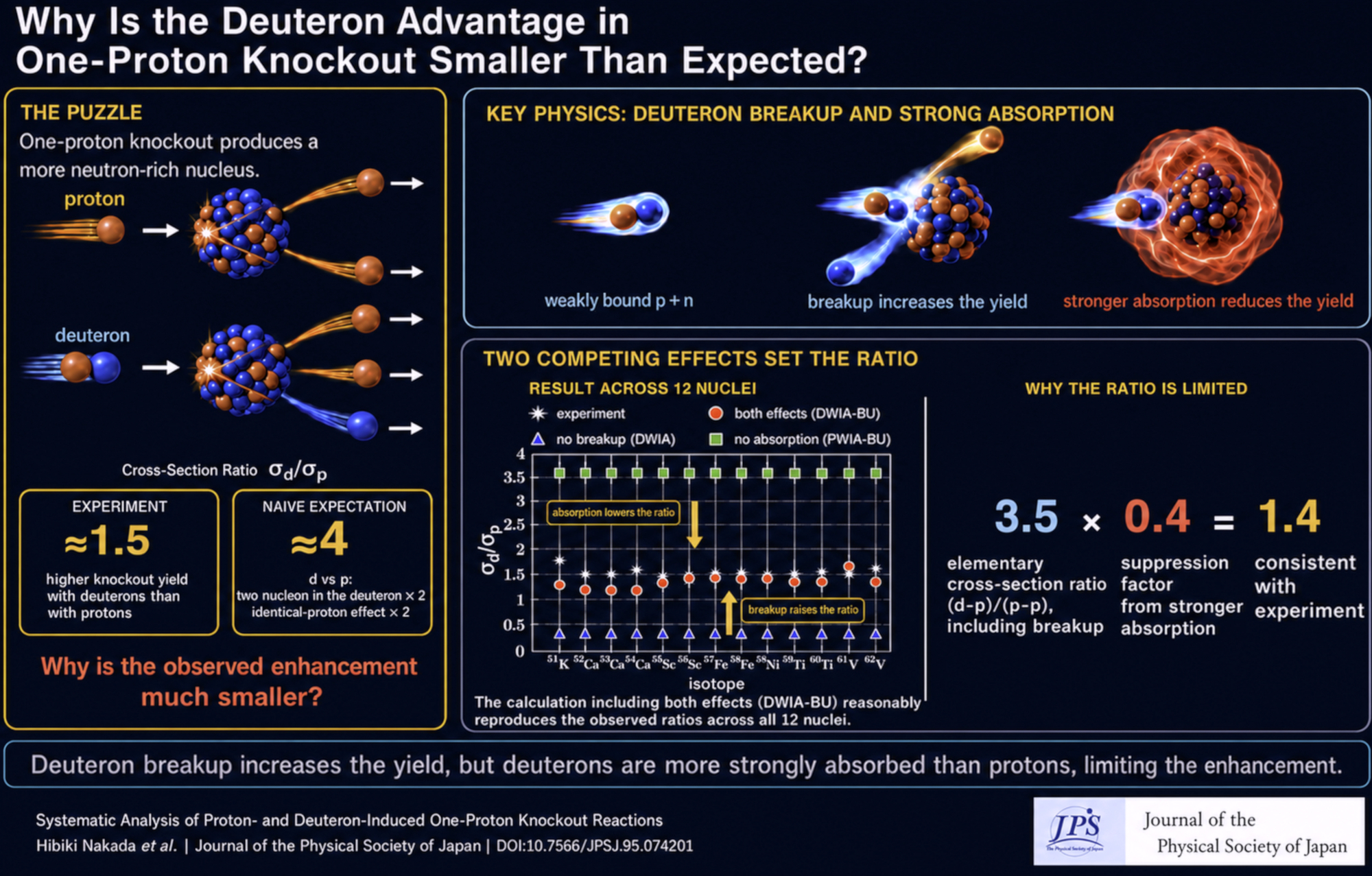
Neutron-rich nuclei, which have larger neutron-to-proton ratios than those of stable nuclei, are important for exploring how nuclear structure changes away from stability. Many of them are short-lived and can be produced only in limited quantities, making efficient production methods especially valuable. One method to produce such nuclei is the one-proton knockout reaction, in which a projectile interacts with a proton inside the target nucleus and knocks it out, leaving a nucleus with a larger neutron-to-proton ratio. Protons are commonly used as projectiles; however, deuterons, a weakly bound proton–neutron system, can also induce the same reaction.
Experiments have shown that the deuteron-induced one-proton knockout cross section is about 1.5 times that of the proton-induced reaction. This enhancement suggests that deuterons may provide a more efficient route for producing neutron-rich nuclei. However, the measured cross-section ratio of about 1.5 is much smaller than the naive expectation of 4. This expectation arises from two enhancement factors of 2: one from the two nucleons in the deuteron and the other from the identical-particle nature of the two protons. Why, then, is the observed ratio so much smaller than expected? To answer this question, we analyzed proton- and deuteron-induced one-proton knockout reactions using the distorted-wave impulse approximation with breakup (DWIA-BU), a newly developed framework that explicitly includes deuteron breakup. The conventional distorted-wave impulse approximation (DWIA), which neglects deuteron breakup, provides a deuteron/proton cross-section ratio of about 0.2, far below the experimental value of about 1.5. In contrast, the plane-wave impulse approximation with breakup (PWIA-BU), which includes deuteron breakup but neglects nuclear absorption (loss of flux into other reaction channels), gives a ratio of about 3.5, which is close to the naive expectation of 4. This result shows that deuteron breakup strongly enhances the one-proton knockout cross section. However, when nuclear absorption is considered, deuterons are absorbed more strongly than protons, which substantially suppresses this enhancement. With both breakup and absorption included in DWIA-BU, the cross-section ratio becomes about 1.4, in good agreement with the experimental value of about 1.5. These results show that the observed enhancement arises from the competition between deuteron breakup, which enhances the cross section, and stronger absorption, which suppresses it.
A systematic analysis of 12 nuclei showed that both breakup and absorption must be properly considered to understand the observed deuteron/proton cross-section ratio. These two competing effects determine how efficiently deuterons induce one-proton knockout compared with protons. This physical insight provides a basis for improving the description of deuteron-induced one-proton knockout reactions across various nuclei and predicting the production yields of neutron-rich nuclei.
(Written by H. Nakada on behalf of all the authors)
Systematic Analysis of Proton- and Deuteron-Induced One-Proton Knockout Reactions
(JPSJ Editors' Choice)
J. Phys. Soc. Jpn.
95,
074201
(2026)
.
Share this topic


Fields
Related Articles
-
A Journey into Nuclear Diversity: Discovery of 22 New Exotic Isotopes Using an Intense 208Pb Beam
Nuclear physics
2026-8-3
Using a newly developed intense 208Pb beam at the RIKEN RI Beam Factory (RIBF), we discovered 22 new proton- and neutron-rich isotopes, which significantly expand the nuclear chart.
-
Verification of Magnetic Structure Observation at the Atomic Scale
Atomic and molecular physics
Cross-disciplinary physics and related areas of science and technology
Nuclear physics
2026-6-2
Magnetic neutron scattering holography (MNH) were performed on a Fe0.08Co0.92 single crystal. The resulting holograms provided the first experimental evidence that MNH is sensitive to magnetic signals.
-
Seven New Pieces of the Nuclear Landscape Puzzle Uncovered Near Cerium-159
Nuclear physics
2026-3-13
RIKEN discovered seven neutron-rich isotopes in the rare-earth region, pushing the nuclear landscape frontier toward an astrophysical r-process path. RIKEN discovered over 200 isotopes using in-flight separation.
-
Probing New Routes to the Synthesis of Superheavy Elements with Intense Titanium-50 Isotopic Beam
Nuclear physics
2025-9-24
Discovery of new superheavy elements require beams beyond the emblematic Calcium-48. Intense titanium-50 beams open a new route used in the present tentative synthesis of oganesson (Z=118).
-
Deriving Mean Square Radius of Neutron Distribution and Neutron Skin Thickness using Electron Scattering
Nuclear physics
2025-8-14
This study demonstrates that the fourth moment of nuclear charge density obtained from electron scattering helps estimate neutron distributions—enabling reliable neutron-skin thickness measurement relevant to nuclear physics and astrophysics.