

Verification of Magnetic Structure Observation at the Atomic Scale
© The Physical Society of Japan
This article is on
Verification of Atomic-Scale Magnetic Imaging Using Polarized Neutrons
J. Phys. Soc. Jpn.
95,
064202
(2026)
.
Magnetic neutron scattering holography (MNH) were performed on a Fe0.08Co0.92 single crystal. The resulting holograms provided the first experimental evidence that MNH is sensitive to magnetic signals.
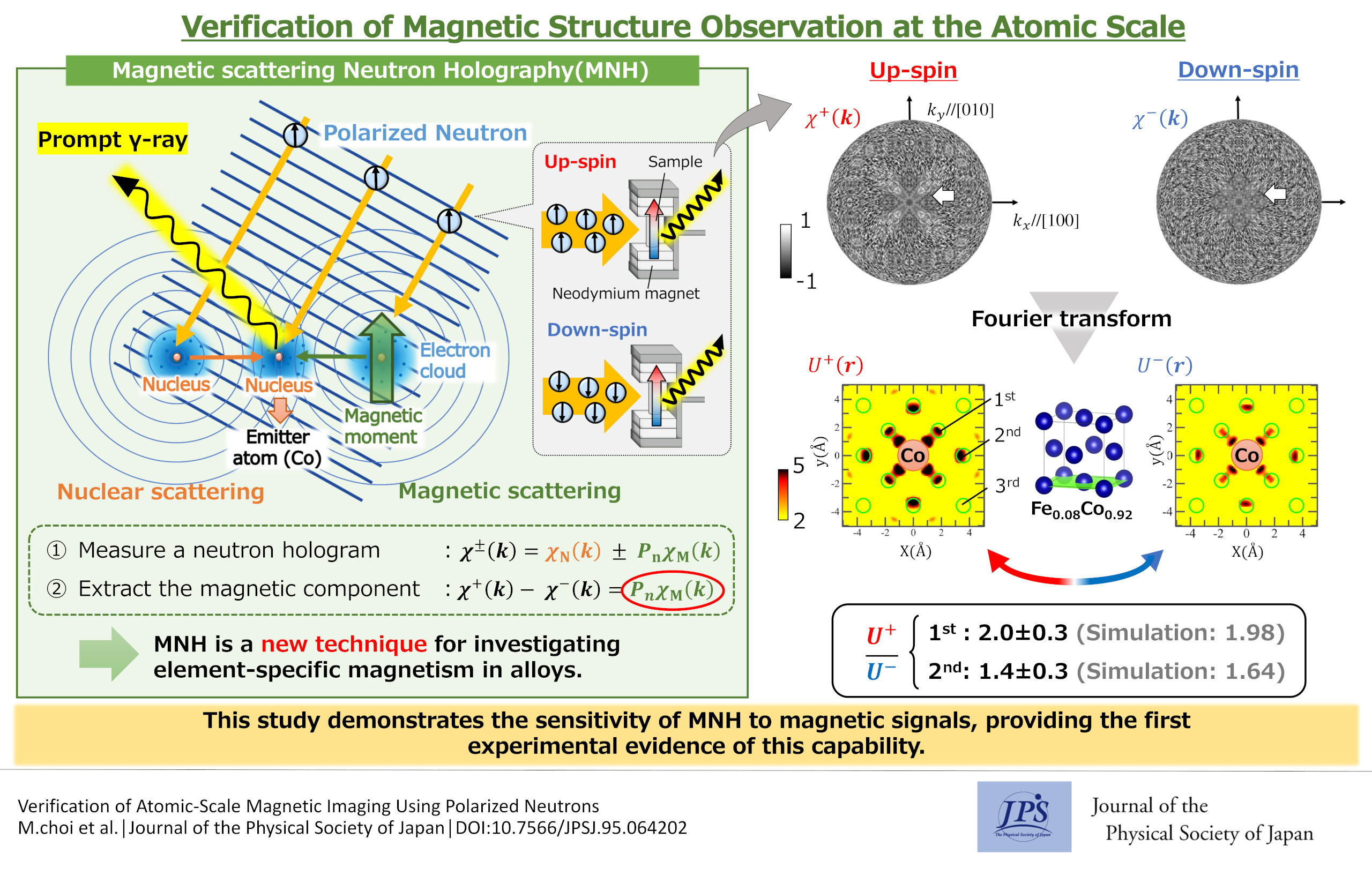
Research into ferromagnetic and antiferromagnetic systems remains a hot topic in condensed-matter physics. Diffraction-based characterization is suitable for determining the average magnetic structure and successfully explaining various macroscopic properties. However, these methods are insufficient for elucidating the local structures of minor elements, such as dopants, prompting the development of more effective characterization techniques.
Atomic-resolution holography has emerged as a powerful tool for investigating local structures, providing model-free reconstructions of three-dimensional atomic arrangements around specific elements. This method has proven effective in identifying dopant sites and revealing unexpected atomic configurations in multiple materials. To extend its application to magnetic systems, researchers have developed magnetic scattering neutron holography (MNH), which employs polarized neutrons as magnetic probes1). Neutrons, with their intrinsic spin (S = 1/2) and neutral charge, provide direct sensitivity to magnetic structures. Simulations suggest that MNH can reconstruct magnetic images that reflect the probability density distribution of magnetic orbital electrons. However, despite extensive experimental efforts, clear evidence of magnetic signals has not yet been reported.
In this study, we aim to verify and identify magnetic signals in MNH data collected at the Japan Proton Accelerator Research Complex. The ferromagnetic alloy Fe0.08Co0.92 was chosen as the sample due to its characteristics as a neutron polarizer crystal, which is expected to exhibit a strong response to polarized neutrons. Meticulous analyses of the measured holograms revealed differences between datasets from up-spin and down-spin states. Furthermore, the spin dependence of the reconstructed image intensities aligns qualitatively with theoretical predictions. confirming the presence of holograms containing spin-dependent magnetic scattering contributions.
Overall, this study demonstrates the feasibility of detecting local magnetic structures using MNH and provides the first experimental evidence of its sensitivity to magnetic signals. The results highlight the potential of MNH as a powerful tool for investigating element-specific magnetism in alloys and open the way for further technical developments and novel applications of neutron-based techniques in condensed-matter physics.
1) T. Kanno, K. Ohoyama, H. Nakada, Y. Fukui, K. Yamakawa, S. Hoshi, M. Takano, Y. Kobayashi, Y. Tomimatsu, S. Takahashi, T. Oku, T. Okudaira, R. Kobayashi, S. Takada, M. Harada, K. Oikawa, Y. Inamura, T. Shishido, K. Sato, and K. Hayashi, Nucl. Instrum. Methods Phys. Res. Sect. Accel. Spectrometers Detect. Assoc. Equip. 1064, 169349 (2024).
(Written by M.Choi on behalf of all authors)
Verification of Atomic-Scale Magnetic Imaging Using Polarized Neutrons
J. Phys. Soc. Jpn.
95,
064202
(2026)
.
Share this topic


Fields
Related Articles
-
Topological Defects as Seeds of Phase Separation: Insights from a Minimal Lattice Model
Cross-disciplinary physics and related areas of science and technology
Statistical physics and thermodynamics
2026-7-13
A minimal lattice model revealed that topological defects with winding number +1 serve as nucleation sites for phase separation in active matter systems.
-
A Deep Dive Into AI-Driven Materials Science
Cross-disciplinary physics and related areas of science and technology
2026-7-6
This review from the Journal of the Physical Society of Japan examines how artificial intelligence overcomes traditional materials science bottlenecks, highlighting the shift from intuition-based discovery to data-driven innovation.
-
Peculiar Magnet Pointing Against an Applied Magnetic Field
Cross-disciplinary physics and related areas of science and technology
Magnetic properties in condensed matter
2026-7-1
TbNiC2 exhibits negative magnetization. A new mechanism, based on the coupling between the charge density wave and the antiferromagnetic order, is proposed to account for this peculiar phenomenon.
-
The Thermal Einstein–de Haas Effect: Theoretical Prediction and Observability in Chiral Carbon Nanotubes
Cross-disciplinary physics and related areas of science and technology
Structure and mechanical and thermal properties in condensed matter
2026-6-22
Although the Einstein–de Haas (EdH) effect describes material rotation in a magnetic field, a thermal EdH effect, driven by a temperature gradient, remains unobserved. Recently, chiral carbon nanotubes were theoretically proposed as promising candidates to observe it.
-
Negative Apparent Viscosity in Liquid Crystals
Cross-disciplinary physics and related areas of science and technology
Electromagnetism, optics, acoustics, heat transfer, and classical and fluid mechanics
Structure and mechanical and thermal properties in condensed matter
2026-6-8
Electrically driven liquid-crystal turbulence generates self-sustained flow and negative apparent viscosity. The fluorinated, chemically robust nematic PPDFB shows a substantially larger negative-viscosity effect than Schiff-base nematics.