

What Shapes Electron Distributions in Nonequilibrium Nanowires?
© The Physical Society of Japan
This article is on
Nonequilibrium Electron Distribution Function in a Voltage-Biased Nanowire: A Nonequilibrium Green’s Function Approach
(JPSJ Editors' Choice)
J. Phys. Soc. Jpn.
95,
034702
(2026)
.
A theoretical framework was developed to describe nonequilibrium electron distributions across the ballistic, diffusive, and local equilibrium transport regimes in voltage-biased nanowires in a unified manner.
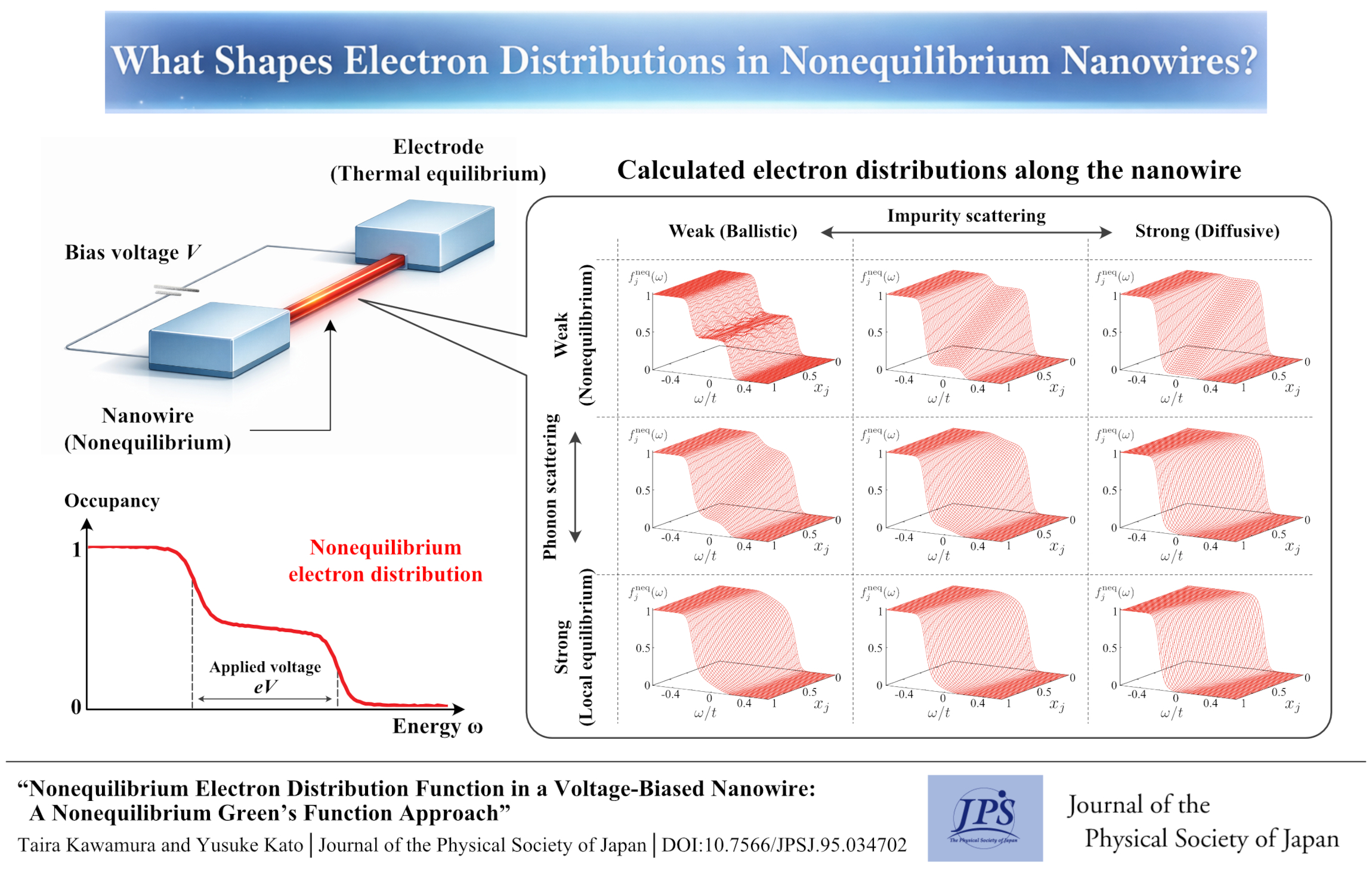
Recent advances in experimental techniques used for probing and controlling nanofabricated devices have stimulated a strong interest in theoretically studying their nonequilibrium properties. In thermal equilibrium, electrons follow the Fermi–Dirac distribution, whereas under nonequilibrium conditions, the electron distribution generally deviates from the Fermi–Dirac form. A typical example of this is a nanowire connected to two electrodes having different electrochemical potentials. The electron distribution in the nanowire exhibits a characteristic “two-step” structure, which can be regarded as a superposition of two Fermi–Dirac distributions shifted by the applied bias voltage.
Such nonequilibrium electron distributions are known to play a crucial role in a variety of quantum phenomena, such as controlling the critical currents in Josephson junctions, formation of π-junctions, and emergence of unconventional superconducting states. Therefore, developing a theoretical framework to determine nonequilibrium electron distributions is essential for exploring quantum many-body phenomena beyond the equilibrium paradigm.
In this study, we developed a theoretical framework based on the nonequilibrium Green’s function, which provided a unified description of the electron distributions in nanowires connected at both ends to electrodes having different electrochemical potentials. By incorporating both elastic impurity scattering and inelastic phonon scattering within the wire, we systematically analyzed the evolution of the electron distributions across different transport regimes.
In the ballistic regime, where scattering is negligible, the electron distribution exhibits a spatially uniform two-step structure. In the diffusive regime, which is characterized by multiple impurity scattering, the distribution retains its two-step character, but becomes position-dependent. When inelastic scattering is significant, energy relaxation leads to a gradual crossover toward a local thermal electron distribution that is well approximated by the Fermi–Dirac distribution function.
A key achievement of this study is that the three distinct transport regimes are captured within a single theoretical framework. In addition, the microscopic theory used in this study enables us to incorporate effects that are difficult to treat in conventional coarse-grained approaches such as contact resistance and interference arising from reflections at interfaces.
The versatility of the nonequilibrium Green’s function method suggests that the present framework can be broadly applied to other driven quantum systems such as superconducting heterostructures and periodically driven systems. Thus, this study provides a solid foundation for exploring a wide range of nonequilibrium quantum many-body phenomena.
(Written by Taira Kawamura on behalf of all the authors)
Nonequilibrium Electron Distribution Function in a Voltage-Biased Nanowire: A Nonequilibrium Green’s Function Approach
(JPSJ Editors' Choice)
J. Phys. Soc. Jpn.
95,
034702
(2026)
.
Share this topic


Fields
Related Articles
-
Toward Clarification of Physical Properties of Quasicrystals: Noncollinear Magnetic Orders in Icosahedral Approximants
Cross-disciplinary physics and related areas of science and technology
Electronic transport in condensed matter
Magnetic properties in condensed matter
2026-4-6
An effective model based on magnetic anisotropy arising from a crystalline electric field is constructed for icosahedral approximants, which not only explains measured ferromagnets and antiferromagnets but also reveals new types of noncollinear magnetic orders.
-
The Physics of Light-Spin Interactions: Advances in Photodriven Quantum Spin Systems
Dielectric, optical, and other properties in condensed matter
Electromagnetism, optics, acoustics, heat transfer, and classical and fluid mechanics
Electronic transport in condensed matter
Magnetic properties in condensed matter
Statistical physics and thermodynamics
2025-12-17
This Special Topics edition of the Journal of the Physical Society of Japan discusses the recent progress and future directions for the rapidly progressing field of photodriven quantum spin systems.
-
Role of Orbital Currents in Future Solid-State Devices
Electronic transport in condensed matter
2025-10-6
This review explores recent experimental advances in the emerging field of orbitronics, focusing on orbital current mechanisms and orbitronic phenomena, providing key research directions for developing energy-efficient memory devices.
-
Carrier Scattering by Antisite Defects Reverses Thermoelectric Polarity in Fe₂VAl
Electronic transport in condensed matter
Structure and mechanical and thermal properties in condensed matter
2025-10-2
Antisite defects in Fe₂VAl create resonance states that boost hole scattering, which shifts carrier dominance to electrons and reverses thermoelectric polarity, thereby offering a new path for material design.
-
Melting of Electronic Ice Using Electric Current
Electronic transport in condensed matter
2025-9-1
Vanadium dioxide exhibits a current-induced non-equilibrium phase transition that is distinct from Joule heating, and is characterized by non-linear conduction and collective electron behavior under surprisingly small electric fields.