

Enhancing Accuracy and Reliability Bayesian Framework for Analysis of AR-HAXPES of Hard X-ray Photoelectron Spectroscopy
© The Physical Society of Japan
This article is on
Bayesian Analysis of Hard X-ray Photoelectron Spectroscopy Data: Integrating Spectral Decomposition and Film Thickness Estimation
(JPSJ Editors' Choice)
J. Phys. Soc. Jpn.
95,
034701
(2026)
.
We present a Bayesian framework for angle-resolved hard X-ray photoelectron spectroscopy (AR-HAXPES), combining Replica Exchange Monte Carlo with hierarchical integration to objectively and precisely estimate thin-film thickness.
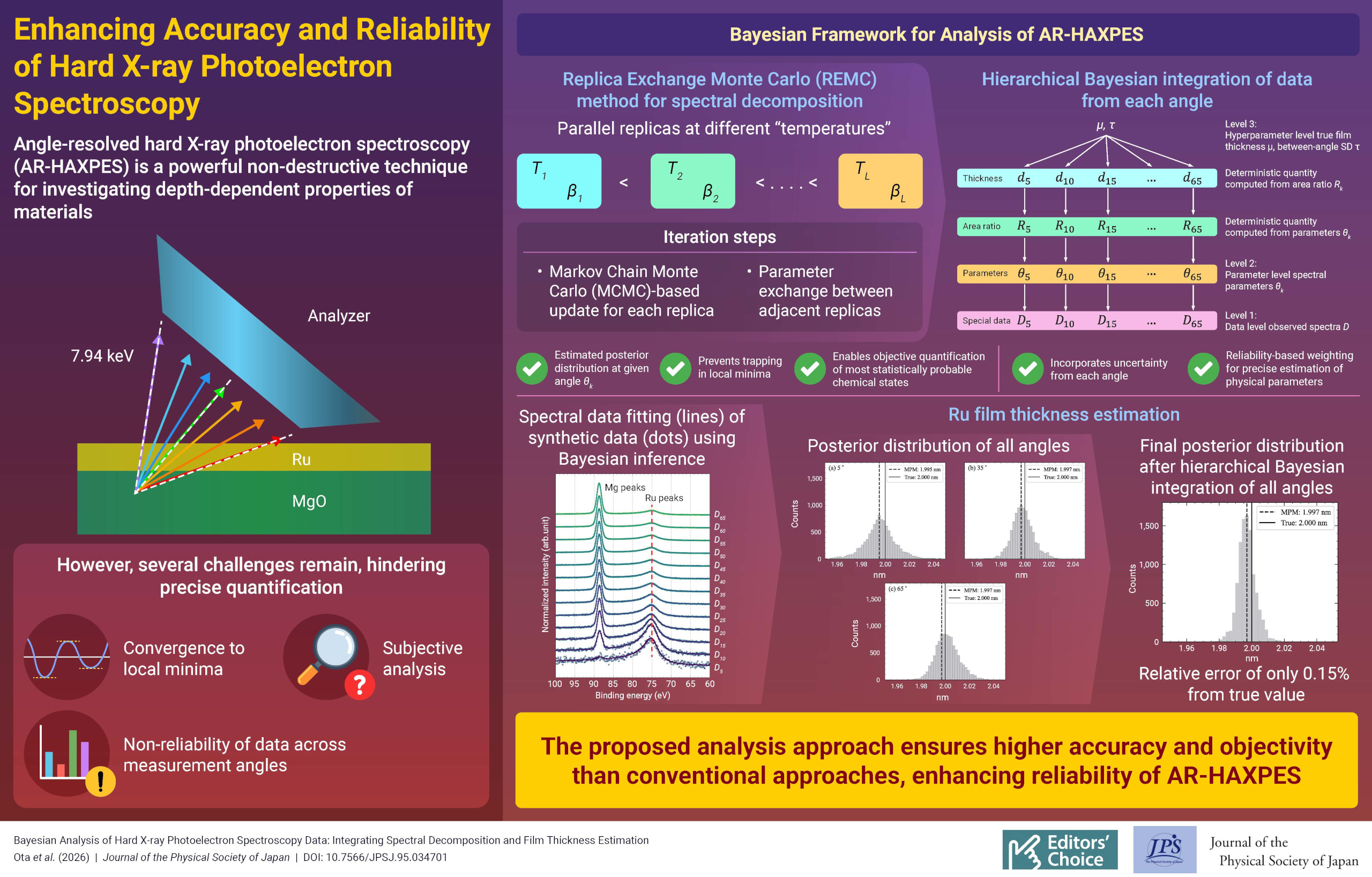
Angle-resolved hard X-ray photoelectron spectroscopy (AR-HAXPES) can probe buried chemical states nondestructively. Hard X-rays yield photoelectrons with long inelastic mean free paths. Hence, by measuring the spectra at multiple take-off angles, the depth sensitivity changes and thin-film thickness can be inferred for laminated materials. However, least-squares peak fitting is sensitive to initial values and analyst choices, and the signal-to-noise ratios vary by angle; therefore, uncertainty-aware integration is essential.
We introduced a Bayesian pipeline that connects spectral decomposition and film thickness estimation within a probabilistic model. For each take-off angle, the spectrum was modeled as a Ru overlayer contribution plus a MgO substrate contribution, with an offset and Shirley background under additive Gaussian noise. The Ru 4s peak has a Doniach–Sunjic line shape suitable for metals, whereas the MgO 2s peak has a Voigt profile suitable for insulators. The Ru 4s and Mg 2s binding energies are close, so their similar kinetic energies simplify the conversion from peak area to thickness.
To avoid local optimum trapping in spectral decomposition, we sampled the posterior spectral parameters using the Replica Exchange Monte Carlo (REMC) method. Unlike point estimates, posterior samples provide the credible intervals and parameter correlations required for principled uncertainty propagation. REMC runs multiple replicas at different temperatures and exchanges states, improving exploration when the posterior is multimodal. From posterior samples, we computed the Ru-to-MgO peak area ratio at each angle and deterministically mapped it to an angle-specific thickness using a standard attenuation relation. The mapping depends on physically defined quantities such as number densities, photoionization cross-sections, and inelastic mean free paths.
We then integrated all angles with a hierarchical Bayesian model that treated angle-specific thicknesses as noisy draws around a single true thickness and estimated the between-angle standard deviation. This integration effectively performed reliability-based weighting, emphasizing angles with tighter posteriors. Using realistic synthetic AR-HAXPES data at 7.94 keV for 13 take-off angles from 5° to 65° with a ground-truth thickness of 2.0 nm, the integrated posterior is sharply centered near the true value. The maximum marginal posterior is 1.997 nm (0.15% relative error), and the 95% highest-posterior-density interval is [1.986, 2.006] nm, which is narrower than the angle-by-angle inferences. The inferred between-angle standard deviation is nearly zero, consistent with the strong cross-angle coherence in the simulated Ru/MgO system. By modifying the likelihood and adding hierarchical parameters, the framework can be extended to non-Gaussian counting statistics and depth inhomogeneities, such as interface roughness.
(Written by Rikito Ota on behalf of all authors.)
Bayesian Analysis of Hard X-ray Photoelectron Spectroscopy Data: Integrating Spectral Decomposition and Film Thickness Estimation
(JPSJ Editors' Choice)
J. Phys. Soc. Jpn.
95,
034701
(2026)
.
Share this topic


Fields
Related Articles
-
Definitive Momentum and Spin Imaging Resolves 20-Year Debate on Gold Surface Spin
Electronic structure and electrical properties of surfaces and nanostructures
Magnetic properties in condensed matter
2026-4-1
Researchers at the Institute for Molecular Science (IMS) have utilized a cutting-edge Photoelectron Momentum Microscope (PMM) at the UVSOR Synchrotron Facility to settle a two-decade-long controversy concerning the direction of electron spin on the Au(111) surface. This study provides a definitive, full-map, comprehensive reference for quantum imaging that is essential for advancing spintronics technology.
-
Oxide Superionic Conductivity of a-Axis-Oriented Ce0.75Sm0.25O2−δ Thin Film
Electronic structure and electrical properties of surfaces and nanostructures
2026-2-2
Highly a-axis oriented Ce0.75Sm0.25O2-δ thin film fabricated on a yttria-stabilized zirconia substrate achieved oxide superionic conductivity, which can apply as an electrolyte in solid oxide fuel cells operating at medium temperature.
-
A Novel Type of Magnetic Band Splitting in a Fe Spin Ladder System
Dielectric, optical, and other properties in condensed matter
Magnetic properties in condensed matter
Superconductivity
2026-1-22
An investigation of a Fe spin ladder system using angle-resolved photoemission spectroscopy revealed a novel type of magnetic band splitting resembling that in altermagnets.
-
Imaging Micron-Scale Pressure Landscapes with NV Nanodiamonds
Dielectric, optical, and other properties in condensed matter
Magnetic properties in condensed matter
2025-12-22
Nanodiamonds containing nitrogen-vacancy centers can be used to map pressure and nonhydrostatic stress inside diamond anvil cells to obtain micron-scale pressure landscapes that clarify local conditions affecting high-pressure materials research.
-
The Physics of Light-Spin Interactions: Advances in Photodriven Quantum Spin Systems
Dielectric, optical, and other properties in condensed matter
Electromagnetism, optics, acoustics, heat transfer, and classical and fluid mechanics
Electronic transport in condensed matter
Magnetic properties in condensed matter
Statistical physics and thermodynamics
2025-12-17
This Special Topics edition of the Journal of the Physical Society of Japan discusses the recent progress and future directions for the rapidly progressing field of photodriven quantum spin systems.