

Definitive Momentum and Spin Imaging Resolves 20-Year Debate on Gold Surface Spin
© The Physical Society of Japan
This article is on
Spin and Orbital Polarizations of Au(111) Surface State Determined by Photoelectron Momentum Microscope
(JPSJ Editors' Choice)
J. Phys. Soc. Jpn.
94,
114707
(2025)
.
Researchers at the Institute for Molecular Science (IMS) have utilized a cutting-edge Photoelectron Momentum Microscope (PMM) at the UVSOR Synchrotron Facility to settle a two-decade-long controversy concerning the direction of electron spin on the Au(111) surface. This study provides a definitive, full-map, comprehensive reference for quantum imaging that is essential for advancing spintronics technology.
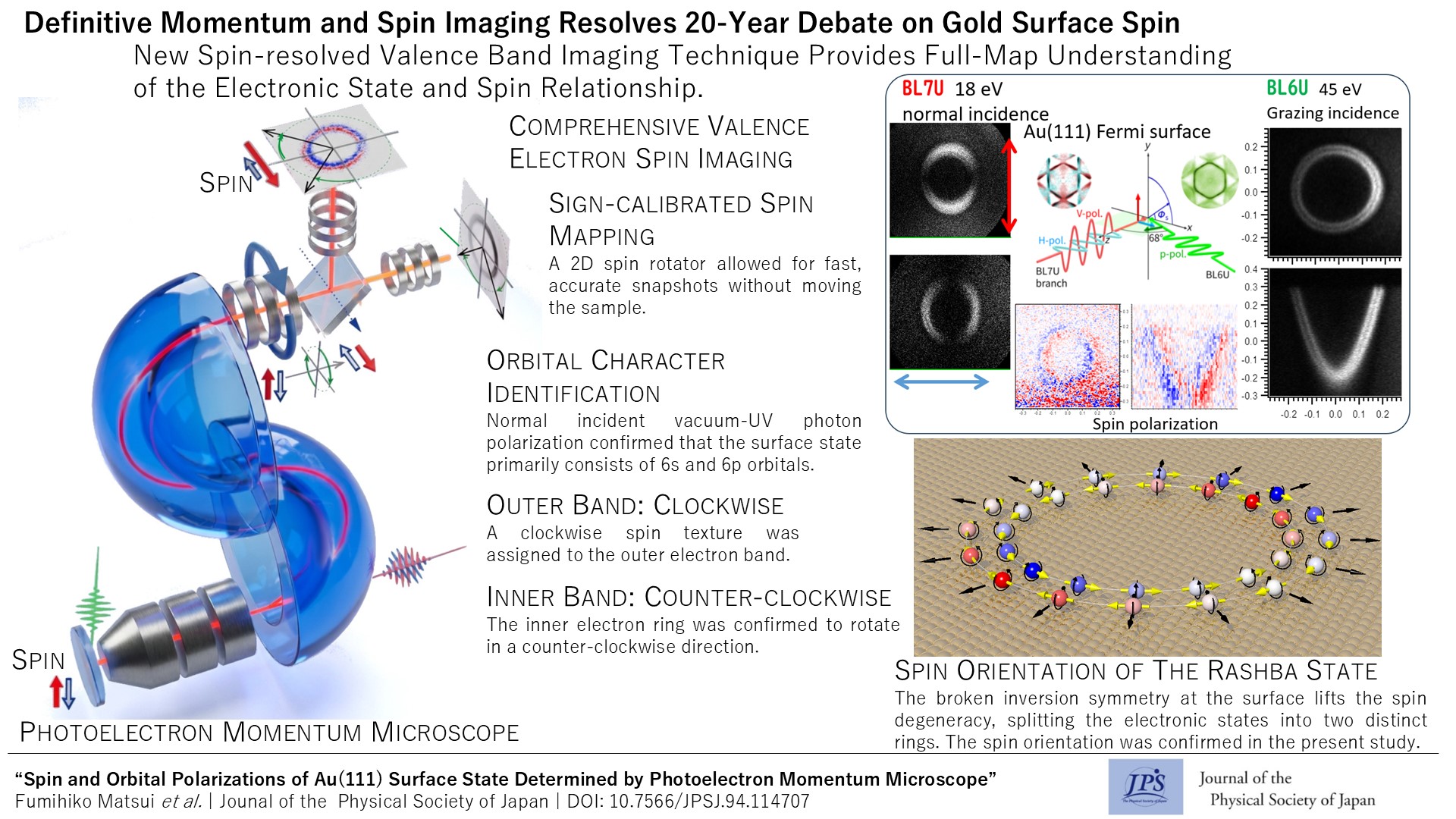
Noble metal surfaces such as gold feature a Shockley surface state and a layer of electrons confined to the topmost atomic layers. The broken crystal inversion symmetry at the surface generates a strong perpendicular electric field, lifting the spin degeneracy and splitting the electronic state into two distinct rings, each with an opposite in-plane spin direction. This spin-splitting phenomenon is known as the Rashba effect.
Historically, conflicting assignments have emerged from prior literature regarding the absolute spin direction (clockwise vs. counterclockwise) owing to variations in experimental setups and analysis conventions. The IMS team aimed to overcome these ambiguities by using a refined, high-efficiency imaging technique.
The experiments employed a unique twin-hemispherical analyzer PMM at UVSOR, capable of capturing a snapshot of a wide, two-dimensional (2D) energy and spin-resolved map of electron momentum (k). Soft X-rays with a grazing incidence, p-polarized configuration were used as the excitation source. Crucially, the system included a spin rotator placed before a 2D spin filter (Ir(001) crystal). The spin rotator enabled the acquisition of two images with opposite spin sensitivity without moving the sample, allowing for fast, sign-calibrated mapping.
The resulting spin-resolved large k-space images provided unambiguous confirmation of the disputed spin assignment. When viewed from the vacuum side, the outer electron band rotated clockwise (cw), and the inner band rotated counterclockwise (ccw). This confirmed the spin-splitting texture characteristics of the Rashba effect.
Furthermore, by illuminating the surface with s-polarized vacuum ultraviolet (VUV) light at normal incidence, the dominant 6s and 6p atomic orbitals constituting the surface states were successfully identified. This orbital identification was validated by confirming an orbital selection rule: the photoelectron intensity dropped to zero for electrons emitted perpendicular to the electric-field vector of the incident photon.
By establishing a robust, image-based assignment of both spin and orbital textures, this study provides a reliable quantum reference dataset for materials science in the future. The refined PMM methodology allows fast, simultaneous, and sign-calibrated mapping of complete 2D spin and orbital textures. This highly efficient method can be extended to build a consistent “atlas” of spin textures, representing a fundamental step for the design and development of spintronic devices that utilize electron spin for novel functionalities.
(Written by F. Matsui on behalf of all authors)
Spin and Orbital Polarizations of Au(111) Surface State Determined by Photoelectron Momentum Microscope
(JPSJ Editors' Choice)
J. Phys. Soc. Jpn.
94,
114707
(2025)
.
Share this topic


Fields
Related Articles
-
Frustrated Sawtooth Yb Chain Yielding Ferromagnetic Order with Reduced Magnetic Moments
Magnetic properties in condensed matter
2026-9-1
The ytterbium-based semiconductor ZnYb2S4 exhibits ferromagnetic order with contracted Yb moments, representing a novel quantum ground state attributed to competing exchange interactions in an effective spin-1/2 frustrated sawtooth chain.
-
Unlocking a 40-Year-Old Mystery: Full-gap Spin-Triplet Superconductivity Unveiled in UBe13
Magnetic properties in condensed matter
Superconductivity
2026-8-12
Recent precise NMR measurements on the heavy-fermion superconductor UBe13 provided “smoking-gun” evidence for a fully-gapped spin-triplet superconducting state, opening a new chapter in the field.
-
Peculiar Magnet Pointing Against an Applied Magnetic Field
Cross-disciplinary physics and related areas of science and technology
Magnetic properties in condensed matter
2026-7-1
TbNiC2 exhibits negative magnetization. A new mechanism, based on the coupling between the charge density wave and the antiferromagnetic order, is proposed to account for this peculiar phenomenon.
-
Magnetic-Field Driven Switching of Multipolar Order in an f-Electron System
Magnetic properties in condensed matter
2026-5-22
This study investigates high-rank multipole physics in f-electron systems, providing the first clear experimental evidence for field-induced switching of ferro-quadrupole order in a non-Kramer ion system, along with a new conceptual framework
-
Enhancing Accuracy and Reliability Bayesian Framework for Analysis of AR-HAXPES of Hard X-ray Photoelectron Spectroscopy
Dielectric, optical, and other properties in condensed matter
Electronic structure and electrical properties of surfaces and nanostructures
Measurement, instrumentation, and techniques
2026-4-28
We present a Bayesian framework for angle-resolved hard X-ray photoelectron spectroscopy (AR-HAXPES), combining Replica Exchange Monte Carlo with hierarchical integration to objectively and precisely estimate thin-film thickness.