

Solving Sign Problem: Phase-Structure Analysis of a Lattice Model with a Topological θ Term Using Tensor Renormalization Group Approach
© The Physical Society of Japan
This article is on
Phase Structure Analysis of a 2D Lattice CP(1) Model with a θ Term using the Tensor Renormalization Group Method
(PTEP Editors' Choice)
Prog. Theor. Exp. Phys.
2026,
013B07
(2026)
.
This study clarifies the phase structure of the two-dimensional lattice CP(1) model with a θ term by employing the tensor renormalization group method and conformal field theory, thus enabling the circumvention of the sign problem and logarithmic corrections.
The two-dimensional CP(1) model is typically investigated as a toy model of quantum chromodynamics (QCD), as it shares several essential features with QCD, including asymptotic freedom and the presence of a topological θ term. In strongly interacting systems such as low-energy QCD, where nonperturbative effects are key, lattice field theory provides an effective framework for theoretical and numerical investigations. Once a lattice model is formulated, one of the primary tasks is to examine its phase structure.
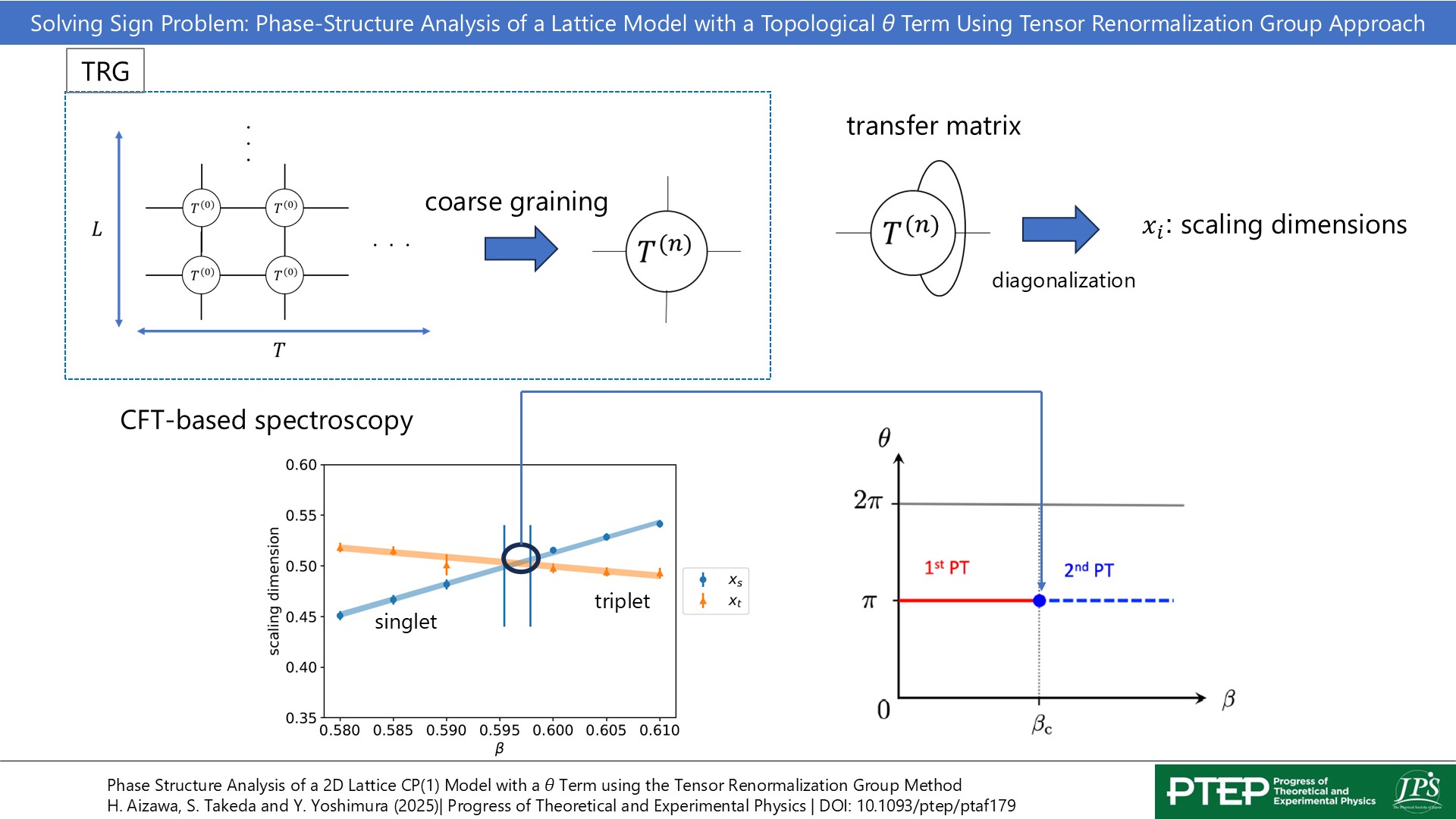
The phase structure of the lattice CP(1) model is characterized in a simple two-parameter space spanned by the θ angle and the inverse coupling β. However, numerical investigations of this model present two major challenges. The first arises at finite θ, where the action becomes a complex number. This result in the sign problem in Monte Carlo simulations, thus rendering conventional importance-sampling approaches ineffective. In this study, we circumvent this issue by employing the tensor renormalization group (TRG), which is based on truncated singular value decomposition and does not rely on importance sampling.
Despite eliminating the sign problem, the second challenge remains: Finite-size scaling is affected by logarithmic corrections. It is commonly employed in numerical studies to determine the locations and orders of phase transitions. However, logarithmic corrections appear in some systems, such as one-dimensional quantum antiferromagnets, thus rendering Finite-size scaling analysis challenging. In fact, CP(1) model is known as a low-energy effective theory for one-dimensional quantum antiferromagnets, and its phase structure is closely related to the Haldane conjecture. Studies on the Haldane conjecture—including analytical approaches such as bosonization—suggest that the CP(1) model at θ=π exhibits a critical point described by the SU(2)K=1Wess–Zumino–Witten conformal field theory (CFT), which is expected to yield logarithmic corrections.
To address these logarithmic corrections, we combined the TRG approach with CFT-based spectroscopy. Using the scaling dimensions from CFT, this method allows the transition point to be determined through finite-size scaling including cases with logarithmic corrections. Then scaling dimensions can be computed relatively easily within the TRG framework. Using this combined framework, we numerically confirmed the expected phase structure and determined the critical coupling to be βc= 0.5952(8).
This result provides numerical support for analytical approaches, including bosonization, and demonstrates the effectiveness of the TRG approach for lattice field theories with a topological θ term.
(written by Hayato Aizawa on behalf of all authors.)
Phase Structure Analysis of a 2D Lattice CP(1) Model with a θ Term using the Tensor Renormalization Group Method
(PTEP Editors' Choice)
Prog. Theor. Exp. Phys.
2026,
013B07
(2026)
.
Share this topic


Fields
Related Articles
-
New Crosscap States: Modular Bootstrap on Unorientable Manifolds
Theoretical Particle Physics
2026-5-11
We derive a generalized modular bootstrap equation for conformal field theories on unorientable manifolds in the presence of symmetry defects and identify new crosscap states labeled by noninvertible symmetries.
-
A Look at the Legacy of Kobayashi–Maskawa Theory
Elementary particles, fields, and strings
Theoretical Particle Physics
2025-10-24
This special topics edition of the Progress of Theoretical and Experimental Physics covers a symposium celebrating the 50-year history of the Kobayashi–Maskawa Theory, highlighting its impact from theoretical and experimental perspectives.
-
Understanding Global Inconsistency and ’t Hooft Anomaly Using Simple Quantum Mechanics
Theoretical Particle Physics
2025-2-21
This study explores the implications of global inconsistency and ’t Hooft anomalies for analyzing quantum field theories, using simple quantum mechanical models to provide valuable insights into these complex phenomena.
-
Understanding Non-Invertible Symmetries in Higher Dimensions Using Topological Defects
Theoretical Particle Physics
2024-9-27
By constructing Kramers-Wannier-Wegner duality and Z2 duality defects and deriving their crossing relations, this study presents the first examples of codimension one non-invertible symmetries in four-dimensional quantum field theories.
-
Quantum Mechanics of One-Dimensional Three-Body Contact Interactions
Mathematical methods, classical and quantum physics, relativity, gravitation, numerical simulation, computational modeling
Theoretical Particle Physics
2024-2-13
The quantum mechanical description of topologically nontrivial three-body contact interactions in one dimension is not well understood. This study explores the Hamiltonian description of these interactions using the path-integral formalism.