

New Crosscap States: Modular Bootstrap on Unorientable Manifolds
© The Physical Society of Japan
This article is on
New Crosscap States
(PTEP Editors' Choice)
Prog. Theor. Exp. Phys.
2026, (2026)
.
We derive a generalized modular bootstrap equation for conformal field theories on unorientable manifolds in the presence of symmetry defects and identify new crosscap states labeled by noninvertible symmetries.
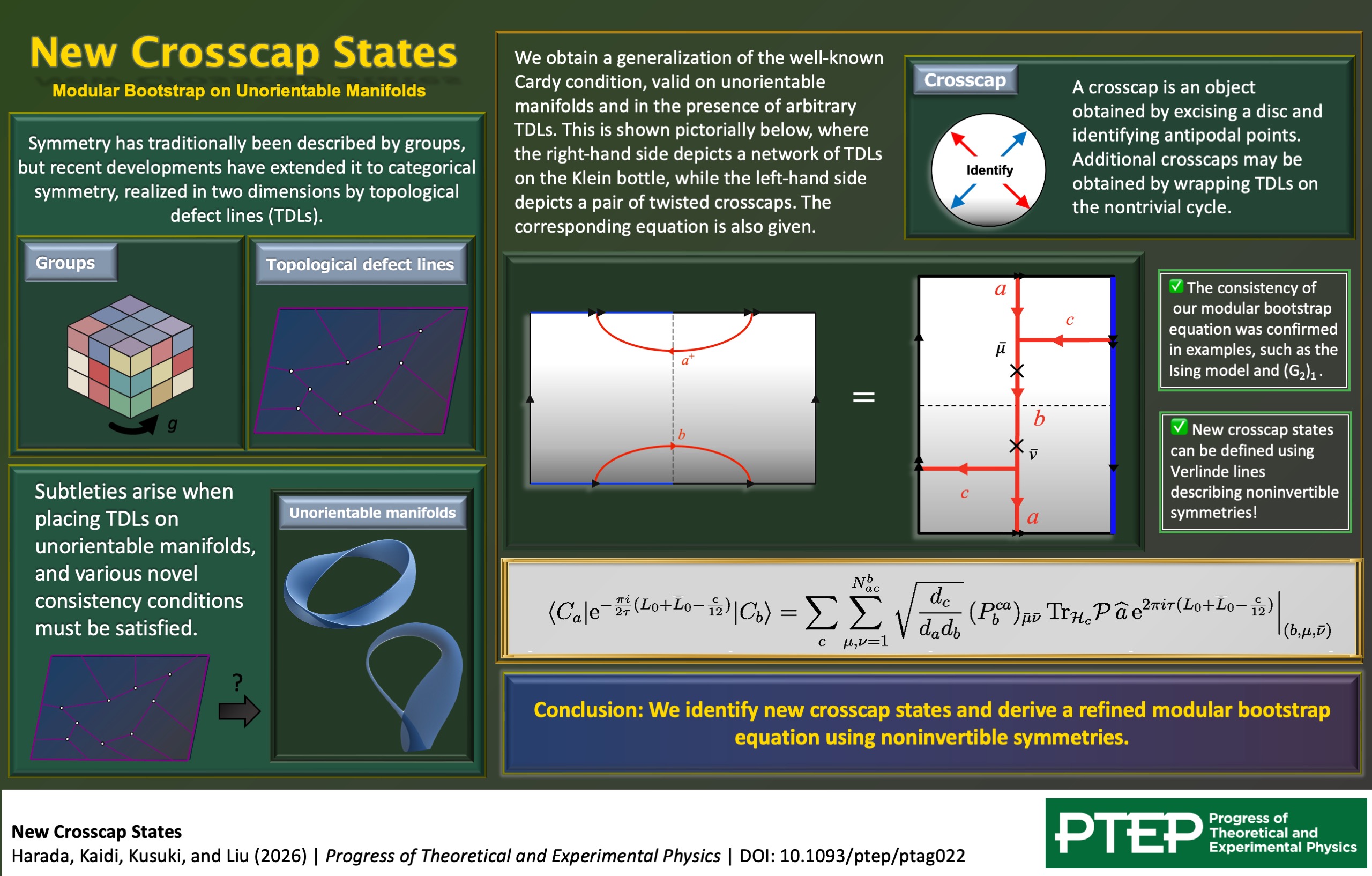
The concept of symmetry in quantum field theory has expanded substantially in recent years. Traditionally, symmetry was understood as a set of invertible transformations with the structure of a group. Recently, however, symmetry has been viewed more generally in terms of topological defects in a theory. From this perspective, the composition of symmetry transformations is described by the fusion of topological defects, which can be noninvertible.
In two-dimensional conformal field theories (CFTs), Verlinde lines are a particular class of topological defects. Their spectrum enables powerful nonperturbative statements about the theory, including constraints on the possible endpoints of renormalization group flows.
In addition to symmetry, modular bootstrap is a powerful tool for studying CFT. Consistency requires that partition functions computed with different choices of time and space directions agree; this is realized as invariance under modular transformations of a torus. This condition constrains both high- and low-energy regimes, providing another nonperturbative tool.
Real quantum systems are finite and include boundaries, so incorporating boundary conditions into a theory is essential. It is known that there exist boundary states, known as Cardy states, which satisfy modular bootstrap consistency and ensure agreement of partition functions computed with different choices of time direction.
In addition to the presence of boundaries, discrete symmetries such as spatial reflection play an important role. This leads to the study of theories on unorientable manifolds, for which new bootstrap conditions generalizing the above become necessary. A convenient way to understand these constraints is via the Klein bottle, which can be expressed as a sum of two crosscaps. Using this equivalence, one obtains a relation between distinct partition functions, providing an unorientable generalization of the modular bootstrap.
In this work, we further generalize the unorientable modular bootstrap to include Verlinde lines. As usual, our result follows from agreement of partition functions computed in different channels. In addition, whereas previous studies labeled crosscaps only by Verlinde lines corresponding to invertible symmetries, in this work we show that crosscaps can be defined using general Verlinde lines, yielding a classification of crosscaps consistent with the generalized bootstrap equation.
Altogether, this study deepens our understanding of symmetry in CFT by connecting noninvertible symmetries with unorientable manifolds. Future directions include extensions to more general CFTs, applications to the classification of topological phases, and the use of new bootstrap equations to constrain physical observables.
(Written by Justin Kaidi on behalf of all authors).
New Crosscap States
(PTEP Editors' Choice)
Prog. Theor. Exp. Phys.
2026, (2026)
.
Share this topic


Fields
Related Articles
-
Solving Sign Problem: Phase-Structure Analysis of a Lattice Model with a Topological θ Term Using Tensor Renormalization Group Approach
Theoretical Particle Physics
2026-3-23
This study clarifies the phase structure of the two-dimensional lattice CP(1) model with a θ term by employing the tensor renormalization group method and conformal field theory, thus enabling the circumvention of the sign problem and logarithmic corrections.
-
A Look at the Legacy of Kobayashi–Maskawa Theory
Elementary particles, fields, and strings
Theoretical Particle Physics
2025-10-24
This special topics edition of the Progress of Theoretical and Experimental Physics covers a symposium celebrating the 50-year history of the Kobayashi–Maskawa Theory, highlighting its impact from theoretical and experimental perspectives.
-
Understanding Global Inconsistency and ’t Hooft Anomaly Using Simple Quantum Mechanics
Theoretical Particle Physics
2025-2-21
This study explores the implications of global inconsistency and ’t Hooft anomalies for analyzing quantum field theories, using simple quantum mechanical models to provide valuable insights into these complex phenomena.
-
Understanding Non-Invertible Symmetries in Higher Dimensions Using Topological Defects
Theoretical Particle Physics
2024-9-27
By constructing Kramers-Wannier-Wegner duality and Z2 duality defects and deriving their crossing relations, this study presents the first examples of codimension one non-invertible symmetries in four-dimensional quantum field theories.
-
Quantum Mechanics of One-Dimensional Three-Body Contact Interactions
Mathematical methods, classical and quantum physics, relativity, gravitation, numerical simulation, computational modeling
Theoretical Particle Physics
2024-2-13
The quantum mechanical description of topologically nontrivial three-body contact interactions in one dimension is not well understood. This study explores the Hamiltonian description of these interactions using the path-integral formalism.