

Toward Clarification of Physical Properties of Quasicrystals: Noncollinear Magnetic Orders in Icosahedral Approximants
© The Physical Society of Japan
This article is on
Non-Collinear and Non-Coplanar Magnetic Orders in 1/1 Periodic Approximant to the Icosahedral Quasicrystal
(JPSJ Editors' Choice)
J. Phys. Soc. Jpn.
95,
044705
(2026)
.
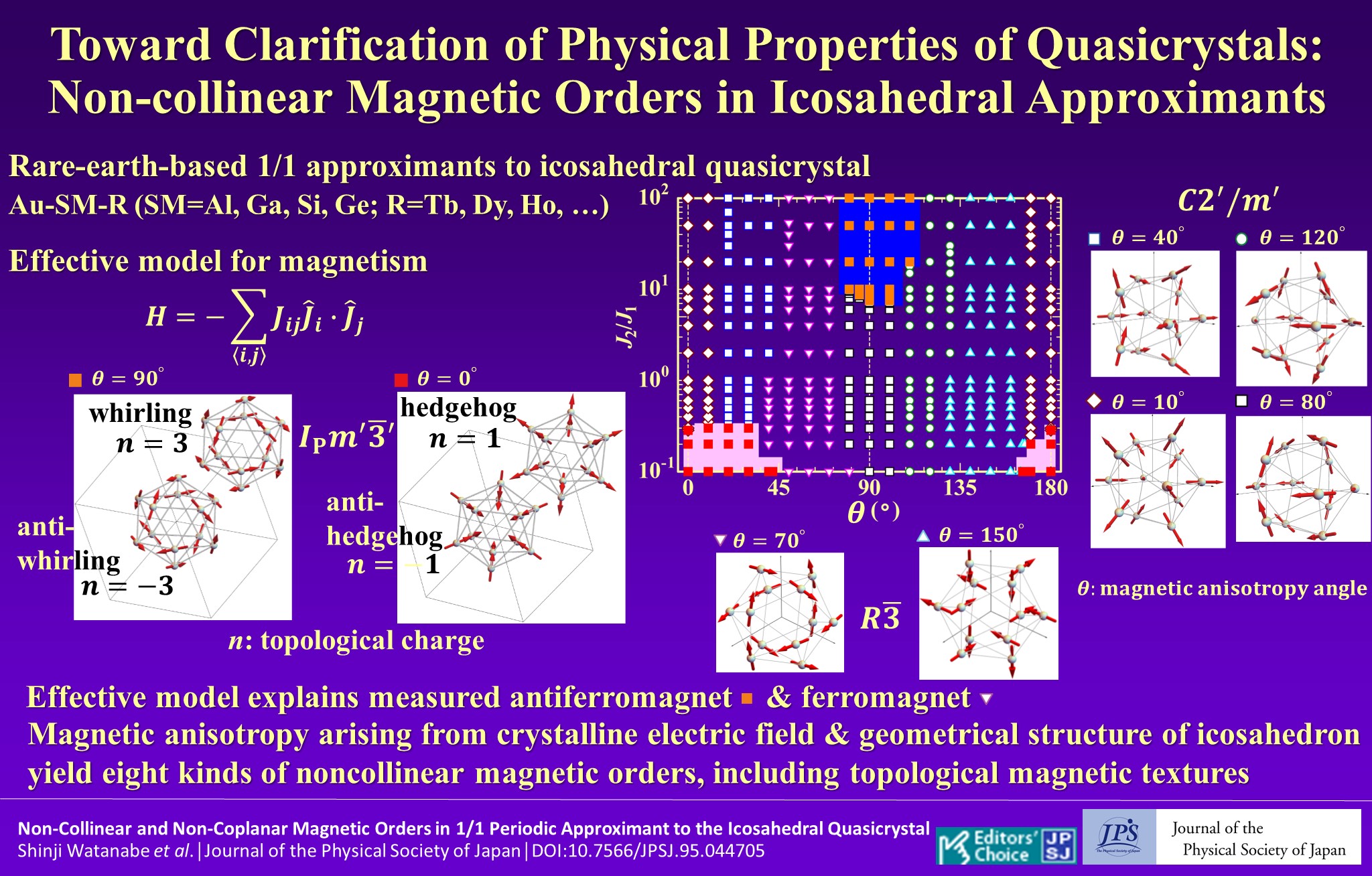
An effective model based on magnetic anisotropy arising from a crystalline electric field is constructed for icosahedral approximants, which not only explains measured ferromagnets and antiferromagnets but also reveals new types of noncollinear magnetic orders.
Quasicrystals (QCs) have no periodicity of atoms but possess structural order. However, their electronic states and physical properties are obscure. Periodic crystals with local atomic configurations common to those of QCs exist and are referred to as approximant crystals (ACs). ACs are unique solids that can be interpolated between conventional periodic crystals and QCs.
Rare-earth-based icosahedral ACs, such as Au-SM-R (SM = Al, Ga, Si, Ge; R = rare-earth elements), are composed of concentric shell structures of atoms, each of which is located at the vertex of the polyhedrons. The rare-earth atoms are located at the 12 vertices of an icosahedron. In AC Au-SM-R, magnetic long-range orders have been observed, in some of which magnetic structures have started to be identified via neutron measurements: a ferromagnetic order was observed in Au70Si17Tb13, whereas an antiferromagnetic order was observed in Au72Al14Tb14, although both exhibited a positive Curie–Weiss temperature. Microscopic theory to explain the mechanism and magnetic structures in a unified manner has been highly awaited.
Interestingly, the local configuration of atoms surrounding the rare-earth atom shows pentagonal geometries in the icosahedral QCs and ACs. Five-fold rotational symmetry is known to be incompatible with the translational symmetry of periodic crystals. Hence, the well-established crystalline-electric-field (CEF) theory based on crystallographic point groups cannot be applied to QCs and ACs, which has prevented us from microscopically understanding their electronic states.
Recently, the theory of the CEFs in icosahedral QCs and ACs has been developed based on a point-charge model. Theoretical analyses of the CEF in 1/1 AC Au-SM-R (R = Tb or Dy) revealed that the magnetic easy axis lies in the mirror plane. In this study, considering the magnetic anisotropy arising from a CEF, we constructed an effective model. By performing a numerically exact calculation, we determined the ground-state phase diagram for the ferromagnetic interactions.
The results show that two types of antiferromagnetic orders and six types of ferromagnetic orders were stabilized, and their magnetic space groups were identified as 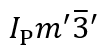 as well as
  , respectively. The whirling-anti-whirling order and hedgehog-anti-hedgehog order were characterized by the topological charges (+3, -3 and +1, -1, respectively). Our results explain the measured antiferromagnetic structure in Au72Al14Tb14 and the ferromagnetic structure in Au70Si17Tb13. Additionally, we revealed that an emergent fictitious magnetic field appeared in the ferromagnetic orders, thus resulting in the topological Hall effect. Our model is expected to be applicable to a broad range of rare-earth-based ACs and QCs, and is effective not only for clarifying magnetism but also for investigating topological properties.
(written by Shinji Watanabe on behalf of all authors.)
Non-Collinear and Non-Coplanar Magnetic Orders in 1/1 Periodic Approximant to the Icosahedral Quasicrystal
(JPSJ Editors' Choice)
J. Phys. Soc. Jpn.
95,
044705
(2026)
.
Share this topic


Fields
Related Articles
-
Only Certain Angles Allow Layer-by-Layer Stacking of Corrugated Rods
Cross-disciplinary physics and related areas of science and technology
2026-10-13
Rods with periodic surface corrugations stack helicoidally at only a discrete set of pitch angles. This rule opens a route for programming the fiber-stacking angle based on fiber surface texture.
-
Mysterious Critical Phenomena Driven by Role Reversal in Multicomponent Systems: From Normal to Reverse RKKY — Twofold Reversal and Induced Critical Exponent
Electronic transport in condensed matter
Structure and mechanical and thermal properties in condensed matter
2026-10-5
The Reverse RKKY mechanism drives a twofold reversal, yielding an anomalous specific‑heat peak with a large, induced critical exponent.
-
Frustrated Sawtooth Yb Chain Yielding Ferromagnetic Order with Reduced Magnetic Moments
Magnetic properties in condensed matter
2026-9-1
The ytterbium-based semiconductor ZnYb2S4 exhibits ferromagnetic order with contracted Yb moments, representing a novel quantum ground state attributed to competing exchange interactions in an effective spin-1/2 frustrated sawtooth chain.
-
How Heart Cells Come to Beat Together through an Elastic Substrate
Cross-disciplinary physics and related areas of science and technology
Statistical physics and thermodynamics
2026-8-24
Two isolated cardiomyocytes (heart muscle cells) can synchronize through deformations of a soft substrate. A dynamical theory explains geometry-dependent phase-locking and synchronization time.
-
Unlocking a 40-Year-Old Mystery: Full-gap Spin-Triplet Superconductivity Unveiled in UBe13
Magnetic properties in condensed matter
Superconductivity
2026-8-12
Recent precise NMR measurements on the heavy-fermion superconductor UBe13 provided “smoking-gun” evidence for a fully-gapped spin-triplet superconducting state, opening a new chapter in the field.