

Electron-Hole Asymmetry Observed in Photoinduced Phase Transition of Excitonic Insulators
© The Physical Society of Japan
This article is on
Temporal Evolution and Fluence Dependence of Band Structure in Photoexcited Ta2Ni0.9Co0.1Se5 Probed by Time- and Angle-Resolved Photoemission Spectroscopy
(JPSJ Editors' Choice)
J. Phys. Soc. Jpn.
92,
064706
(2023)
.
During a photoinduced phase transition from an excitonic insulator to a semimetal, photoinduced energy shift of its hole band is delayed than that of its electron band indicating electron-hole asymmetry.
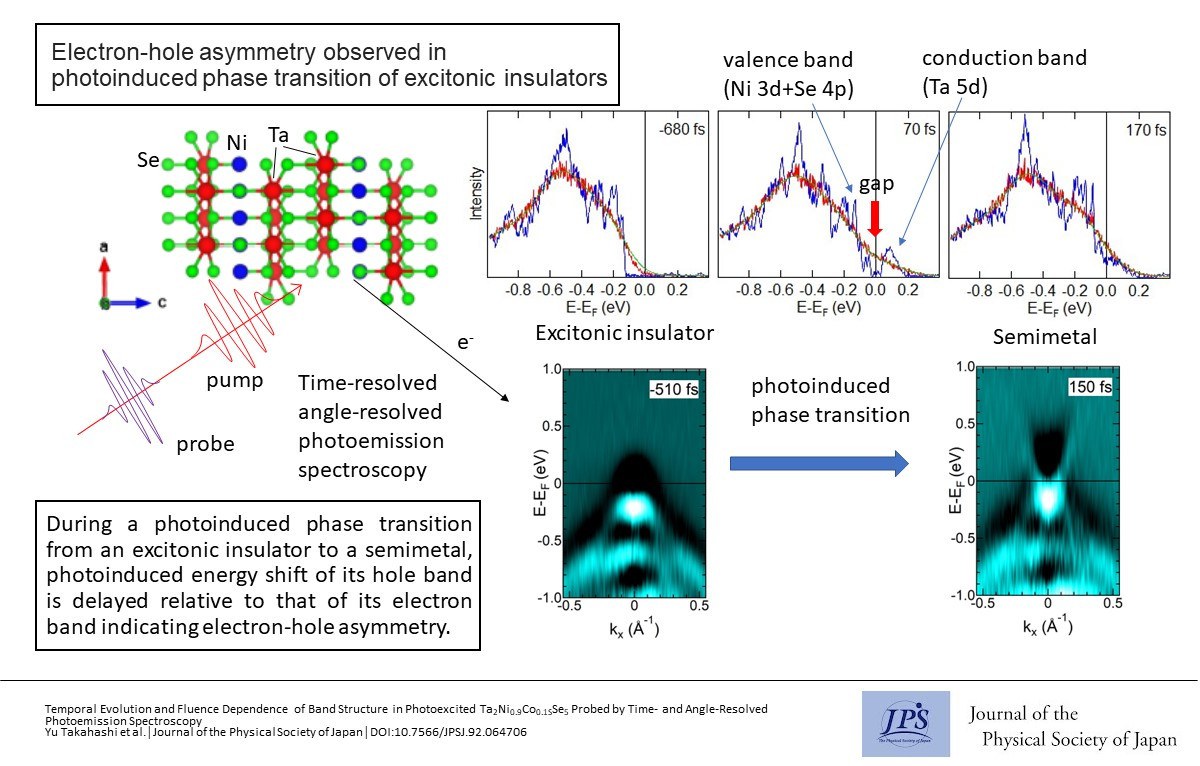
Existence of excitonic insulators was theoretically predicted in 1960s. They can be realized if conduction and valence bands in a semiconductor or semimetal are hybridized by the electron-hole attractive Coulomb interaction. The electron-hole hybridization by the attractive Coulomb interaction can be viewed as a Bose-Einstein condensation of bounded electron-hole pairs or excitons. In 2009, a layered transition-metal chalcogenide Ta2NiSe5 was proposed to be an excitonic insulator. This has been confirmed by various experimental techniques. In particular, a photoinduced phase transition with 100 fs time scale from the excitonic insulating state to a semimetal state is one strongest proof. In the present study, the photoinduced energy shift of conduction and valence bands (electron and hole bands) of Ta2Ni0.9Co0.1Se5(which is also an excitonic insulator) is investigated by time-resolved angle-resolved photoemission spectroscopy. In a canonical excitonic insulator, valence and conduction bands are expected to shift simultaneously to close the energy gap between them owing to the screening effect of the photoinduced carriers. However, in Ta2Ni0.9Co0.1Se5, the energy shift of the valence band is delayed than that of the conduction band. This observation indicates that the electron-hole symmetry (which is assumed in the canonical theory for excitonic insulators) is broken and that the mechanism of the electron-hole hybridization is complicated in the layered transition-metal chalcogenide. We speculate that the electron-lattice interaction and electronic correlation in the valence band of Ni 3d and Se 4p orbitals provide the residual and transient energy gap during the photoinduced phase transition to the semimetal state.
(written by T. Mizokawa on behalf of all authors.)
Temporal Evolution and Fluence Dependence of Band Structure in Photoexcited Ta2Ni0.9Co0.1Se5 Probed by Time- and Angle-Resolved Photoemission Spectroscopy
(JPSJ Editors' Choice)
J. Phys. Soc. Jpn.
92,
064706
(2023)
.
Share this topic


Fields
Related Articles
-
Enhancing Accuracy and Reliability Bayesian Framework for Analysis of AR-HAXPES of Hard X-ray Photoelectron Spectroscopy
Dielectric, optical, and other properties in condensed matter
Electronic structure and electrical properties of surfaces and nanostructures
Measurement, instrumentation, and techniques
2026-4-28
We present a Bayesian framework for angle-resolved hard X-ray photoelectron spectroscopy (AR-HAXPES), combining Replica Exchange Monte Carlo with hierarchical integration to objectively and precisely estimate thin-film thickness.
-
Definitive Momentum and Spin Imaging Resolves 20-Year Debate on Gold Surface Spin
Electronic structure and electrical properties of surfaces and nanostructures
Magnetic properties in condensed matter
2026-4-1
Researchers at the Institute for Molecular Science (IMS) have utilized a cutting-edge Photoelectron Momentum Microscope (PMM) at the UVSOR Synchrotron Facility to settle a two-decade-long controversy concerning the direction of electron spin on the Au(111) surface. This study provides a definitive, full-map, comprehensive reference for quantum imaging that is essential for advancing spintronics technology.
-
Oxide Superionic Conductivity of a-Axis-Oriented Ce0.75Sm0.25O2−δ Thin Film
Electronic structure and electrical properties of surfaces and nanostructures
2026-2-2
Highly a-axis oriented Ce0.75Sm0.25O2-δ thin film fabricated on a yttria-stabilized zirconia substrate achieved oxide superionic conductivity, which can apply as an electrolyte in solid oxide fuel cells operating at medium temperature.
-
A Novel Type of Magnetic Band Splitting in a Fe Spin Ladder System
Dielectric, optical, and other properties in condensed matter
Magnetic properties in condensed matter
Superconductivity
2026-1-22
An investigation of a Fe spin ladder system using angle-resolved photoemission spectroscopy revealed a novel type of magnetic band splitting resembling that in altermagnets.
-
Imaging Micron-Scale Pressure Landscapes with NV Nanodiamonds
Dielectric, optical, and other properties in condensed matter
Magnetic properties in condensed matter
2025-12-22
Nanodiamonds containing nitrogen-vacancy centers can be used to map pressure and nonhydrostatic stress inside diamond anvil cells to obtain micron-scale pressure landscapes that clarify local conditions affecting high-pressure materials research.