

Strange Metal Behavior Potentially Associated to Hidden Electronic Nematicity
© The Physical Society of Japan
This article is on
Charge Transport in Ba1-xRbxFe2As2 Single Crystals
(JPSJ Editors' Choice)
J. Phys. Soc. Jpn.
91,
104706
(2022)
.
Iron-based superconductor, Ba1-xRbxFe2As2, exhibits “strange metal” behavior—linear dependence of resistivity on temperature. It seems that hidden electronic nematic fluctuations play a greater role than the well-known antiferromagnetic fluctuations.
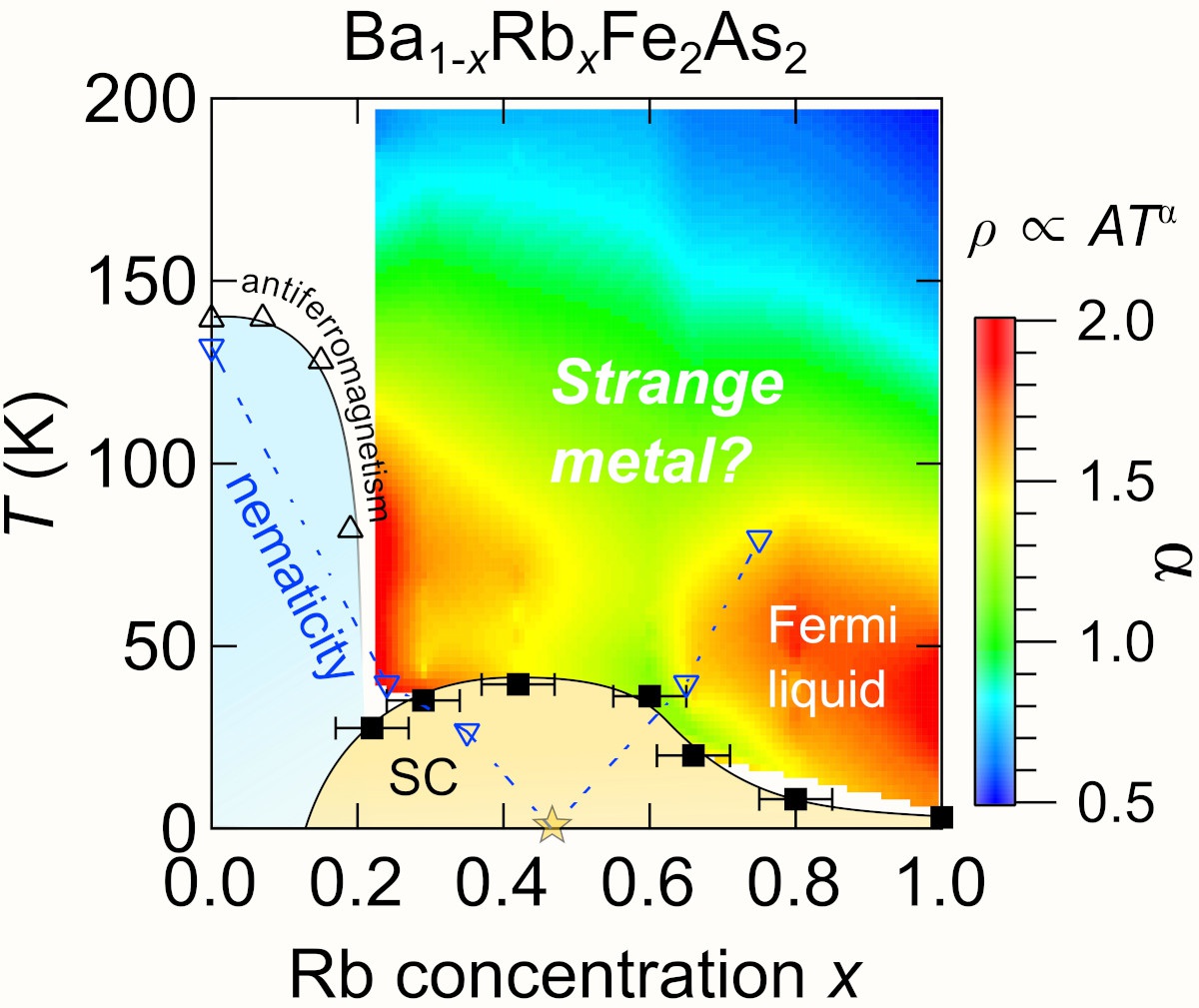
Electrical resistivity of a crystal is the measure of how easily electrons flow in it under the influence of an external electrical field. Although it is a familiar physical quantity, important insights can still be gathered by investigating it. Resistivity originates from collisions of electrons with other scatters, such as electrons and phonons. Its temperature dependence is indicative of the most common scattering event in the given temperature range. For example, according to Landau’s Fermi liquid theory, the scattering between two electrons produces resistivity, which depends quadratically on temperature. This is a consequence of the fact that electrons are fermions, and it also demonstrates that electrons carrying a current can be treated as “quasiparticles”.
However, a variety of strongly correlated metals exhibit a puzzling linear dependence of resistivity on temperature, referred to as “strange metal” behavior, inside the temperature regime in which electron-electron scattering is dominant. This challenges the “quasiparticle” explanation of charge transport. So far, in many cases, such T-linear resistivity has been observed when an antiferromagnetic transition is suppressed to zero temperature. This indicates that the intensification of spin fluctuations might be the source of the observed strange metal behavior. Indeed, several theories have been developed that corroborate this hypothesis.
This study presents systematic measurements of the electrical resistivity of single crystals of the iron-based superconductor, Ba1-xRbxFe2As2. The parent compound BaFe2As2 undergoes an antiferromagnetic transition accompanied by tetragonal-orthorhombic structural distortion, which breaks the four-fold rotational symmetry. By substituting Ba with Rb ions, antiferromagnetic structural transition is rapidly suppressed. Surprisingly, resistivity of the crystal exhibits T-linear behavior around the compositions farther from the endpoint of the antiferromagnetic order, where the spin fluctuations are thought to become strongest. However, it has been recently pointed out that although structural transition already disappears at these compositions, a critical instability remains in the electronic systems towards the four-fold rotational symmetry breaking, which may be potentially associated to the observed strange metalbehavior.
Recently, several quantum materials have been observed to exhibit an intrinsic instability of electrons towards the spontaneous rotational breaking of the underlying lattice. Based on an analogy with nematic liquid crystals, this state is called the electronic nematic state. Our conclusions suggest that fluctuations of an electronic nematic order can lead to strange metal behavior as well as antiferromagnetic fluctuations. However, further investigation of the precise form of the resistivity down to zero temperature masked by high superconducting transition temperature is required to derive more decisive conclusions. The current results serve as adequate motivation to perform such a challenging experiment.
(Written by Kousuke Ishida on behalf of all authors)
Charge Transport in Ba1-xRbxFe2As2 Single Crystals
(JPSJ Editors' Choice)
J. Phys. Soc. Jpn.
91,
104706
(2022)
.
Share this topic


Fields
Related Articles
-
What Shapes Electron Distributions in Nonequilibrium Nanowires?
Electronic transport in condensed matter
2026-4-20
A theoretical framework was developed to describe nonequilibrium electron distributions across the ballistic, diffusive, and local equilibrium transport regimes in voltage-biased nanowires in a unified manner.
-
Unveiling the Nodal Topology of the Spin-Triplet Superconductor Candidate UTe2
Structure and mechanical and thermal properties in condensed matter
Superconductivity
2026-4-13
Using high-quality UTe2 (Tc = 2.1 K), we identify its nodal gap structure. Field-angle‑resolved specific‑heat reveals a b-axis singularity, supporting spin-triplet superconductivity with nodes along the b axis.
-
Toward Clarification of Physical Properties of Quasicrystals: Noncollinear Magnetic Orders in Icosahedral Approximants
Cross-disciplinary physics and related areas of science and technology
Electronic transport in condensed matter
Magnetic properties in condensed matter
2026-4-6
An effective model based on magnetic anisotropy arising from a crystalline electric field is constructed for icosahedral approximants, which not only explains measured ferromagnets and antiferromagnets but also reveals new types of noncollinear magnetic orders.
-
Do Superconductors Dream of Tsunamis?
— A Cross-disciplinary Journey of Solitons —
Mathematical methods, classical and quantum physics, relativity, gravitation, numerical simulation, computational modeling
Superconductivity
2026-2-10
Tsunami-like solitons propagating over rocky-desert-like disordered backgrounds have been identified in a novel soliton equation derived from the theory of parity-mixed superconductivity.
-
A Novel Type of Magnetic Band Splitting in a Fe Spin Ladder System
Dielectric, optical, and other properties in condensed matter
Magnetic properties in condensed matter
Superconductivity
2026-1-22
An investigation of a Fe spin ladder system using angle-resolved photoemission spectroscopy revealed a novel type of magnetic band splitting resembling that in altermagnets.