

Observing the de Haas–van Alphen Effect to Unveil the Electronic Structure of UTe2 Superconductor
© The Physical Society of Japan
This article is on
First Observation of the de Haas-van Alphen Effect and Fermi Surfaces in the Unconventional Superconductor UTe2
J. Phys. Soc. Jpn.
91,
083704
(2022)
.
The topology of Fermi surfaces with heavy effective masses in strongly correlated topological superconductor UTe2 was investigated using quantum oscillation measurements and theoretical calculations.
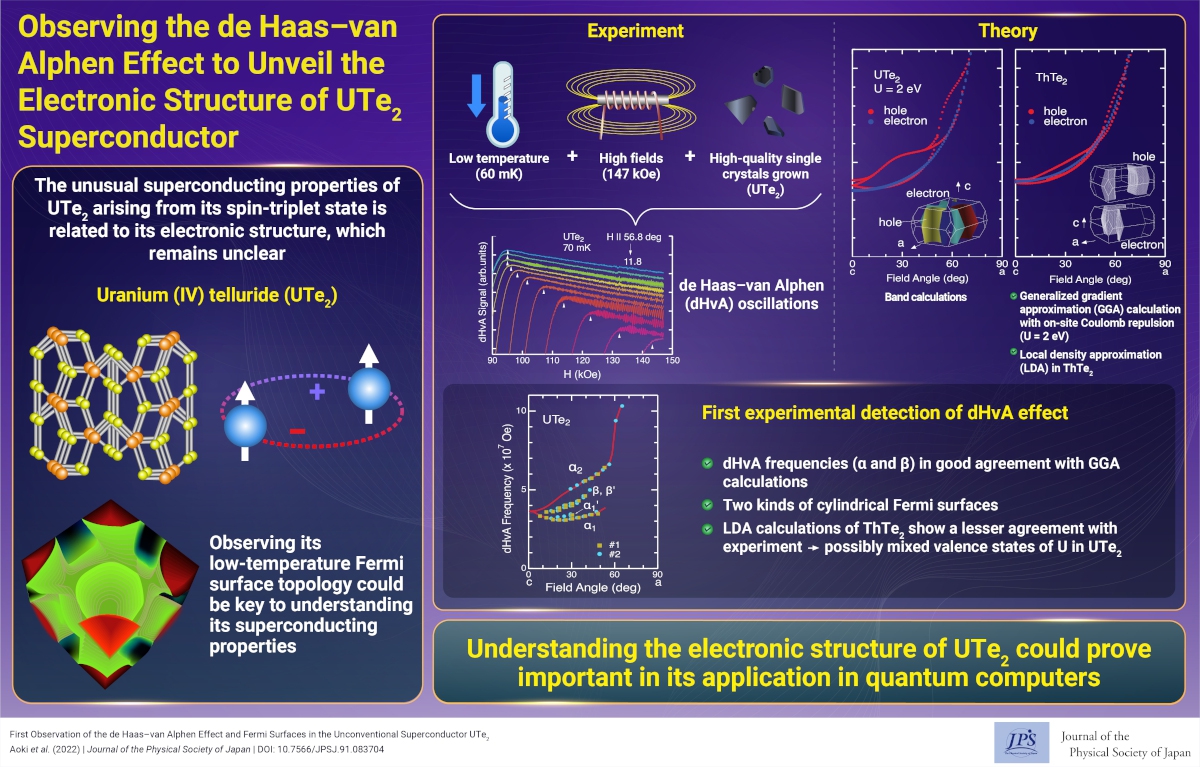
Heavy fermion UTe2 is one of the hottest topics in condensed matter physics. This is because of its unconventional superconducting properties, such as high field-reentrant superconductivity and multiple superconducting phases under pressure. Superconductivity is achieved owing to the formation of superconducting Cooper pairs of electrons. In UTe2, the unconventional pairing mechanism must be responsible for this; thus, the spin-triplet state is expected. It is crucial to investigate the electronic state microscopically, that is, to determine the Fermi surfaces using a microscopic experimental probe combined with a band theory.
A powerful experimental probe is the quantum oscillation measurement method, such as the de Haas–van Alphen (dHvA) effect, which is the oscillatory effect in magnetization caused by the quantization of cyclotron motions in high magnetic fields. Three conditions must be satisfied to detect quantum oscillations: low temperature, high magnetic field, and high-quality single crystals. These are somewhat difficult experimental conditions. In particular, high-quality single crystals are inevitably crucial for UTe2 with strong electronic correlations.
In this study, we grew the ultrapure single crystals of UTe2 using “a new recipe” of a single crystal growth technique, as demonstrated by a high and sharp superconducting transition in specific heat measurements. Using this high-quality single crystal, we successfully detected quantum oscillations (the dHvA effect) for the first time in UTe2. By rotating the field directions, the topology of Fermi surfaces is precisely determined experimentally. The results are consistent with the band structure calculations, indicating the existence of two types of cylindrical Fermi surfaces from the hole and electron bands. The dHvA signals are detected only at extremely low temperatures below 0.12 K, revealing the heavy effective mass resulting from strong electronic correlations.
The bare band structure calculations based on the 5f-itinerant model predict a small bandgap at the Fermi energy level, indicating a Kondo insulator. This is inconsistent with the real system because UTe2is a good metal with a large carrier number. To explain the experimental results obtained from the band calculations, we need to introduce the onsite Coulomb interaction, U. This suggests a possible mixed valence state of UTe2.
As Fermi surfaces, known as the “face of metal,” are essential information for the electronic states, our results are a good starting point for clarifying unusual phenomena in UTe2 and other unconventional superconductors.
(Written by D. Aoki on behalf of all the authors.)
First Observation of the de Haas-van Alphen Effect and Fermi Surfaces in the Unconventional Superconductor UTe2
J. Phys. Soc. Jpn.
91,
083704
(2022)
.
Share this topic


Fields
Related Articles
-
Unveiling the Nodal Topology of the Spin-Triplet Superconductor Candidate UTe2
Structure and mechanical and thermal properties in condensed matter
Superconductivity
2026-4-13
Using high-quality UTe2 (Tc = 2.1 K), we identify its nodal gap structure. Field-angle‑resolved specific‑heat reveals a b-axis singularity, supporting spin-triplet superconductivity with nodes along the b axis.
-
Do Superconductors Dream of Tsunamis?
— A Cross-disciplinary Journey of Solitons —
Mathematical methods, classical and quantum physics, relativity, gravitation, numerical simulation, computational modeling
Superconductivity
2026-2-10
Tsunami-like solitons propagating over rocky-desert-like disordered backgrounds have been identified in a novel soliton equation derived from the theory of parity-mixed superconductivity.
-
A Novel Type of Magnetic Band Splitting in a Fe Spin Ladder System
Dielectric, optical, and other properties in condensed matter
Magnetic properties in condensed matter
Superconductivity
2026-1-22
An investigation of a Fe spin ladder system using angle-resolved photoemission spectroscopy revealed a novel type of magnetic band splitting resembling that in altermagnets.
-
Hybrid Quantum-Classical Computing for Quasiparticle Band Structures
Electron states in condensed matter
Mathematical methods, classical and quantum physics, relativity, gravitation, numerical simulation, computational modeling
2025-12-12
The proposed hybrid quantum-classical computing method enables practical calculations of quasiparticle band structures to expand the possibilities for quantum materials research.
-
Advances in Photoemission Study of Functional Molecular Materials
Dielectric, optical, and other properties in condensed matter
Superconductivity
2025-11-25
This work provides the first observation of the superconducting gap in molecular superconductors and their gap symmetry using photoemission spectroscopy, which will significantly accelerate the study of molecular conductors.