

Spin Transport in a Two-Dimensional Tilted Dirac Electron System
© The Physical Society of Japan
This article is on
Anomalous Spin Transport Properties of Gapped Dirac Electrons with Tilting
(JPSJ Editors' Choice)
J. Phys. Soc. Jpn.
91,
023708
(2022)
.
We propose that spin current in an organic conductor, α-(BETS)2I3, is an appropriate physical quantity to detect the topological nature of the material whose electrons obey a quasi-two-dimensional Dirac equation.
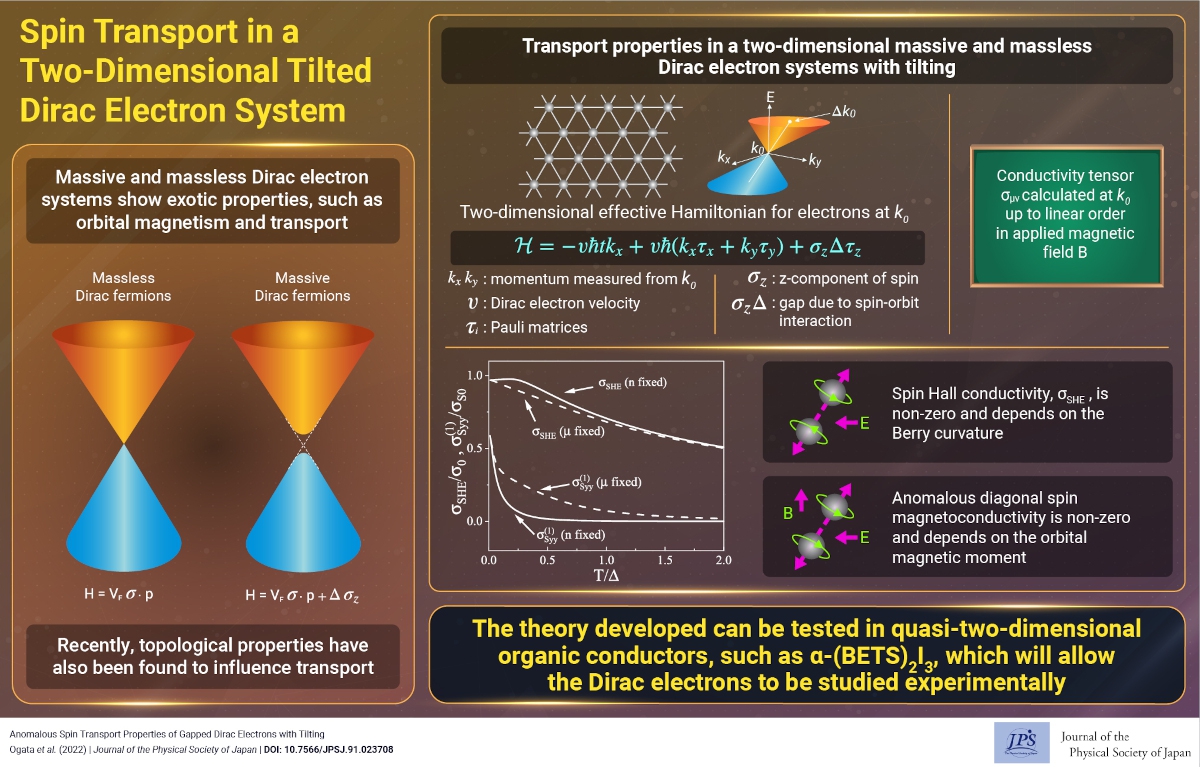
In quantum mechanics, electrons are described by wave forms, and thus, their wave functions are characterized by wave numbers in the Fourier space. Recently, the topological nature of the wave functions in the Fourier space (that is, momentum space) has been confirmed to provide various peculiar properties to materials, which are called “topological materials.” However, extracting the topological nature as an observable quantity in a bulk material is difficult. In this paper, we propose that spin current in an organic conductor is an appropriate physical quantity to detect the topological property of the material.
The organic conductors considered in this study are layered materials composed of relatively large molecules, and the electrons can move around hopping on various molecules forming a quasi-two-dimensional electron system. Material parameters such as the lattice constant, kinetic energy of electrons, and interaction between particles can be rather easily controlled by pressure or by substituting molecules with slightly different molecules. Consequently, organic conductors demonstrate various interesting properties as shown in a wide variety of phase diagrams of parameters. Recently, related to the topological nature, a certain class of organic conductors whose electrons obey the quasi-two-dimensional Dirac equation has been focused on. The Dirac equation was proposed by Dirac in 1928, which combined the newly born field of quantum mechanics and relativity. It predicts positrons occupying the vacuum. However, an electron–positron pair creation requires very high energy. In an organic conductor, α-(BETS)2I3, the first-principles band calculation shows that electrons inside obey an equation similar to the Dirac equation, but with a very small energy gap. Therefore, in this material, the corresponding electron–positron (called hole in solids) pair creation requires considerably less energy than that for the original electron–positron pair creation. It can be created using thermal energy even at room temperatures.
Theoretically, the two-dimensional Dirac electrons have been shown to have very peculiar topological properties. However, the conventional physical quantities are often written as an integral over the momentum space. Consequently, the topological nature of the Dirac electrons represented by Berry curvature vanishes after integration because the Berry curvature has two opposite-sign contributions at the two distinct Dirac points in the momentum space. In this study, we noticed that this cancellation can be avoided by considering spin current, and the topological nature of the Dirac electrons in α-(BETS)2I3can be detected in the spin current that can be measured using recent experimental techniques. More explicitly, we calculated the spin Hall conductivity and spin conductivity in a magnetic field based on a linear response theory.
(written by Masao Ogata on behalf of all authors)
Anomalous Spin Transport Properties of Gapped Dirac Electrons with Tilting
(JPSJ Editors' Choice)
J. Phys. Soc. Jpn.
91,
023708
(2022)
.
Share this topic


Fields
Related Articles
-
Enhancing Accuracy and Reliability Bayesian Framework for Analysis of AR-HAXPES of Hard X-ray Photoelectron Spectroscopy
Dielectric, optical, and other properties in condensed matter
Electronic structure and electrical properties of surfaces and nanostructures
Measurement, instrumentation, and techniques
2026-4-28
We present a Bayesian framework for angle-resolved hard X-ray photoelectron spectroscopy (AR-HAXPES), combining Replica Exchange Monte Carlo with hierarchical integration to objectively and precisely estimate thin-film thickness.
-
What Shapes Electron Distributions in Nonequilibrium Nanowires?
Electronic transport in condensed matter
2026-4-20
A theoretical framework was developed to describe nonequilibrium electron distributions across the ballistic, diffusive, and local equilibrium transport regimes in voltage-biased nanowires in a unified manner.
-
Toward Clarification of Physical Properties of Quasicrystals: Noncollinear Magnetic Orders in Icosahedral Approximants
Cross-disciplinary physics and related areas of science and technology
Electronic transport in condensed matter
Magnetic properties in condensed matter
2026-4-6
An effective model based on magnetic anisotropy arising from a crystalline electric field is constructed for icosahedral approximants, which not only explains measured ferromagnets and antiferromagnets but also reveals new types of noncollinear magnetic orders.
-
Definitive Momentum and Spin Imaging Resolves 20-Year Debate on Gold Surface Spin
Electronic structure and electrical properties of surfaces and nanostructures
Magnetic properties in condensed matter
2026-4-1
Researchers at the Institute for Molecular Science (IMS) have utilized a cutting-edge Photoelectron Momentum Microscope (PMM) at the UVSOR Synchrotron Facility to settle a two-decade-long controversy concerning the direction of electron spin on the Au(111) surface. This study provides a definitive, full-map, comprehensive reference for quantum imaging that is essential for advancing spintronics technology.
-
Oxide Superionic Conductivity of a-Axis-Oriented Ce0.75Sm0.25O2−δ Thin Film
Electronic structure and electrical properties of surfaces and nanostructures
2026-2-2
Highly a-axis oriented Ce0.75Sm0.25O2-δ thin film fabricated on a yttria-stabilized zirconia substrate achieved oxide superionic conductivity, which can apply as an electrolyte in solid oxide fuel cells operating at medium temperature.