

Phosphorous-Based Zintl Compounds as Viable Semimetals
© The Physical Society of Japan
This article is on
High-Pressure Synthesis of a Massive and Non-Symmorphic Dirac Semimetal Candidate MoP4
(JPSJ Editors' Choice)
J. Phys. Soc. Jpn.
90,
123704
(2021)
.
A black-phosphorus-derived Zintl compound, MoP4, is obtained by high-pressure synthesis. The material exhibits a non-quadratic large magnetoresistance and semi-metallic Seebeck behavior, as predicted by the first principles calculations yielding massive and non-symmorphic Dirac semimetal states.
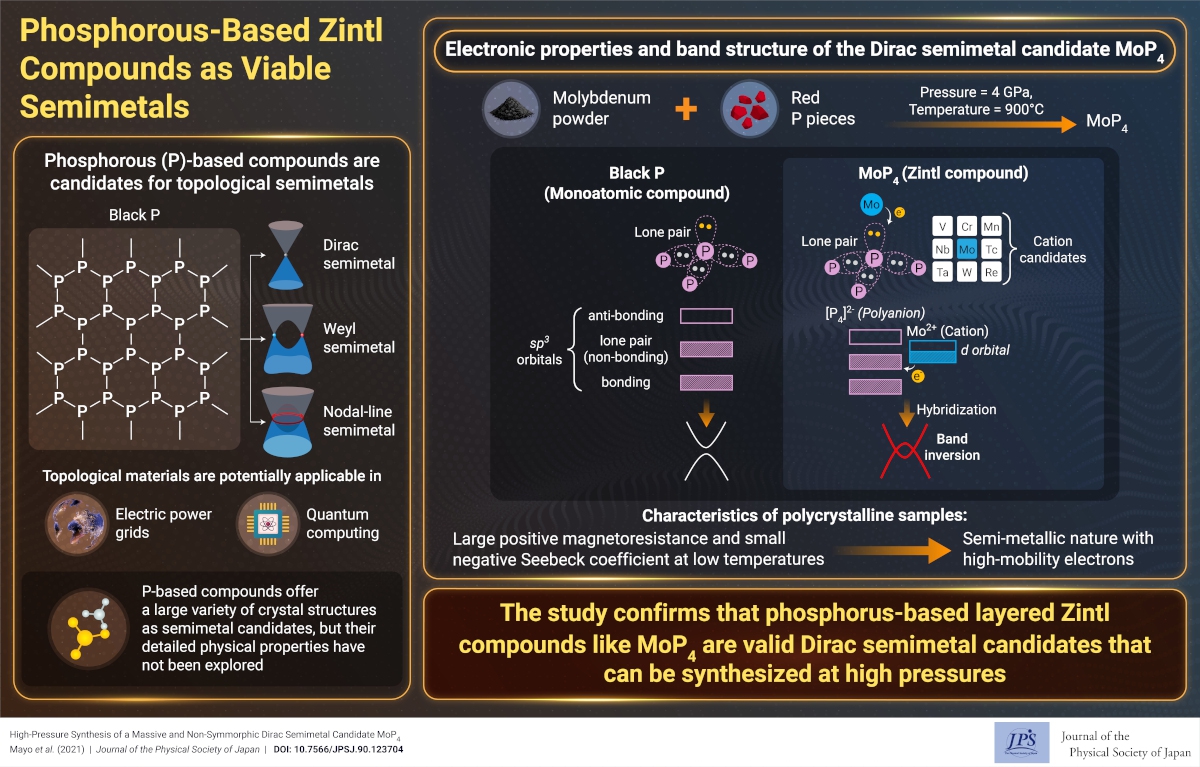
Topological materials, which have non-trivial geometrical properties in their band structures, have attracted attention owing to their exotic quantum transport phenomena and applications to ultrafast and low-power-consumption devices. Dirac electron systems, such as graphene, are a typical example. To exploit the quantum properties inherent in Dirac electronic materials and to advance their functionality, a system that facilitates chemical band engineering is desirable. However, the relationship between the momentum-space topological band structure and the real-space crystal structure is generally not self-evident, and an ideal system to explore such a relationship has yet to be reported.
To realize topological semimetal states, band inversion between the valence and conduction bands is required. To realize such band structures, the authors focused on phosphorus-based Zintl compounds. Zintl compounds are materials consisting of nonmetallic elements. They form covalent polyanion clusters, and metal cations; hence, the crystals have an intermediate character between ionic and covalent crystals. The key feature is that the octet rule is satisfied in the polyanion clusters by receiving electrons from the metal cations and forming lone electron pairs, thereby tending to yield semiconducting or semi-metallic electronic structures.
The authors have successfully performed high-pressure synthesis of single-crystal and polycrystalline MoP4, a Zintl compound with a layered structure derived from black phosphorus, and they found that this system is a promising platform for exploring new topological semimetals. In the high-quality polycrystalline sample, a non-quadratic large positive magnetoresistance was observed at low temperatures, and a sign change from positive to negative in the Seebeck coefficient was observed with decreasing temperature, suggesting that MoP4 is a semimetal with high mobility electron carriers. First principles calculations using refined single-crystal structure parameters revealed that a Dirac-semimetal-like band dispersion consisting of Mo-4d and phosphorus-3p orbitals is realized near the Fermi level and is responsible for the high mobility electron carriers.
This presents a general case that the topological electronic structure can be generated and controlled on a real-space basis through hybridization of the valence orbital of the metal cation inserted between the phosphorus polyanion layers and the p-orbital of phosphorus. Because MP4can encapsulate various transition metal ions other than Mo2+, such as Cr2+ and W2+, the design and development of phosphorus-based Dirac materials with various functions optimized via chemical substitution are expected to advance in the future.
Material design focusing on black phosphorus, a well-known high mobility semiconductor and Dirac semimetal candidate, is expected to be a promising guideline for the strategic development of topological materials based on structure-function relationships.
(Written by A. H. Mayo on behalf of all authors)
High-Pressure Synthesis of a Massive and Non-Symmorphic Dirac Semimetal Candidate MoP4
(JPSJ Editors' Choice)
J. Phys. Soc. Jpn.
90,
123704
(2021)
.
Share this topic


Fields
Related Articles
-
The Thermal Einstein–de Haas Effect: Theoretical Prediction and Observability in Chiral Carbon Nanotubes
Cross-disciplinary physics and related areas of science and technology
Structure and mechanical and thermal properties in condensed matter
2026-6-22
Although the Einstein–de Haas (EdH) effect describes material rotation in a magnetic field, a thermal EdH effect, driven by a temperature gradient, remains unobserved. Recently, chiral carbon nanotubes were theoretically proposed as promising candidates to observe it.
-
Negative Apparent Viscosity in Liquid Crystals
Cross-disciplinary physics and related areas of science and technology
Electromagnetism, optics, acoustics, heat transfer, and classical and fluid mechanics
Structure and mechanical and thermal properties in condensed matter
2026-6-8
Electrically driven liquid-crystal turbulence generates self-sustained flow and negative apparent viscosity. The fluorinated, chemically robust nematic PPDFB shows a substantially larger negative-viscosity effect than Schiff-base nematics.
-
Role of the Diffusion Layer in Energy Devices
Cross-disciplinary physics and related areas of science and technology
Structure and mechanical and thermal properties in condensed matter
2026-5-1
In many energy devices, electron transfer occurs between ions dissolved in the electrolyte and the electrodes. For keep current flowing, new ions must be supplied continuously to the electrode surface from the bulk region. The diffusion layer’s role in diffusive mass transfer was clarified using the rotating disk electrode method.
-
Enhancing Accuracy and Reliability Bayesian Framework for Analysis of AR-HAXPES of Hard X-ray Photoelectron Spectroscopy
Dielectric, optical, and other properties in condensed matter
Electronic structure and electrical properties of surfaces and nanostructures
Measurement, instrumentation, and techniques
2026-4-28
We present a Bayesian framework for angle-resolved hard X-ray photoelectron spectroscopy (AR-HAXPES), combining Replica Exchange Monte Carlo with hierarchical integration to objectively and precisely estimate thin-film thickness.
-
Unveiling the Nodal Topology of the Spin-Triplet Superconductor Candidate UTe2
Structure and mechanical and thermal properties in condensed matter
Superconductivity
2026-4-13
Using high-quality UTe2 (Tc = 2.1 K), we identify its nodal gap structure. Field-angle‑resolved specific‑heat reveals a b-axis singularity, supporting spin-triplet superconductivity with nodes along the b axis.