

Realizing Spin Liquids Experimentally with Kapellasite-type Quantum Kagome Antiferromagnet
© The Physical Society of Japan
This article is on
μSR Study of Kapellasite-type Quantum Kagome Antiferromagnet CaCu3(OH)6Cl2∙0.6H2O
(JPSJ Editors' Choice)
J. Phys. Soc. Jpn.
91,
013701
(2022)
.
This study reports the observation of the spin fluctuation in a quantum kagome antiferromagnet CaCu3(OH)6Cl2·0.6H2O which persists down to 82 mK using the μSR technique.
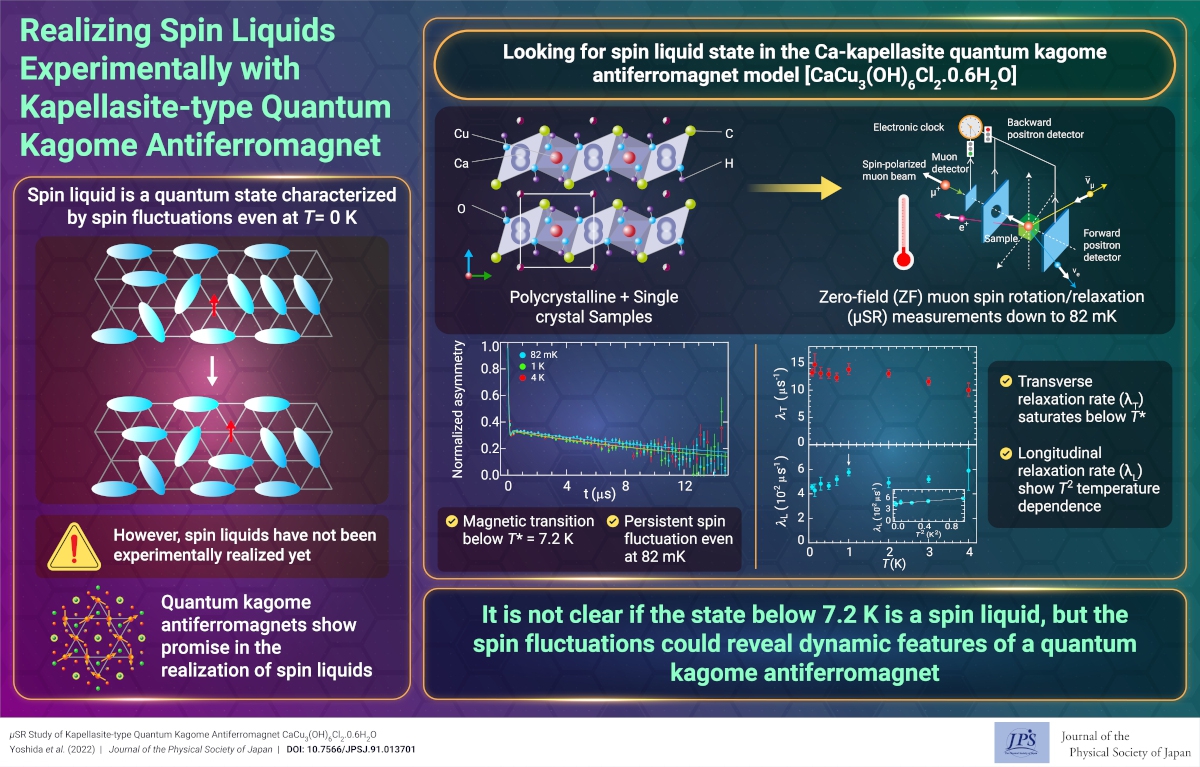
At ambient pressure, water has three states depending on the temperature; gaseous (water vapor), liquid (water), and solid (ice) states. Below 0 °C, water freezes to form ice which comprises crystals with molecules arranged periodically. Electron spins, which are responsible for the magnetism of materials, have similar thermodynamic properties. In general magnets, the paramagnetic (gaseous) state is stable at high temperatures in which the electron spins have random directions, whereas when the temperature is lowered, a phase transition occurs at a certain critical temperature to the magnetically ordered (solid) state in which the electron spins exhibit a periodical alignment. The magnetically ordered (solid) state is, for instance, a ferromagnetic state in which all the electron spins are aligned in one direction or an antiferromagnetic state in which all the neighboring spins point in opposite directions. By controlling and utilizing these magnetic states, modern electronics has progressed exponentially. Recently, the "magnetic frustration" effect, which prevents such electron spins from forming a solid state, has been actively investigated, and the realization and potential applications of the spin liquid state which is "a liquid state of electron spins" caused by the frustration effect have garnered significant interest.
In a spin liquid state, the spins continue to fluctuate without freezing even at absolute zero. The most famous model of the spin liquid state is the resonant valence bond (RVB) state proposed by Nobel laureate P.W. Anderson in 1973, and its relevance to the mechanism of high-temperature superconductivity and the feasibility of quantum computing using fractional excitations and associated quantum entanglement of the spin liquid state. Therefore, the realization and clarification of the spin liquid state is one of the most important issues in modern physics.
The authors have focused on Ca-Kapellasite (CaCu3(OH)6Cl2·0.6H2O) as a model material for a quantum kagome antiferromagnet, which has a strong frustration and is expected to be an excellent candidate for the spin liquid state. The spin dynamics of this material has been investigated in detail down to the extremely low temperature of 82 mK through the μSR technique. It has been elucidated from the magnetization measurements that Ca-Kapellasite exhibits magnetic order at 7.2 K. Therefore, it appears to be a magnetic material that can be described by the mean-field approximation of classical spin systems. However, the proposed μSR experiments revealed that the spins were fluctuating even in the magnetically ordered state. This indicates the dynamic aspect of the magnetic state of a quantum kagome antiferromagnet. It is expected that the development of chemically modified samples and related materials, as well as precise measurements of the physical properties, will significantly advance the understanding of the physics of kagome spin liquids.
(Written by H. K. Yoshida on behalf of all authors)
μSR Study of Kapellasite-type Quantum Kagome Antiferromagnet CaCu3(OH)6Cl2∙0.6H2O
(JPSJ Editors' Choice)
J. Phys. Soc. Jpn.
91,
013701
(2022)
.
Share this topic


Fields
Related Articles
-
Peculiar Magnet Pointing Against an Applied Magnetic Field
Cross-disciplinary physics and related areas of science and technology
Magnetic properties in condensed matter
2026-7-1
TbNiC2 exhibits negative magnetization. A new mechanism, based on the coupling between the charge density wave and the antiferromagnetic order, is proposed to account for this peculiar phenomenon.
-
Magnetic-Field Driven Switching of Multipolar Order in an f-Electron System
Magnetic properties in condensed matter
2026-5-22
This study investigates high-rank multipole physics in f-electron systems, providing the first clear experimental evidence for field-induced switching of ferro-quadrupole order in a non-Kramer ion system, along with a new conceptual framework
-
Toward Clarification of Physical Properties of Quasicrystals: Noncollinear Magnetic Orders in Icosahedral Approximants
Cross-disciplinary physics and related areas of science and technology
Electronic transport in condensed matter
Magnetic properties in condensed matter
2026-4-6
An effective model based on magnetic anisotropy arising from a crystalline electric field is constructed for icosahedral approximants, which not only explains measured ferromagnets and antiferromagnets but also reveals new types of noncollinear magnetic orders.
-
Definitive Momentum and Spin Imaging Resolves 20-Year Debate on Gold Surface Spin
Electronic structure and electrical properties of surfaces and nanostructures
Magnetic properties in condensed matter
2026-4-1
Researchers at the Institute for Molecular Science (IMS) have utilized a cutting-edge Photoelectron Momentum Microscope (PMM) at the UVSOR Synchrotron Facility to settle a two-decade-long controversy concerning the direction of electron spin on the Au(111) surface. This study provides a definitive, full-map, comprehensive reference for quantum imaging that is essential for advancing spintronics technology.
-
Topological Hall Effect in Praseodymium Diantimonide
Magnetic properties in condensed matter
2026-2-27
The discovery of the topological Hall effect in a praseodymium-based compound is significant because its magnetism is not limited to a simple spin-only configuration as in many previous rare-earth systems.