

Unlocking a 40-Year-Old Mystery: Full-gap Spin-Triplet Superconductivity Unveiled in UBe13
© The Physical Society of Japan
This article is on
NMR Evidence for Full-Gap Spin-Triplet Superconducting State in UBe13
(JPSJ Editors' Choice )
J. Phys. Soc. Jpn.
95,
074711
(2026)
.
Recent precise NMR measurements on the heavy-fermion superconductor UBe13 provided “smoking-gun” evidence for a fully-gapped spin-triplet superconducting state, opening a new chapter in the field.
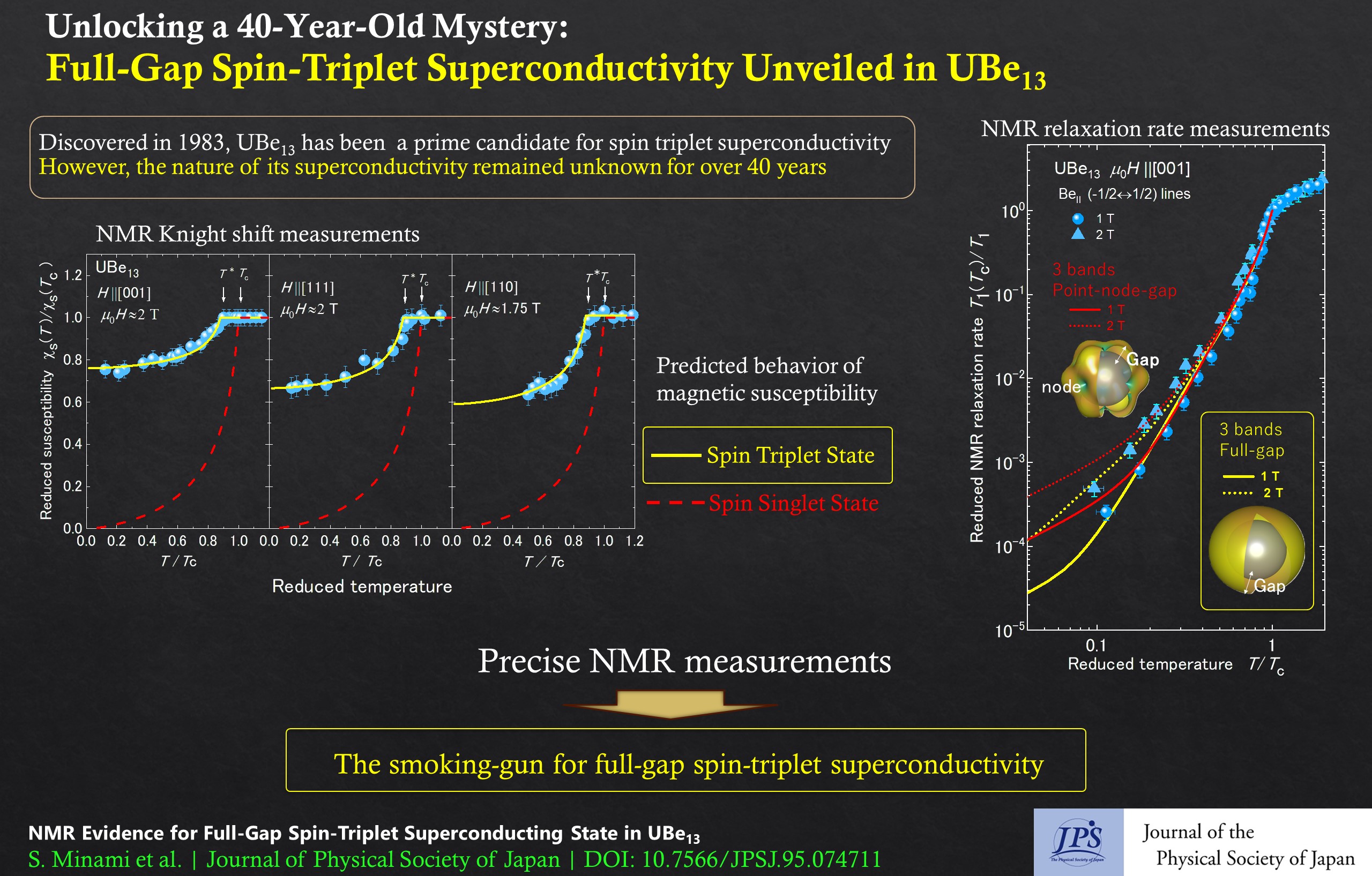
Superconductivity remains one of the most fascinating quantum phenomena in condensed-matter physics. At low temperatures, electrons overcome their mutual Coulomb repulsion to form pairs known as “Cooper pairs,” enabling them to flow with zero electrical resistance. According to conventional Bardeen–Cooper–Schrieffer (BCS) theory, these pairs consist of electrons with opposite spins (spin-singlet state). However, an exotic state was later proposed where electrons with the same spin direction pair up—a phenomenon called spin-triplet superconductivity. Discovered in 1983, the heavy-fermion compound UBe13 has long been considered a prime candidate for this triplet state. Yet, because of the extreme difficulty of growing high-quality single crystals and its anomalous normal- and superconducting-state behaviors, the exact nature of its superconductivity remained an unsolved mystery for over 40 years.
Definitively identifying a spin-triplet state requires measuring the magnetic susceptibility of the paired spins. However, standard macroscopic magnetization measurements fail because the immense Meissner effect—the diamagnetism caused by superconducting shielding currents—completely masks the subtle spin susceptibility. To overcome this experimental hurdle, nuclear magnetic resonance (NMR) was utilized. As a microscopic technique that uses the atomic nucleus as a local quantum probe, NMR suppresses the disruptive Meissner effect on a microscopic scale, enabling the intrinsic spin state of the Cooper pairs to be observed directly. Furthermore, measurements of the NMR relaxation rate enable the exact shape of the superconducting energy gap to be mapped out.
Through this sophisticated microscopic approach on high-quality UBe13 single crystals (Tc = 0.85 K), the spin susceptibility and the superconducting energy gap were investigated in detail. The reduction patterns of the spin susceptibility definitively proved the realization of a spin-triplet superconducting state. Furthermore, NMR relaxation rate measurements revealed that UBe13 possesses a highly unique multiband, nodeless (fully gapped) state. This means conducting electrons travel through multiple pathways (bands), and every single pathway features a complete energy barrier with no “loopholes” (nodes).
The combination of a spin-triplet state and a nodeless multiband gap defines an extremely rare phase called “topological spin-triplet superconductivity.” This state is theoretically predicted to host Majorana particles on the surface of the material. Because these particles are topologically protected against environmental noise and defects, they are highly sought after as ideal building blocks for fault-tolerant, next-generation quantum computers. This definitive proof in UBe13 is expected to ignite a new wave of breakthroughs in quantum materials research.
(Written by Hideki Tou on behalf of the authors.)
NMR Evidence for Full-Gap Spin-Triplet Superconducting State in UBe13
(JPSJ Editors' Choice )
J. Phys. Soc. Jpn.
95,
074711
(2026)
.
Share this topic


Fields
Related Articles
-
Revealing Electronic Quantum Behavior Masked by Nuclear Heat
Measurement, instrumentation, and techniques
Structure and mechanical and thermal properties in condensed matter
Superconductivity
2026-9-7
The initial slope method is used to reveal intrinsic electronic specific heat by eliminating the overwhelming nuclear contributions during low-temperature calorimetry, opening a new window into quantum materials.
-
Frustrated Sawtooth Yb Chain Yielding Ferromagnetic Order with Reduced Magnetic Moments
Magnetic properties in condensed matter
2026-9-1
The ytterbium-based semiconductor ZnYb2S4 exhibits ferromagnetic order with contracted Yb moments, representing a novel quantum ground state attributed to competing exchange interactions in an effective spin-1/2 frustrated sawtooth chain.
-
Peculiar Magnet Pointing Against an Applied Magnetic Field
Cross-disciplinary physics and related areas of science and technology
Magnetic properties in condensed matter
2026-7-1
TbNiC2 exhibits negative magnetization. A new mechanism, based on the coupling between the charge density wave and the antiferromagnetic order, is proposed to account for this peculiar phenomenon.
-
Magnetic-Field Driven Switching of Multipolar Order in an f-Electron System
Magnetic properties in condensed matter
2026-5-22
This study investigates high-rank multipole physics in f-electron systems, providing the first clear experimental evidence for field-induced switching of ferro-quadrupole order in a non-Kramer ion system, along with a new conceptual framework
-
Unveiling the Nodal Topology of the Spin-Triplet Superconductor Candidate UTe2
Structure and mechanical and thermal properties in condensed matter
Superconductivity
2026-4-13
Using high-quality UTe2 (Tc = 2.1 K), we identify its nodal gap structure. Field-angle‑resolved specific‑heat reveals a b-axis singularity, supporting spin-triplet superconductivity with nodes along the b axis.