

Rumors Spread Wider Despite Low Transmissibility
© The Physical Society of Japan
This article is on
The SIS Competition Model for Conflicting Rumors
J. Phys. Soc. Jpn.
95,
064801
(2026)
.
This study proposes an SIS competition model that integrates rumor spread and opinion changes. This analysis reveals novel mechanisms for conflicting rumor coexistence, thus demonstrating that rumors paradoxically survive through low transmissibility.
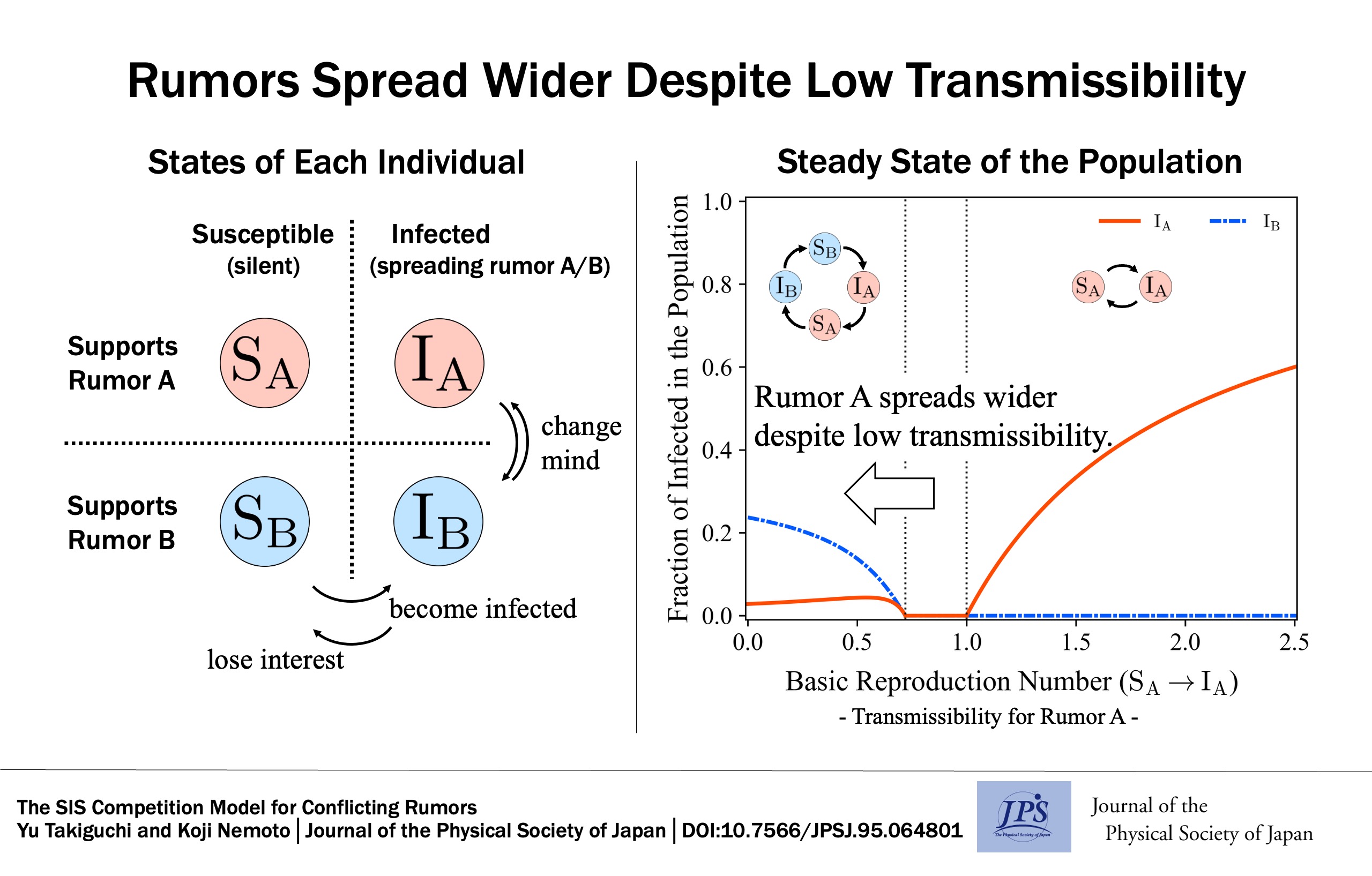
Under what conditions can fake news be eradicated using corrective information? What mechanisms allow for the coexistence of conflicting rumors? Addressing these questions is crucial. The spread of rumors has been conventionally investigated using epidemic models, whereas changes in opinions have been analyzed using opinion models. However, almost no frameworks integrate both.
To establish such a framework, the standard susceptible–infected–susceptible (SIS) model is first considered. In this baseline model, individuals are either “susceptible” (S, not spreading a rumor) or “infected” (I, actively spreading a rumor). A rumor—serving as an infectious disease—infects an S individual and causes a transition to I with a certain probability per unit time per I individual in a population. Meanwhile, an I individual loses interest and reverts to S with a certain probability per unit time. The fate of the outbreak is dictated by the basic reproduction number—the expected number of secondary infections generated by a single I in a completely susceptible population, which is determined solely by transition probabilities. A reproduction number < 1 causes the infection to shrink and die out, whereas a reproduction number > 1 causes exponential growth, thus resulting in a pandemic.
In this study, an SIS competition model is proposed to capture the dynamic interactions between rumor spread and opinion changes. The model introduces two conflicting rumors, A and B. Accordingly, individuals are classified into one of four states: SA, IA, SB, or IB. An SA individual supports rumor A but is not spreading it, whereas an IA individual supports rumor A and is actively spreading it. If an SA individual is infected by IB, they then change their opinion from A to B and become IB. Importantly, the infection probability of a rumor differs depending on the rumor currently supported by the individual; for example, the transition probability for SA → IA is different from that for SB → IA. Through such mechanisms, individuals change their opinions based on the rumors they hear; conversely, a rumor’s transmissibility changes depending on their opinions.
Linear stability analysis was performed to determine all the steady states and their local stabilities. Crucially, in the proposed model, rumor A can survive even if its reproduction number for SA → IA is less than 1. This is because new spreaders can emerge through SB → IA transitions. If the reproduction number for SA → IA is less than 1 but still relatively high, then rumor A depletes IB individuals. Because rumor A relies on rumor B to sustain its spread, eradicating IB causes IA individuals to become extinct. Therefore, rumor A can paradoxically survive and coexist because of its low transmissibility.
(Written by Yu Takiguchi on behalf of all authors.)
The SIS Competition Model for Conflicting Rumors
J. Phys. Soc. Jpn.
95,
064801
(2026)
.
Share this topic


Fields
Related Articles
-
Topological Defects as Seeds of Phase Separation: Insights from a Minimal Lattice Model
Cross-disciplinary physics and related areas of science and technology
Statistical physics and thermodynamics
2026-7-13
A minimal lattice model revealed that topological defects with winding number +1 serve as nucleation sites for phase separation in active matter systems.
-
A Deep Dive Into AI-Driven Materials Science
Cross-disciplinary physics and related areas of science and technology
2026-7-6
This review from the Journal of the Physical Society of Japan examines how artificial intelligence overcomes traditional materials science bottlenecks, highlighting the shift from intuition-based discovery to data-driven innovation.
-
Peculiar Magnet Pointing Against an Applied Magnetic Field
Cross-disciplinary physics and related areas of science and technology
Magnetic properties in condensed matter
2026-7-1
TbNiC2 exhibits negative magnetization. A new mechanism, based on the coupling between the charge density wave and the antiferromagnetic order, is proposed to account for this peculiar phenomenon.
-
The Thermal Einstein–de Haas Effect: Theoretical Prediction and Observability in Chiral Carbon Nanotubes
Cross-disciplinary physics and related areas of science and technology
Structure and mechanical and thermal properties in condensed matter
2026-6-22
Although the Einstein–de Haas (EdH) effect describes material rotation in a magnetic field, a thermal EdH effect, driven by a temperature gradient, remains unobserved. Recently, chiral carbon nanotubes were theoretically proposed as promising candidates to observe it.
-
Negative Apparent Viscosity in Liquid Crystals
Cross-disciplinary physics and related areas of science and technology
Electromagnetism, optics, acoustics, heat transfer, and classical and fluid mechanics
Structure and mechanical and thermal properties in condensed matter
2026-6-8
Electrically driven liquid-crystal turbulence generates self-sustained flow and negative apparent viscosity. The fluorinated, chemically robust nematic PPDFB shows a substantially larger negative-viscosity effect than Schiff-base nematics.