

Topological Aspects of a Nonlinear System: The Dimerized Toda Lattice
© The Physical Society of Japan
This article is on
Topological Edge States and Bulk-edge Correspondence in Dimerized Toda Lattice
(JPSJ Editors' Choice)
J. Phys. Soc. Jpn.
91,
024703
(2022)
.
A nonlinear topological phase is shown to emerge in the dimerized Toda lattice. It is experimentally detectable by measuring the voltage propagation in electric circuits.
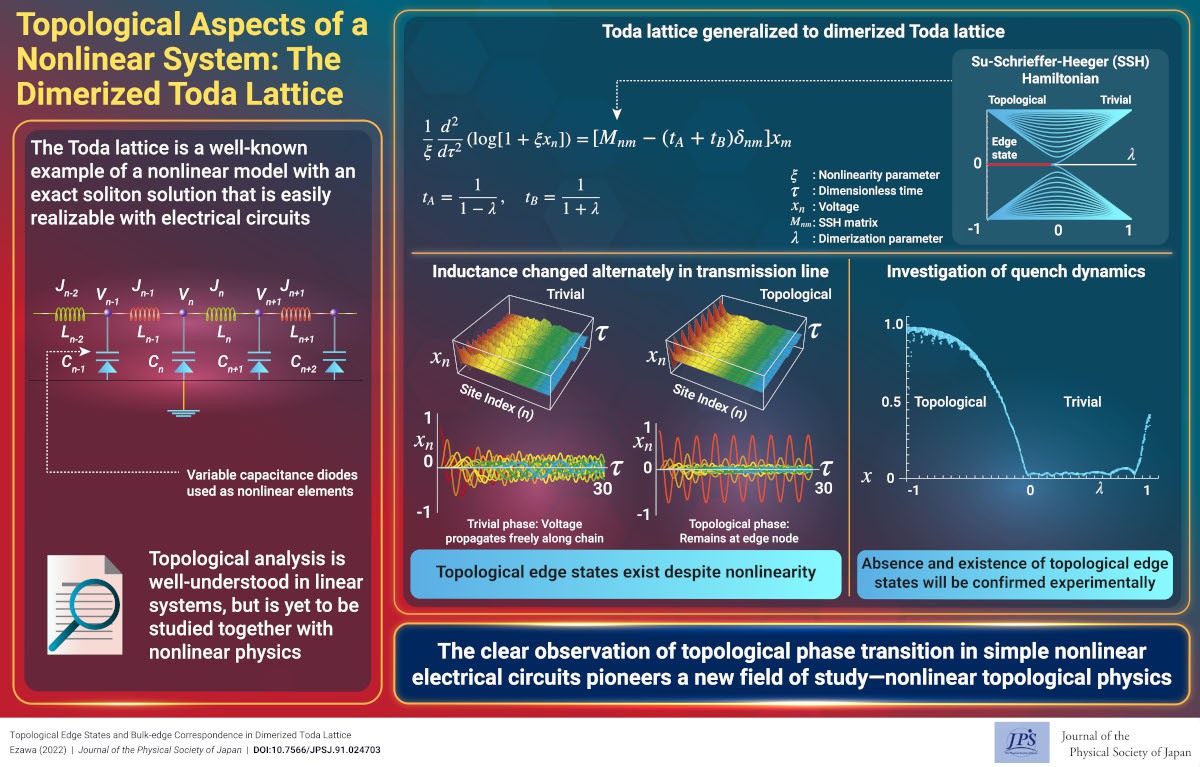
Nonlinear physics is an extensively studied field that is highlighted by the emergence of solitons and chaos. A soliton is a solitary wave that is stabilized by the nonlinear term. It is originally proposed in the surface wave of water and then found in various systems. The Toda lattice is a typical nonlinear model possessing an exact soliton solution. It is experimentally realized in a transmission line consisting of inductors and variable-capacitance diodes, where the variable-capacitance diodes provide the nonlinear elements. A stable voltage propagation was observed in this transmission line. In contrast, the topological physics is an emerging field, where characteristic topological edge states emerge in the topological phase. The Su–Schrieffer–Heeger (SSH) model is the simplest example of a topological insulator, where the bonds are alternating. To date, nonlinear and topological physics were studied independently. It is an interesting problem to study a nonlinear topological physics, which will open a new field of physics.
We generalize the Toda lattice to a dimerized Toda lattice as in the case of the SSH model. We show that this model is realized by changing the inductance alternately in the transmission line realizing the Toda lattice. This model has topological edge states although it is a nonlinear model. We verify it by investigating the quench dynamics, where we apply a voltage at the edge node and explore its time evolution. The voltage propagates freely along the chain in the trivial phase, whereas it remains at the edge node in the topological phase. Hence, the absence and the existence of the topological edge states are well signaled by the voltage propagation dynamics. Thus, nonlinear topological physics will be relatively easily realized and studied experimentally in electric circuits. This result will open a new field of nonlinear topological physics.
(Written by M. Ezawa)
Topological Edge States and Bulk-edge Correspondence in Dimerized Toda Lattice
(JPSJ Editors' Choice)
J. Phys. Soc. Jpn.
91,
024703
(2022)
.
Share this topic


Fields
Related Articles
-
Enhancing Accuracy and Reliability Bayesian Framework for Analysis of AR-HAXPES of Hard X-ray Photoelectron Spectroscopy
Dielectric, optical, and other properties in condensed matter
Electronic structure and electrical properties of surfaces and nanostructures
Measurement, instrumentation, and techniques
2026-4-28
We present a Bayesian framework for angle-resolved hard X-ray photoelectron spectroscopy (AR-HAXPES), combining Replica Exchange Monte Carlo with hierarchical integration to objectively and precisely estimate thin-film thickness.
-
What Shapes Electron Distributions in Nonequilibrium Nanowires?
Electronic transport in condensed matter
2026-4-20
A theoretical framework was developed to describe nonequilibrium electron distributions across the ballistic, diffusive, and local equilibrium transport regimes in voltage-biased nanowires in a unified manner.
-
Toward Clarification of Physical Properties of Quasicrystals: Noncollinear Magnetic Orders in Icosahedral Approximants
Cross-disciplinary physics and related areas of science and technology
Electronic transport in condensed matter
Magnetic properties in condensed matter
2026-4-6
An effective model based on magnetic anisotropy arising from a crystalline electric field is constructed for icosahedral approximants, which not only explains measured ferromagnets and antiferromagnets but also reveals new types of noncollinear magnetic orders.
-
Definitive Momentum and Spin Imaging Resolves 20-Year Debate on Gold Surface Spin
Electronic structure and electrical properties of surfaces and nanostructures
Magnetic properties in condensed matter
2026-4-1
Researchers at the Institute for Molecular Science (IMS) have utilized a cutting-edge Photoelectron Momentum Microscope (PMM) at the UVSOR Synchrotron Facility to settle a two-decade-long controversy concerning the direction of electron spin on the Au(111) surface. This study provides a definitive, full-map, comprehensive reference for quantum imaging that is essential for advancing spintronics technology.
-
Oxide Superionic Conductivity of a-Axis-Oriented Ce0.75Sm0.25O2−δ Thin Film
Electronic structure and electrical properties of surfaces and nanostructures
2026-2-2
Highly a-axis oriented Ce0.75Sm0.25O2-δ thin film fabricated on a yttria-stabilized zirconia substrate achieved oxide superionic conductivity, which can apply as an electrolyte in solid oxide fuel cells operating at medium temperature.