

Unusual Nonlinear Conductivity in Charge-Ordered α-(BEDT-TTF)2I3
© The Physical Society of Japan
This article is on
Third-order Electrical Conductivity of the Charge-Ordered Organic Salt Alpha-(BEDT-TTF)2I3
J. Phys. Soc. Jpn.
91,
023703
(2022)
.
Unusual nonlinear conduction is detected in organic molecular salt α-(BEDT-TTF)2I3. The observed third-order nonlinear conductivity implies a quadrupole instability hidden in this charge-ordered organic salt.
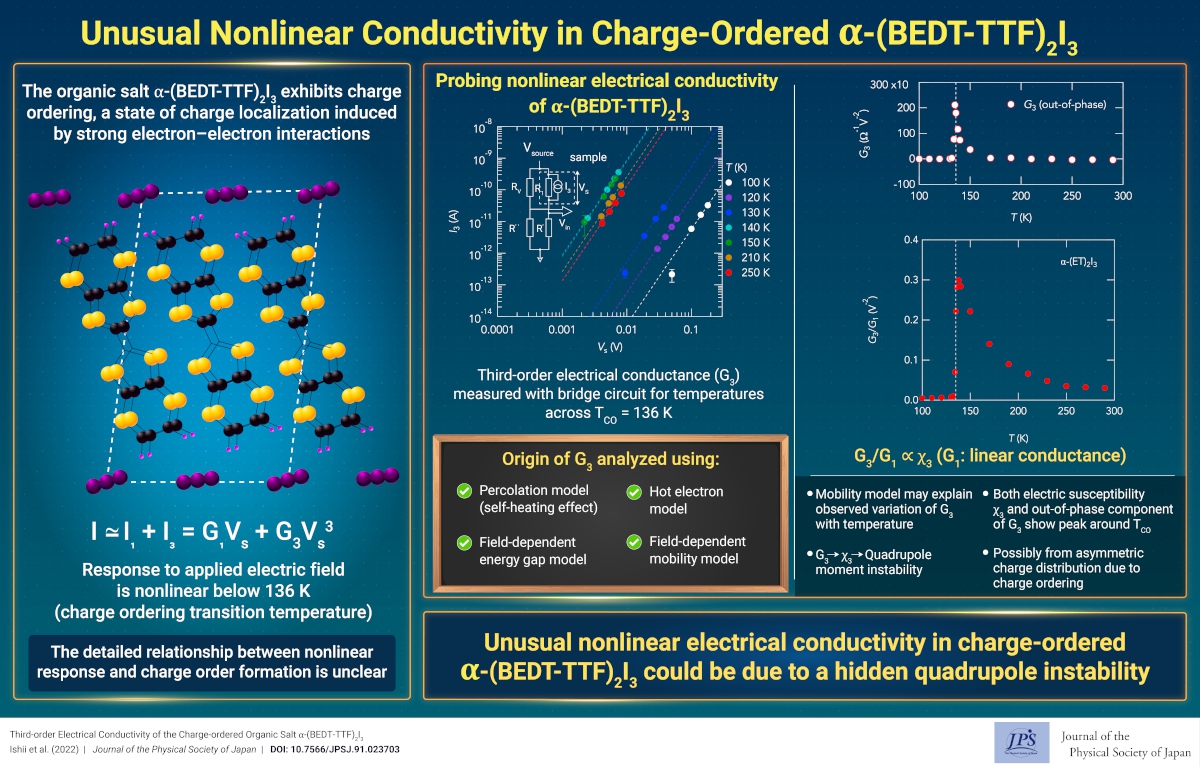
When voltage V is applied to the sample, electrical current I proportional to the voltage flows as V = R × I or I = G × V, where Rand G (= 1/R) denote the resistance and conductance, respectively. This is the well-known Ohm’s law, also called as the linear conduction because of a linear relationship between current I and voltage V.
In contrast, several materials show nonlinear conduction, in which current I is not proportional to voltage V. The representatives are the nonlinear semiconductor devices such as diodes and transistors, as widely used in modern electronics. Recently, nonlinear conduction has also been observed in various correlated insulators, and it becomes a challenging issue to clarify the underlying mechanism of the nonlinearity.
A peculiar class of the organic-molecular-based compounds hosts an emergent electron crystal called “charge order,” in which the electrons are arranged periodically owing to the Coulomb repulsion. It provides a fascinating playground to study the nonlinear conduction because such a charge crystal may be highly sensitive to the external electric field as the normal crystal is affected by the external mechanical force. Indeed, organic salt α-(ET)2I3, in which the charge order emerges at TCO = 136 K, exhibits interesting nonlinear transport such as a collective sliding motion of charge order above the threshold field.
In the present study, the authors aim to examine the low-field nonlinear response of charge-ordered salt α-(ET)2I3by a harmonic conductivity experiment. Generally, the nonlinear conduction can be expressed as a Taylor series of current I as I = G1V+ G2V2 + G3V3…, where Gidenotes the ith-order conductance. The first term on the right-hand side is the Ohmic term. In this experiment, a bridge circuit technique was utilized to accurately detect third-order conductance G3.
The authors note that the third-order conductance of α-(ET)2I3is critically enhanced near the charge order transition temperature. As the origin, a close relation between the third-order conductance and the third-order electric susceptibility has been discussed. Thermodynamically, the third-order susceptibility may relate to a quadrupole moment; thus, the present results imply a quadrupole instability hidden in the charge-ordered organic salt.
Although the crystal structure of molecular-based compounds appears very complicating at the first glance, it is greatly simplified by regarding the complicated molecule as a point-like charge (electric monopole). The present results indicate that the asymmetric charge distribution in the molecule unit with a higher-order quadrupole moment is essential to thoroughly understand various intriguing properties of molecular solids.
(Written by R. Okazaki on behalf of all authors)
Third-order Electrical Conductivity of the Charge-Ordered Organic Salt Alpha-(BEDT-TTF)2I3
J. Phys. Soc. Jpn.
91,
023703
(2022)
.
Share this topic


Fields
Related Articles
-
What Shapes Electron Distributions in Nonequilibrium Nanowires?
Electronic transport in condensed matter
2026-4-20
A theoretical framework was developed to describe nonequilibrium electron distributions across the ballistic, diffusive, and local equilibrium transport regimes in voltage-biased nanowires in a unified manner.
-
Toward Clarification of Physical Properties of Quasicrystals: Noncollinear Magnetic Orders in Icosahedral Approximants
Cross-disciplinary physics and related areas of science and technology
Electronic transport in condensed matter
Magnetic properties in condensed matter
2026-4-6
An effective model based on magnetic anisotropy arising from a crystalline electric field is constructed for icosahedral approximants, which not only explains measured ferromagnets and antiferromagnets but also reveals new types of noncollinear magnetic orders.
-
The Physics of Light-Spin Interactions: Advances in Photodriven Quantum Spin Systems
Dielectric, optical, and other properties in condensed matter
Electromagnetism, optics, acoustics, heat transfer, and classical and fluid mechanics
Electronic transport in condensed matter
Magnetic properties in condensed matter
Statistical physics and thermodynamics
2025-12-17
This Special Topics edition of the Journal of the Physical Society of Japan discusses the recent progress and future directions for the rapidly progressing field of photodriven quantum spin systems.
-
Role of Orbital Currents in Future Solid-State Devices
Electronic transport in condensed matter
2025-10-6
This review explores recent experimental advances in the emerging field of orbitronics, focusing on orbital current mechanisms and orbitronic phenomena, providing key research directions for developing energy-efficient memory devices.
-
Carrier Scattering by Antisite Defects Reverses Thermoelectric Polarity in Fe₂VAl
Electronic transport in condensed matter
Structure and mechanical and thermal properties in condensed matter
2025-10-2
Antisite defects in Fe₂VAl create resonance states that boost hole scattering, which shifts carrier dominance to electrons and reverses thermoelectric polarity, thereby offering a new path for material design.