

Economic Irreversibility: The Universal Guiding Principle of Infection Control
© The Physical Society of Japan
This article is on
J. Phys. Soc. Jpn.
90,
114007
(2021)
.
It is preferable to avoid lockdowns, as lockdowns at seriously spread phases are very expensive. It would be economically better to utilize less intense countermeasures as early as possible to avoid lockdowns in later phases.
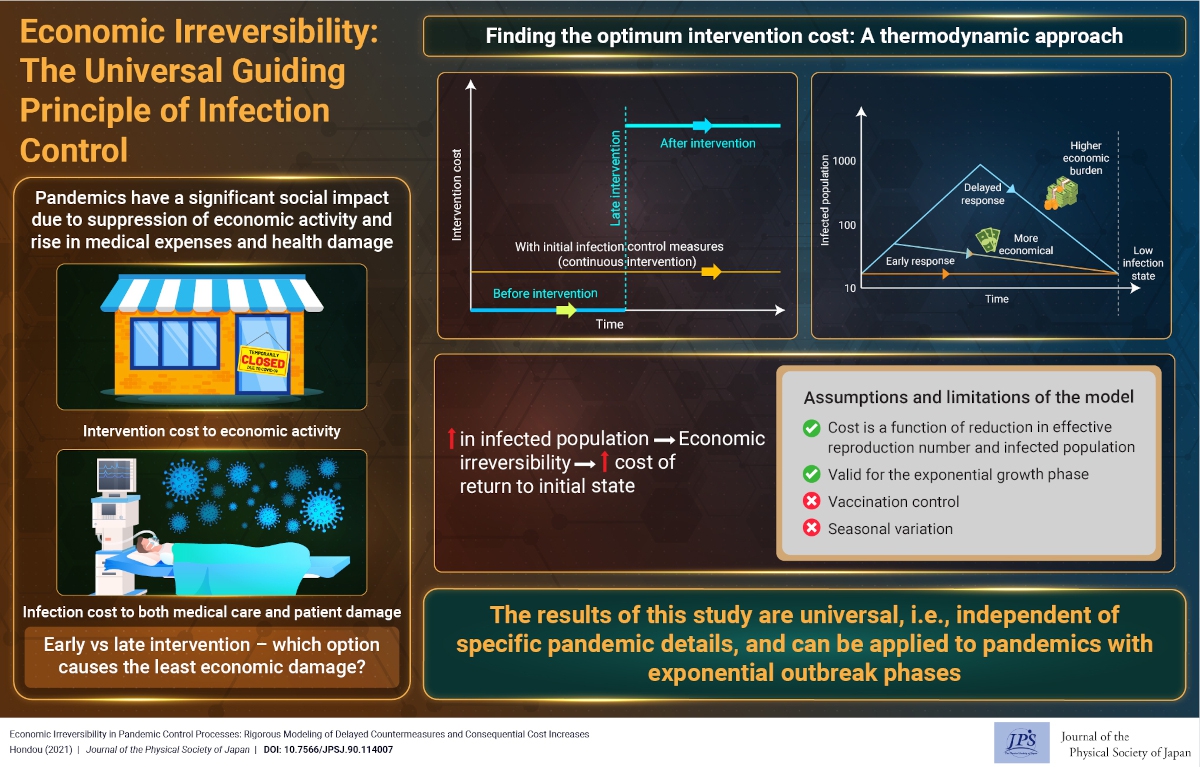
Since the early 2020, governments across the globe have grappled with preventing the spread of COVID-19 and mitigating the economic impacts of this deadly virus. Several debates have raged over the methods to balance stringent infection control while maintaining a sense of economic normalcy.
In this study, theories of thermodynamics have been used to generate a new concept termed as "economic irreversibility." It contends that delaying infection control measures is additionally expensive in the long run.
Although, certain economists have utilized a cost-benefit analysis to argue for timely intervention, its universal applicability remains questionable. This is because previous studies have been performed using numerical simulations that include investigating specific situations with given parameters the results of which depend on the socio-economic conditions and on the characteristics of the infectious agents.
To further develop a universal guiding principle to control pandemics, the author’s experience in thermodynamics is utilized.
A cost-benefit analysis is an optimization problem similar to exploring more efficient thermal cycles in thermodynamics. The benefit and cost are the reduction in infections, and the economic damage caused by the countermeasure, respectively. The efficiency of the countermeasure processes are theoretically compared with the same period in which the initial and the final infection status (the number of infected persons) remain the same.
The application of economic irreversibility showed that the delay in infection control results in increased costs and contradicts the idea that infection control translates into economic damage. In terms of thermodynamics, it can be said that early countermeasures render the situation more reversible.
Furthermore, this study did not require adjusting for different infectious diseases or socio-economic conditions, making it applicable on a wider scale. It can be applied to the current COVID-19 pandemic or probable future ones, regardless of whether “herd immunity” exists or not. To the best of the author’s knowledge, this is the first analytical study of the economic efficiency during pandemic control.
The validity of the present study is subject to the assumptions of the methodology. In this study, two principal assumptions have been made:
1. | The intervention cost depends on the effective reproduction number, and its cost function is concave as to the effective reproduction number. |
2. | The epidemic is in the infection-spreading phase and thus the infected population increases and decreases while obeying exponential dynamics. |
It is assumed that countermeasures are utilized in order corresponding to their cost-effectiveness. Moreover, exponential dynamics is a common feature of pandemics. Thus, the results are not restricted to a specific model; however, they demonstrate the basic underlying characteristics of pandemic countermeasures.
(Written by T. Hondou)
J. Phys. Soc. Jpn.
90,
114007
(2021)
.
Share this topic


Fields
Related Articles
-
Giant Brute-Force Simulation to Reveal Nucleation and Growth of Ultrasonic Cavitation Bubbles
Electromagnetism, optics, acoustics, heat transfer, and classical and fluid mechanics
Statistical physics and thermodynamics
2026-7-27
This study reveals the early-stage dynamics of ultrasonic cavitation using a record 100-billion-atom simulation to capture bubble nucleation, growth, clustering, and periodic splitting under nonequilibrium conditions.
-
Monitored Quantum Systems and Quantum Trajectories
General and Mathematical Physics
Mathematical methods, classical and quantum physics, relativity, gravitation, numerical simulation, computational modeling
Statistical physics and thermodynamics
2026-7-21
This review in Progress of Theoretical and Experimental Physics introduces monitored quantum systems and quantum trajectories, emphasizing their spectral properties, typical behaviors such as ergodicity and purification, and measurement-induced phases.
-
Topological Defects as Seeds of Phase Separation: Insights from a Minimal Lattice Model
Cross-disciplinary physics and related areas of science and technology
Statistical physics and thermodynamics
2026-7-13
A minimal lattice model revealed that topological defects with winding number +1 serve as nucleation sites for phase separation in active matter systems.
-
A Deep Dive Into AI-Driven Materials Science
Cross-disciplinary physics and related areas of science and technology
2026-7-6
This review from the Journal of the Physical Society of Japan examines how artificial intelligence overcomes traditional materials science bottlenecks, highlighting the shift from intuition-based discovery to data-driven innovation.
-
Peculiar Magnet Pointing Against an Applied Magnetic Field
Cross-disciplinary physics and related areas of science and technology
Magnetic properties in condensed matter
2026-7-1
TbNiC2 exhibits negative magnetization. A new mechanism, based on the coupling between the charge density wave and the antiferromagnetic order, is proposed to account for this peculiar phenomenon.