

Large Thermoelectric Effect in High Mobility Semimetals
© The Physical Society of Japan
This article is on
J. Phys. Soc. Jpn.
93,
103703
(2024)
.
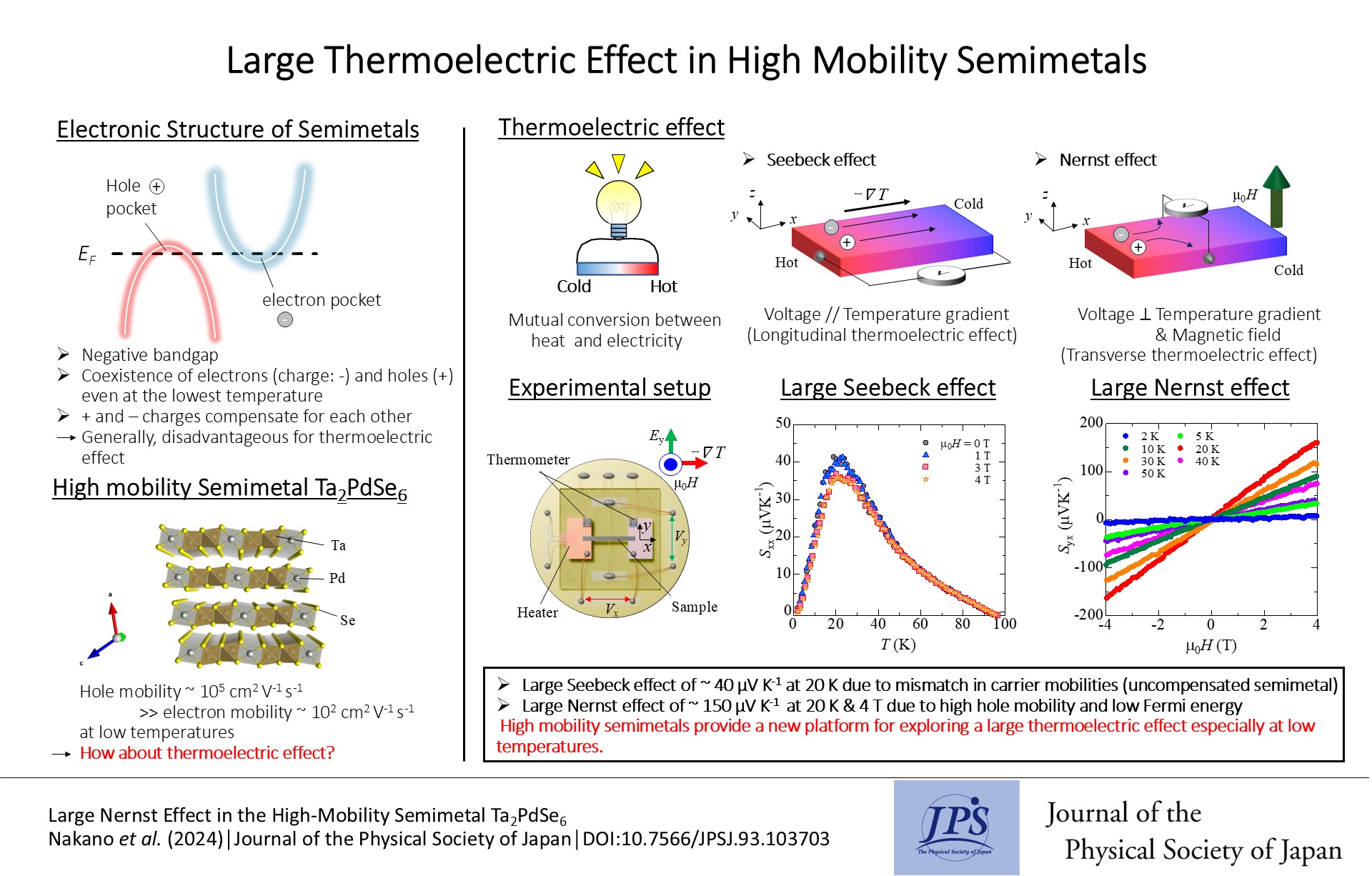
Semimetals are a class of materials characterized by a slight overlap between their conduction and valence bands. Owing to the band structure, the same number of electrons and holes coexist in an ideal semimetal, even at the lowest temperature, giving rise to exotic transport phenomena such as nonsaturating large magnetoresistance. On the other hand, it has been considered that semimetals are disadvantageous for the thermoelectric effect, that is, the mutual conversion between heat and electricity via conducting electrons, because the thermoelectric voltages originating from an electron and hole compensate for each other. Is there a way to avoid such compensation?
One method is to make the carrier mobilities of the electrons and holes asymmetric. Because mobility provides the velocity of a carrier accelerated by a certain electric field, if electrons and holes have completely different mobilities, compensation in the longitudinal thermoelectric effect (Seebeck effect) is expected to be suppressed. Another method involves the use of a magnetic field. Although electrons and holes diffuse along the same direction in the Seebeck effect, a magnetic field bends the diffusion in the opposite direction for electrons and holes; thus, the transverse thermoelectric effect (Nernst effect) can avoid compensation.
In this study, we investigate the thermoelectric effect of the high-mobility semimetal Ta2PdSe6. The holes in Ta2PdSe6 are known to have a significantly high mobility of approximately 105 cm2 V-1 s-1, and the value is two orders of magnitude higher than that of electrons. In other words, Ta2PdSe6 satisfies the uncompensated condition for the Seebeck effect, and falls in the category of uncompensated semimetals. Furthermore, we can also expect a large Nernst effect because it is roughly proportional to the carrier mobility.
Single crystals of Ta2PdSe6, investigated in this study,exhibited large Seebeck and Nernst effects as expected, with the Seebeck coefficient of 40 μV K-1 at 20 K and the Nernst coefficient of 150 μV K-1 at 20 K and 4 T. Each value is topclass among thermoelectric materials reported thus far in the cryogenic temperature range. This demonstrates that semimetals with the significant mismatch of charge carrier (electron and hole) mobilities exhibit superior thermoelectric properties. Furthermore, we qualitatively explained the origin of the large Nernst coefficient in Ta2PdSe6 using the single-band semi-classical transport theory. The insights gained from this study on the thermoelectric effects in uncompensated semimetal Ta2PdSe6 are expected to stimulate further exploration of many other thermoelectric semimetals with high carrier mobilities.
(Written by A. Nakano on behalf of all authors)
J. Phys. Soc. Jpn.
93,
103703
(2024)
.
Share this topic


Fields
Related Articles
-
What Shapes Electron Distributions in Nonequilibrium Nanowires?
Electronic transport in condensed matter
2026-4-20
A theoretical framework was developed to describe nonequilibrium electron distributions across the ballistic, diffusive, and local equilibrium transport regimes in voltage-biased nanowires in a unified manner.
-
Toward Clarification of Physical Properties of Quasicrystals: Noncollinear Magnetic Orders in Icosahedral Approximants
Cross-disciplinary physics and related areas of science and technology
Electronic transport in condensed matter
Magnetic properties in condensed matter
2026-4-6
An effective model based on magnetic anisotropy arising from a crystalline electric field is constructed for icosahedral approximants, which not only explains measured ferromagnets and antiferromagnets but also reveals new types of noncollinear magnetic orders.
-
The Physics of Light-Spin Interactions: Advances in Photodriven Quantum Spin Systems
Dielectric, optical, and other properties in condensed matter
Electromagnetism, optics, acoustics, heat transfer, and classical and fluid mechanics
Electronic transport in condensed matter
Magnetic properties in condensed matter
Statistical physics and thermodynamics
2025-12-17
This Special Topics edition of the Journal of the Physical Society of Japan discusses the recent progress and future directions for the rapidly progressing field of photodriven quantum spin systems.
-
Role of Orbital Currents in Future Solid-State Devices
Electronic transport in condensed matter
2025-10-6
This review explores recent experimental advances in the emerging field of orbitronics, focusing on orbital current mechanisms and orbitronic phenomena, providing key research directions for developing energy-efficient memory devices.
-
Carrier Scattering by Antisite Defects Reverses Thermoelectric Polarity in Fe₂VAl
Electronic transport in condensed matter
Structure and mechanical and thermal properties in condensed matter
2025-10-2
Antisite defects in Fe₂VAl create resonance states that boost hole scattering, which shifts carrier dominance to electrons and reverses thermoelectric polarity, thereby offering a new path for material design.