

A New Method for Probing Hidden Multipoles in Crystal Field Quartet Using Ultrasonic Waves
© The Physical Society of Japan
This article is on
Theory of Magnetoacoustic Resonance to Probe Multipole Effects Due to a Crystal Field Quartet
(JPSJ Editors' Choice)
J. Phys. Soc. Jpn.
93,
114701
(2024)
.
A new method of acoustically driven resonance is proposed to unveil the multipole degrees of freedom of a crystal-field quartet and demonstrate the realization of spin acoustic control.
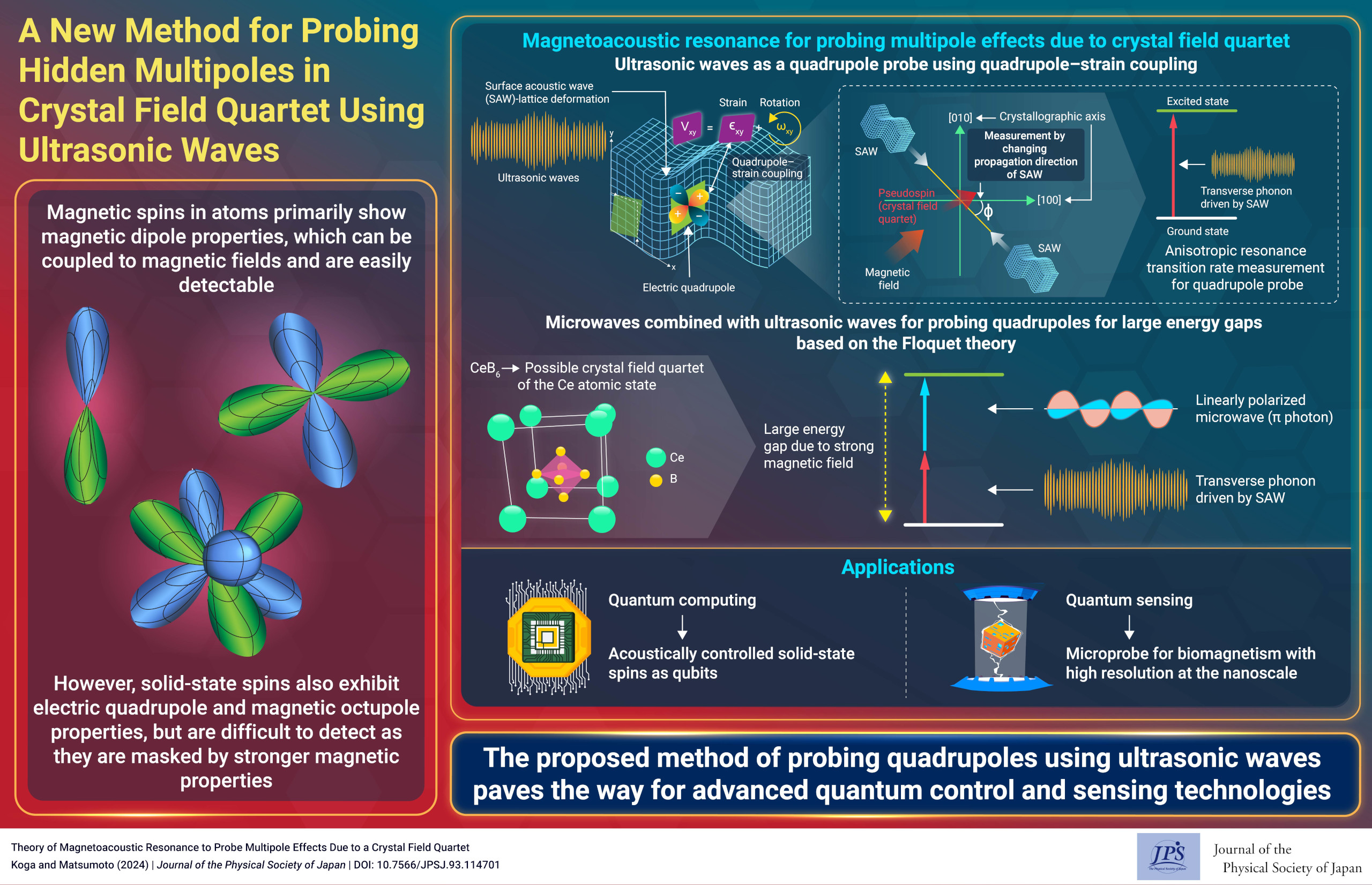
Magnetic atoms primarily exhibit the properties of magnetic dipoles. In addition to magnetic dipoles general, solid-state spins have electric quadrupoles and magnetic octupoles known as typical multipole degrees of freedom. Magnetic dipoles can be coupled to a magnetic field and are easily detectable. However, directly observing the characteristics of multipoles is challenging because of the practical limitations of external fields coupled with multipoles. Because a quadrupole can be coupled to strain fields induced by lattice deformations, we present a new magnetoacoustic resonance method for analyzing the multipoles of solid-state spins using an ultrasonic wave propagating on the surface layer of the lattice. Recent developments in acoustic measurements have increased the importance of fundamental theory for the direct observation of quadrupole characteristics using magnetoacoustic resonance.
In this study, we focus on the rich multipole physics of CeB6, which may have originated from a crystal-field quartet of the Ce atomic state. A method to directly analyze multipoles is desirable. Ce quadrupoles can be coupled to strain fields driven by ultrasonic waves, and CeB6 is a favorable candidate for testing our method. Using solely ultrasonic waves renders it difficult to realize high-frequency measurements, which are necessary in the case of CeB6, owing to technical limitations arising from the increase in frequency. This challenging problem can be solved by combining acoustic and optical measurements, i.e., using microwaves with ultrasonic waves simultaneously, because the microwave frequencies can be increased sufficiently for experiments under relatively high magnetic fields. This method is inspired by the analogy of two-photon absorption transition using electromagnetic waves with two different frequencies.
Our method of using quadrupoles coupled with ultrasonic waves may result in the use of acoustically operating solid-state spins as qubits for quantum computers and can be used in various applications of quantum information technology. Additionally, this innovation in acoustic control may complement conventional methods of optical control. Another important application is quantum sensing, such as biomagnetism microprobes with high resolution at the nanoscale.
(Written by Mikito Koga on behalf of all authors)
Theory of Magnetoacoustic Resonance to Probe Multipole Effects Due to a Crystal Field Quartet
(JPSJ Editors' Choice)
J. Phys. Soc. Jpn.
93,
114701
(2024)
.
Share this topic


Fields
Related Articles
-
Magnetic-Field Driven Switching of Multipolar Order in an f-Electron System
Magnetic properties in condensed matter
2026-5-22
This study investigates high-rank multipole physics in f-electron systems, providing the first clear experimental evidence for field-induced switching of ferro-quadrupole order in a non-Kramer ion system, along with a new conceptual framework
-
Toward Clarification of Physical Properties of Quasicrystals: Noncollinear Magnetic Orders in Icosahedral Approximants
Cross-disciplinary physics and related areas of science and technology
Electronic transport in condensed matter
Magnetic properties in condensed matter
2026-4-6
An effective model based on magnetic anisotropy arising from a crystalline electric field is constructed for icosahedral approximants, which not only explains measured ferromagnets and antiferromagnets but also reveals new types of noncollinear magnetic orders.
-
Definitive Momentum and Spin Imaging Resolves 20-Year Debate on Gold Surface Spin
Electronic structure and electrical properties of surfaces and nanostructures
Magnetic properties in condensed matter
2026-4-1
Researchers at the Institute for Molecular Science (IMS) have utilized a cutting-edge Photoelectron Momentum Microscope (PMM) at the UVSOR Synchrotron Facility to settle a two-decade-long controversy concerning the direction of electron spin on the Au(111) surface. This study provides a definitive, full-map, comprehensive reference for quantum imaging that is essential for advancing spintronics technology.
-
Topological Hall Effect in Praseodymium Diantimonide
Magnetic properties in condensed matter
2026-2-27
The discovery of the topological Hall effect in a praseodymium-based compound is significant because its magnetism is not limited to a simple spin-only configuration as in many previous rare-earth systems.
-
A Novel Type of Magnetic Band Splitting in a Fe Spin Ladder System
Dielectric, optical, and other properties in condensed matter
Magnetic properties in condensed matter
Superconductivity
2026-1-22
An investigation of a Fe spin ladder system using angle-resolved photoemission spectroscopy revealed a novel type of magnetic band splitting resembling that in altermagnets.