

Towards Next Generation Magnetic Storage: Magnetic Skyrmions in EuPtSi
© The Physical Society of Japan
This article is on
Unique Helical Magnetic Order and Field-Induced Phase in Trillium Lattice Antiferromagnet EuPtSi
(The 29th Outstanding Paper Award of the Physical Society of Japan)
J. Phys. Soc. Jpn.
88,
013702
(2019)
.
This study explores the magnetic behavior of rare-earth magnet EuPtSi using single-crystal neutron diffraction, potentially revealing magnetic skyrmion lattice formation.
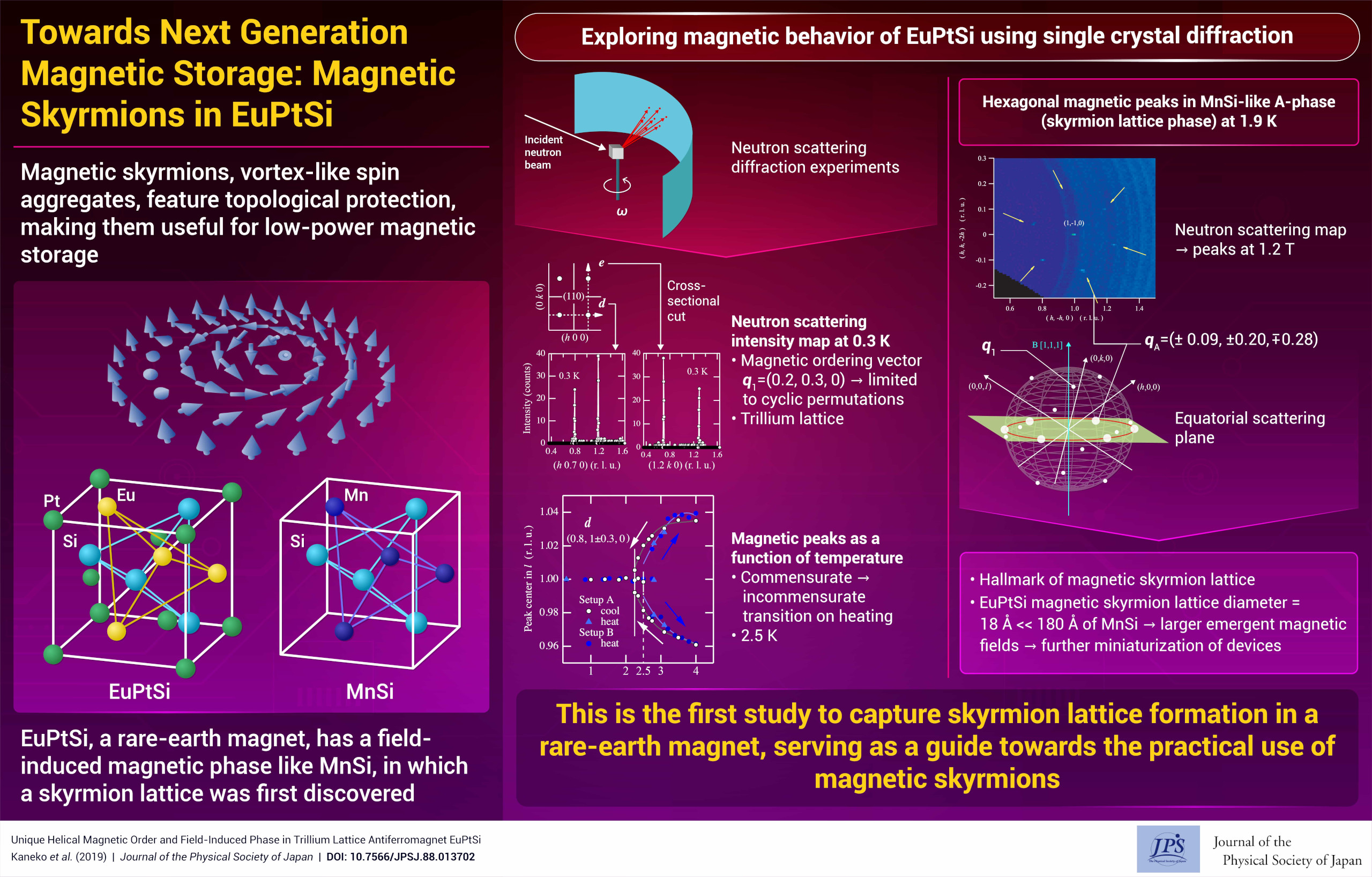
Magnetic skyrmions are nanoscale, vortex-like collections of magnetic moments that appear in some magnetic materials. These are arranged in a stable, swirling pattern, forming a topologically protected structure, meaning that they cannot be easily destroyed or transformed. This stability, and the ability to be driven by ultra-low currents, make magnetic skyrmions promising for next-generation ultra-low power magnetic storage devices.
In 2009, small skyrmion lattices were first discovered in the 3d electron system of Manganese monosilicide (MnSi) under magnetic fields, demonstrating a topological Hall effect. This discovery spurred intensive research on skyrmions, leading to the discovery of similar phenomena in other 3d electron systems.
Europium-platinum-silicon (EuPtSi), an intermetallic compound, is characterized by a non-centrosymmetric cubic structure known as a trillium lattice, somewhat similar to MnSi’s structure. In 2018, a field-induced state was found in a limited region of the phase diagram of EuPtSi, resembling the A phase of MnSi, which hosts the skyrmion lattice. An unusually large Hall effect was also observed in this phase, likely arising from topological effect.
Motivated by these findings, in this study, we investigated the magnetic behavior of EuPtSi using single-crystal neutron diffraction. Our results showed that at a temperature of 0.3 K, EuPtSi exhibited a helical magnetic order, characteristic of its trillium lattice structure. Upon heating, at about 2.5 K, it undergoes a first-order transition from commensurate to an incommensurate magnetic phase. Our results showed that at a temperature of 0.3 K, EuPtSi exhibited a commensurate helical magnetic order, that transforms into incommensurate phases at the first-order transition at about 2.5 K. This reflects chiral nature of its trillium lattice structure.
Under a vertical magnetic field of 1.2 Tesla, at 1.9 K, EuPtSi enters the so-called A phase, where magnetic peaks form hexagonal patterns in the equatorial scattering plane. This field-induced transition is the hallmark of skyrmion lattice formation in EuPtSi.
Notably, the magnetic skyrmion lattice in EuPtSi has a significantly smaller diameter of 18 Angstrom, compared to 180 Angstrom in MnSi, resulting in a hundred times higher density and potentially larger emergent magnetic fields, leading to a larger Hall effect, as found in the previous study. This could enable further miniaturization of magnetic skyrmion-based devices.
This study is the first to capture skyrmion lattice formation in an Eu-based rare-earth magnet, offering effective approaches for investigating magnetism in Eu-based compounds. Due to its potential in guiding further exploration of magnetic skyrmion lattices in rare-earth compounds, this study was honored with the Outstanding Paper Award of the Physical Society of Japan.
Overall, this study marks a significant step forward toward practical applications of magnetic skyrmions, with the potential to revolutionize electronics.
Unique Helical Magnetic Order and Field-Induced Phase in Trillium Lattice Antiferromagnet EuPtSi
(The 29th Outstanding Paper Award of the Physical Society of Japan)
J. Phys. Soc. Jpn.
88,
013702
(2019)
.
Share this topic


Fields
Related Articles
-
Peculiar Magnet Pointing Against an Applied Magnetic Field
Cross-disciplinary physics and related areas of science and technology
Magnetic properties in condensed matter
2026-7-1
TbNiC2 exhibits negative magnetization. A new mechanism, based on the coupling between the charge density wave and the antiferromagnetic order, is proposed to account for this peculiar phenomenon.
-
Magnetic-Field Driven Switching of Multipolar Order in an f-Electron System
Magnetic properties in condensed matter
2026-5-22
This study investigates high-rank multipole physics in f-electron systems, providing the first clear experimental evidence for field-induced switching of ferro-quadrupole order in a non-Kramer ion system, along with a new conceptual framework
-
Toward Clarification of Physical Properties of Quasicrystals: Noncollinear Magnetic Orders in Icosahedral Approximants
Cross-disciplinary physics and related areas of science and technology
Electronic transport in condensed matter
Magnetic properties in condensed matter
2026-4-6
An effective model based on magnetic anisotropy arising from a crystalline electric field is constructed for icosahedral approximants, which not only explains measured ferromagnets and antiferromagnets but also reveals new types of noncollinear magnetic orders.
-
Definitive Momentum and Spin Imaging Resolves 20-Year Debate on Gold Surface Spin
Electronic structure and electrical properties of surfaces and nanostructures
Magnetic properties in condensed matter
2026-4-1
Researchers at the Institute for Molecular Science (IMS) have utilized a cutting-edge Photoelectron Momentum Microscope (PMM) at the UVSOR Synchrotron Facility to settle a two-decade-long controversy concerning the direction of electron spin on the Au(111) surface. This study provides a definitive, full-map, comprehensive reference for quantum imaging that is essential for advancing spintronics technology.
-
Topological Hall Effect in Praseodymium Diantimonide
Magnetic properties in condensed matter
2026-2-27
The discovery of the topological Hall effect in a praseodymium-based compound is significant because its magnetism is not limited to a simple spin-only configuration as in many previous rare-earth systems.