

Conversion of Chiral Phonons into Magnons in Magnets
© The Physical Society of Japan
This article is on
Conversion of Chiral Phonons into Magnons in Ferromagnets and Antiferromagnets
(JPSJ Editors' Choice)
J. Phys. Soc. Jpn.
93,
034708
(2024)
.
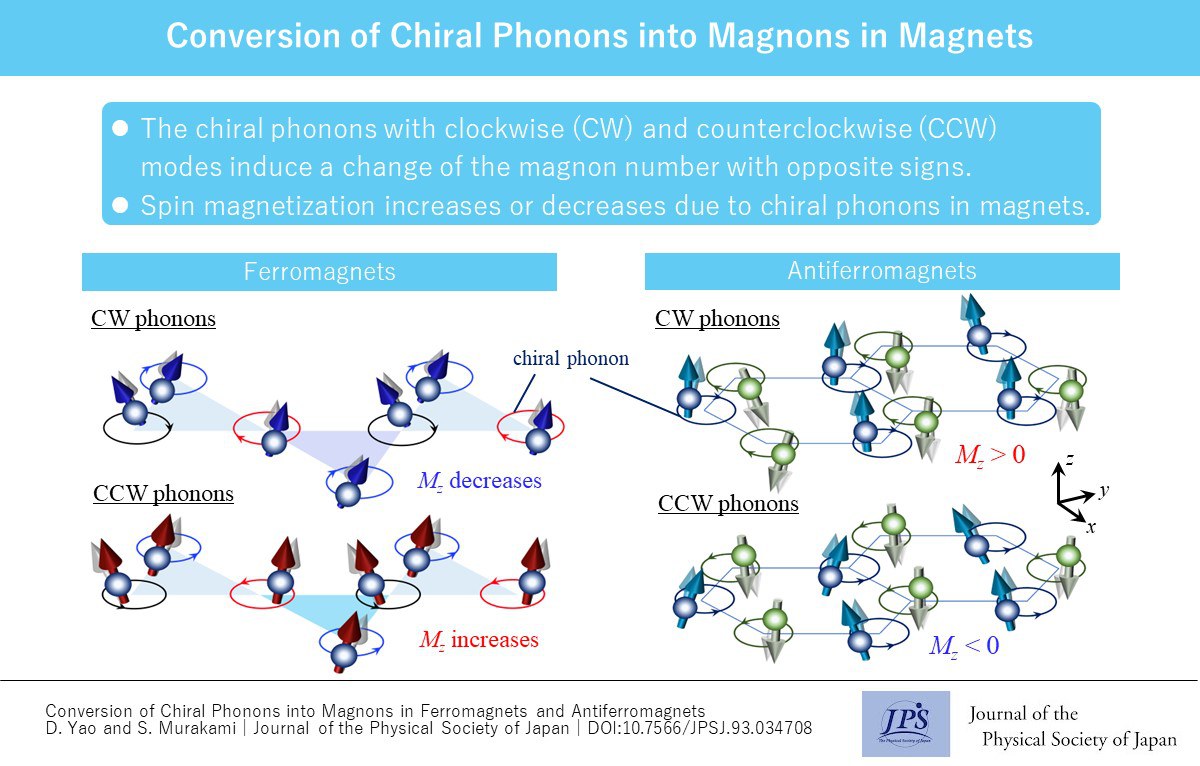
A new phenomenon involving the conversion of chiral phonons into magnons is theoretically predicted. The effective magnetic field induced by chiral phonons causes a change in the spin magnetization of magnets.
Spin-rotation coupling, which refers to the coupling between mechanical rotations and electron spins, leads to various phenomena, such as the Einstein-de Haas effect and the Barnett effect, in which the mechanical rotation of a crystal acts on the electron spins as an effective magnetic field. Recently, surface acoustic waves and chiral phonons involving the rotational motion of atoms have attracted considerable attention in spintronics. Surface acoustic waves refer to classical surface waves in continuous elastic media, whereas chiral phonons represent the microscopic local rotation of atoms with a phonon angular momentum.
Previous studies have indicated a phenomenon involving the conversion of phonon angular momentum into electron spins and charges in nonmagnetic materials and shown that chiral phonons behave as an effective magnetic field. Chiral phonons accompanying atomic rotations modulate electron hopping and spin-orbital coupling because the distance between atoms periodically changes with time. In the case of magnets, spin-spin interactions, such as exchange interactions and Dzyaloshinskii-Moriya interaction, always exist. These spin-spin interactions govern the collective propagation of precessions of electron spins, which are known as magnons. However, the interplay between atomic rotation and magnons in magnets is not fully understood.
In this study, we investigate a new conversion of chiral phonons into magnons in both ferromagnets and antiferromagnets and show that chiral phonons modulate spin-spin interactions. Because the masses of atoms are much larger than those of electrons, the behavior of magnon dynamics in an adiabatic response to atomic rotations leads to a geometric effect. We demonstrate that this effect requires breaking the spin-rotation symmetry. Consequently, the geometric effect due to chiral phonons results in a nontrivial change in magnon excitations. Specifically, chiral phonons with clockwise and counterclockwise rotational modes induce a change in magnon numbers with opposite signs, which corresponds to increasing and decreasing spin magnetization due to the chiral nature of atomic rotations.
The proposed effect is universal for a wide range of magnets. Measurement in an antiferromagnet is easier than in a ferromagnet because the net spin magnetization becomes nonzero owing to the geometric effect induced by chiral phonons. Our theory can generally be applied to real materials and is expected to be experimentally realized in some candidate materials, such as antiferromagnets XPS3 (X =Fe, Mn, and Ni), with a strong magnetic anisotropy.
(Written by D. Yao and S. Murakami)
Conversion of Chiral Phonons into Magnons in Ferromagnets and Antiferromagnets
(JPSJ Editors' Choice)
J. Phys. Soc. Jpn.
93,
034708
(2024)
.
Share this topic


Fields
Related Articles
-
What Shapes Electron Distributions in Nonequilibrium Nanowires?
Electronic transport in condensed matter
2026-4-20
A theoretical framework was developed to describe nonequilibrium electron distributions across the ballistic, diffusive, and local equilibrium transport regimes in voltage-biased nanowires in a unified manner.
-
Toward Clarification of Physical Properties of Quasicrystals: Noncollinear Magnetic Orders in Icosahedral Approximants
Cross-disciplinary physics and related areas of science and technology
Electronic transport in condensed matter
Magnetic properties in condensed matter
2026-4-6
An effective model based on magnetic anisotropy arising from a crystalline electric field is constructed for icosahedral approximants, which not only explains measured ferromagnets and antiferromagnets but also reveals new types of noncollinear magnetic orders.
-
The Physics of Light-Spin Interactions: Advances in Photodriven Quantum Spin Systems
Dielectric, optical, and other properties in condensed matter
Electromagnetism, optics, acoustics, heat transfer, and classical and fluid mechanics
Electronic transport in condensed matter
Magnetic properties in condensed matter
Statistical physics and thermodynamics
2025-12-17
This Special Topics edition of the Journal of the Physical Society of Japan discusses the recent progress and future directions for the rapidly progressing field of photodriven quantum spin systems.
-
Role of Orbital Currents in Future Solid-State Devices
Electronic transport in condensed matter
2025-10-6
This review explores recent experimental advances in the emerging field of orbitronics, focusing on orbital current mechanisms and orbitronic phenomena, providing key research directions for developing energy-efficient memory devices.
-
Carrier Scattering by Antisite Defects Reverses Thermoelectric Polarity in Fe₂VAl
Electronic transport in condensed matter
Structure and mechanical and thermal properties in condensed matter
2025-10-2
Antisite defects in Fe₂VAl create resonance states that boost hole scattering, which shifts carrier dominance to electrons and reverses thermoelectric polarity, thereby offering a new path for material design.