

Which is Moving?—Pinning Down the Origin of Fluctuations in Muon Spin Relaxation—
© The Physical Society of Japan
This article is on
Distinguishing Ion Dynamics from Muon diffusion in Muon Spin Relaxation
(JPSJ Editors' Choice)
J. Phys. Soc. Jpn.
93,
044602
(2024)
.
The study demonstrated that we can distinguish between the diffusion motion of the muon itself and the motion of the surrounding ions in muon spin relaxation.
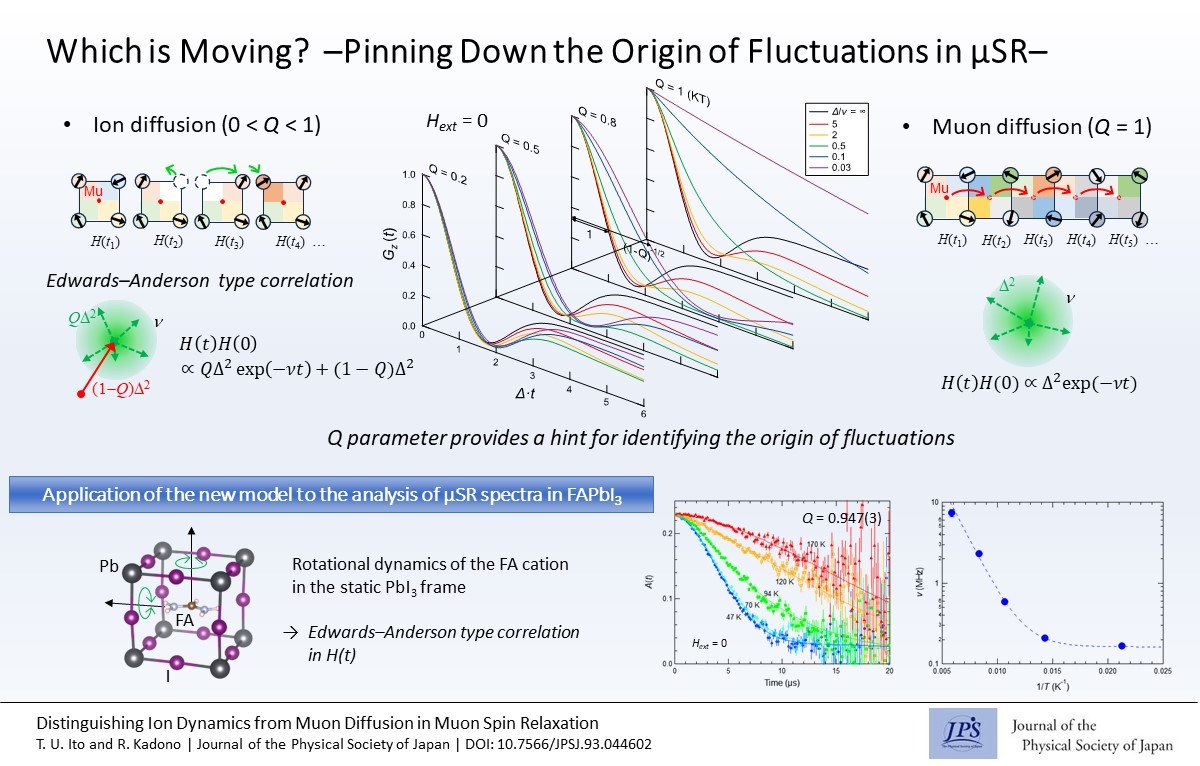
In the muon spin relaxation (µSR) measurements, the distribution (described by linewidth D) of internal magnetic field H(t) and its temporal fluctuations (with mean fluctuation rate n) can be observed by implanting spin-polarized muons into a material. However, distinguishing whether the fluctuations are caused by the diffusive motion of the muon itself or the motion of the ions around it, is difficult. In this study, by reviewing the strong collision model, which is an assumption used to describe spin relaxation, we observed that the difference in the cause of the fluctuation appeared as a difference in the spin relaxation function. The new model reproduces well the spin relaxation owing to the local rotational motion of cation molecules observed in hybrid perovskites; this opens the way to distinguish the cause of fluctuations solely from the µSR data.
When a muon exhibits jump-diffusion in a nonmagnetic material, the configuration of the nuclear magnetic moments around the muon changes simultaneously before and after the site change. The fluctuation of H(t) owing to these jumps is well approximated by the strong collision model [where the autocorrelation of H(t) is given by equation H(t)H(0)~D2exp(-nt)], and the time evolution of the muon spin polarization, Gz(t), is described by the dynamical Kubo–Toyabe (KT) relaxation function. However, if the H(t) fluctuations are due to the jump diffusion of ions, only a part of the ion configuration around the muon changes in one jump, and the strong collision model is not necessarily expected to be applicable.
Therefore, we performed Monte Carlo simulations for Gz(t) using a model in which the fluctuations of H(t) owing to ion motion were described by an Edwards–Anderson type autocorrelation function with the quasi-static and dynamic components of the autocorrelation separated by parameter Q [where H(t)H(0)~QD2exp(-nt) + (1-Q)D2], and Gz(t) was noted to deviate significantly from the KT function. To further verify this model, we compared the µSR spectra observed in the hybrid organic–inorganic perovskite FAPbI3 [FA refers to HC(NH2)2] with the simulation results. The least-squares curve fitting results showed excellent agreement with the model with Q = 0.947(3), yielding reasonable fluctuation frequencies for the dynamical component. This result opens the possibility of experimentally distinguishing between fluctuations owing to the dynamics of ions around muons and fluctuations owing to the self-diffusion of muons.
Written by T. U. Ito and R. Kadono
Distinguishing Ion Dynamics from Muon diffusion in Muon Spin Relaxation
(JPSJ Editors' Choice)
J. Phys. Soc. Jpn.
93,
044602
(2024)
.
Share this topic


Fields
Related Articles
-
Topological Defects as Seeds of Phase Separation: Insights from a Minimal Lattice Model
Cross-disciplinary physics and related areas of science and technology
Statistical physics and thermodynamics
2026-7-13
A minimal lattice model revealed that topological defects with winding number +1 serve as nucleation sites for phase separation in active matter systems.
-
A Deep Dive Into AI-Driven Materials Science
Cross-disciplinary physics and related areas of science and technology
2026-7-6
This review from the Journal of the Physical Society of Japan examines how artificial intelligence overcomes traditional materials science bottlenecks, highlighting the shift from intuition-based discovery to data-driven innovation.
-
Peculiar Magnet Pointing Against an Applied Magnetic Field
Cross-disciplinary physics and related areas of science and technology
Magnetic properties in condensed matter
2026-7-1
TbNiC2 exhibits negative magnetization. A new mechanism, based on the coupling between the charge density wave and the antiferromagnetic order, is proposed to account for this peculiar phenomenon.
-
The Thermal Einstein–de Haas Effect: Theoretical Prediction and Observability in Chiral Carbon Nanotubes
Cross-disciplinary physics and related areas of science and technology
Structure and mechanical and thermal properties in condensed matter
2026-6-22
Although the Einstein–de Haas (EdH) effect describes material rotation in a magnetic field, a thermal EdH effect, driven by a temperature gradient, remains unobserved. Recently, chiral carbon nanotubes were theoretically proposed as promising candidates to observe it.
-
Negative Apparent Viscosity in Liquid Crystals
Cross-disciplinary physics and related areas of science and technology
Electromagnetism, optics, acoustics, heat transfer, and classical and fluid mechanics
Structure and mechanical and thermal properties in condensed matter
2026-6-8
Electrically driven liquid-crystal turbulence generates self-sustained flow and negative apparent viscosity. The fluorinated, chemically robust nematic PPDFB shows a substantially larger negative-viscosity effect than Schiff-base nematics.