

What Determines the Sign of Spin Current? ~ Theoretical Study of Spin Seebeck Effect in Antiferromagnetic Insulators
© The Physical Society of Japan
This article is on
Microscopic Theory of Spin Seebeck Effect in Antiferromagnets
(JPSJ Editors' Choice)
J. Phys. Soc. Jpn.
93,
034702
(2024)
.
We developed a microscopic theory for the spin Seebeck effect in antiferromagnets, that explains the sign reversal of the spin current at the spin-flop transition point and describes the sorts of dominant carriers.
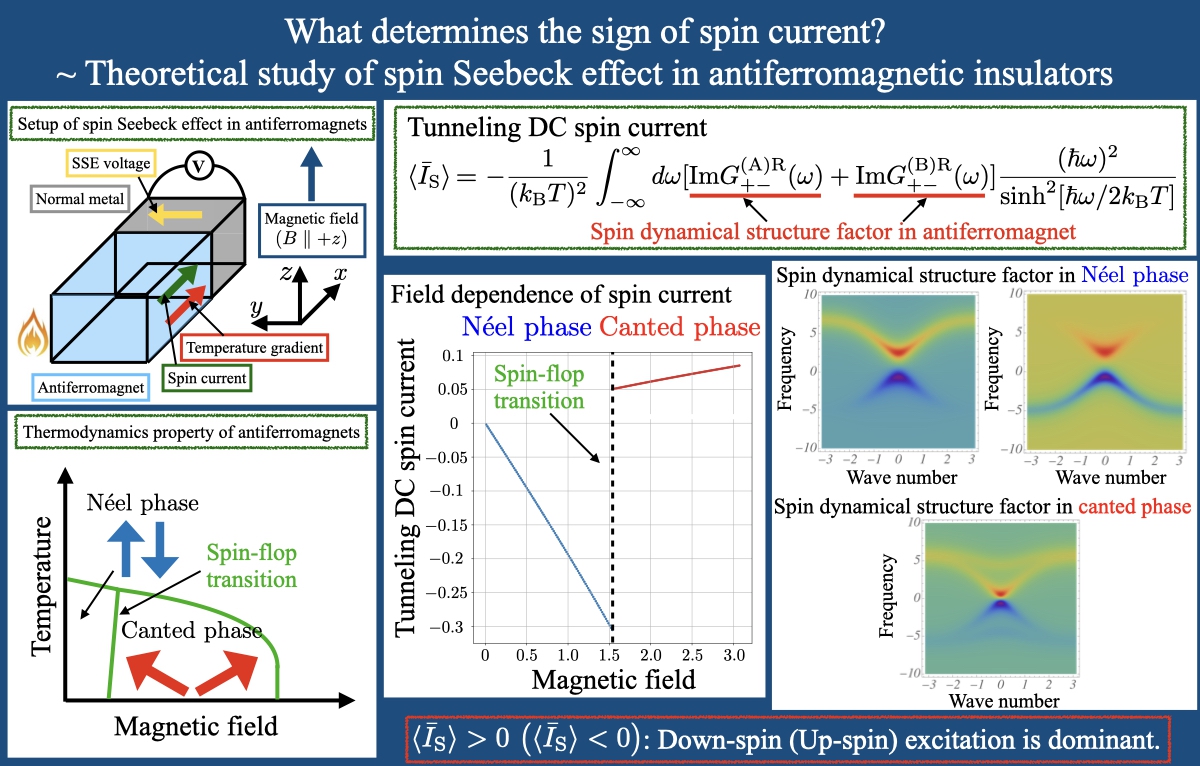
The spin Seebeck effect (SSE) is an established method for generating a DC spin current using a temperature gradient. In the standard experimental setup, a temperature gradient is applied to a bilayer junction of a target magnet and a metal; the gradient direction is perpendicular to their interface. The generated spin current runs along the gradient in the magnet and is injected into the metal, where it is converted into an electric voltage via the inverse-spin Hall effect. Because the spin current is essentially non-conserved and almost impossible to directly detect, attachment of a metal is necessary to (indirectly) observe the spin current as an electric signal.
Since its discovery in 2008, the SSE has been explored in various magnetic materials including antiferromagnets, which are one of the most fundamental magnetic materials and have garnered attention as a new platform for ultrafast spintronics because their magnetic excitations (magnons) reside in a higher-energy THz regime than magnons in ferromagnets. Thus, it is important to understand the nonequilibrium phenomena in antiferromagnets, including the SSE. Most theoretical research on SSE in antiferromagnets relies on phenomenological arguments; thus, development of microscopic understanding is desirable.
Based on spin-wave theory and the non-equilibrium Green’s function approach, we analyze the DC spin current flowing from the antiferromagnet to the attached metal. We determine the relationship between the spin current and the inelastic neutron scattering spectrum. The tunnel spin current is expressed with dynamical spin structure factors that are proportional to the density of states of spin-current carriers and can be measured by inelastic neutron scattering. Our analysis shows that the sign of the spin current is determined by the spin polarization direction of the dominant carrier and that the sign reverses at the spin-flop transition point. This result is in agreement with a recent SSE experiment on Cr2O3. Furthermore, our theory predicts that in a low-temperature regime, the spin current in the canted phase exhibits a non-monotonic field dependence, which could be potentially observed in future experiments.
In addition to these predictions, our microscopic theory makes it possible to quantitatively compare the SSE of antiferromagnets with those of other magnets. Such a quantitative comparison is difficult within the phenomenology, which is an advantage of our microscopic theory.
Development of microscopic theories generally deepens the understanding of observed phenomena and helps predict new related phenomena. Our findings are expected to contribute to understanding the SSE in antiferromagnets and unexplored non-equilibrium dynamics in future spintronics and non-equilibrium physics.
Written by K. Masuda and M. Sato.
Microscopic Theory of Spin Seebeck Effect in Antiferromagnets
(JPSJ Editors' Choice)
J. Phys. Soc. Jpn.
93,
034702
(2024)
.
Share this topic


Fields
Related Articles
-
What Shapes Electron Distributions in Nonequilibrium Nanowires?
Electronic transport in condensed matter
2026-4-20
A theoretical framework was developed to describe nonequilibrium electron distributions across the ballistic, diffusive, and local equilibrium transport regimes in voltage-biased nanowires in a unified manner.
-
Toward Clarification of Physical Properties of Quasicrystals: Noncollinear Magnetic Orders in Icosahedral Approximants
Cross-disciplinary physics and related areas of science and technology
Electronic transport in condensed matter
Magnetic properties in condensed matter
2026-4-6
An effective model based on magnetic anisotropy arising from a crystalline electric field is constructed for icosahedral approximants, which not only explains measured ferromagnets and antiferromagnets but also reveals new types of noncollinear magnetic orders.
-
The Physics of Light-Spin Interactions: Advances in Photodriven Quantum Spin Systems
Dielectric, optical, and other properties in condensed matter
Electromagnetism, optics, acoustics, heat transfer, and classical and fluid mechanics
Electronic transport in condensed matter
Magnetic properties in condensed matter
Statistical physics and thermodynamics
2025-12-17
This Special Topics edition of the Journal of the Physical Society of Japan discusses the recent progress and future directions for the rapidly progressing field of photodriven quantum spin systems.
-
Role of Orbital Currents in Future Solid-State Devices
Electronic transport in condensed matter
2025-10-6
This review explores recent experimental advances in the emerging field of orbitronics, focusing on orbital current mechanisms and orbitronic phenomena, providing key research directions for developing energy-efficient memory devices.
-
Carrier Scattering by Antisite Defects Reverses Thermoelectric Polarity in Fe₂VAl
Electronic transport in condensed matter
Structure and mechanical and thermal properties in condensed matter
2025-10-2
Antisite defects in Fe₂VAl create resonance states that boost hole scattering, which shifts carrier dominance to electrons and reverses thermoelectric polarity, thereby offering a new path for material design.