

Double Superconductivity in Nodal Line Material NaAlSi; Coexistence of Bulk and 2D Superconductivities
© The Physical Society of Japan
This article is on
Anomalous Diamagnetic Torque Signals in Topological Nodal-Line Semimetal NaAlSi
(JPSJ Editors' Choice)
J. Phys. Soc. Jpn.
92,
074703
(2023)
.
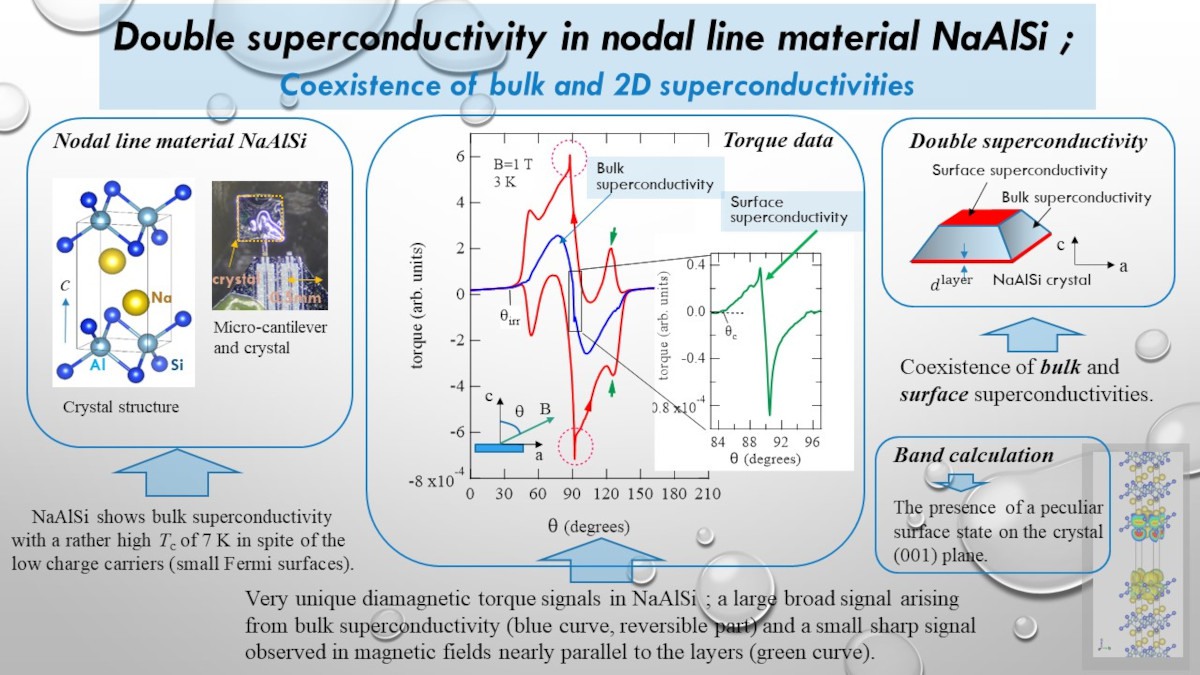
Unique diamagnetic torque signals are found in the nodal line material NaAlSi, which suggests the presence of double superconductivity; i.e., bulk superconductivity and 2D superconductivity on the crystal surface.
Topological materials have attracted great interest because of unique electronic states resulting from their linear energy dispersion. A large number of topological materials have been synthesized and discovered. Among them, some topological materials have unique band structures. The crossing points of the bands with linear dispersion, called Dirac points, extend in k-space and form nodal line loops. One of the most intriguing properties of such topological nodal line materials is the formation of surface states on certain crystal surfaces. Till now, extensive efforts have been made to elucidate the surface states of topological materials.
The nodal line material NaAlSi has a tetragonal unit cell composed of Al-Si tetrahedral layers and Na in between. Conduction bands are formed by the s and p orbitals of Al and Si. In spite of the low charge carriers (small Fermi surfaces), NaAlSi shows bulk superconductivity with a rather high Tc of 7 K.
Magnetic torque is defined as the outer product of the magnetic field and magnetization. We have performed magnetic torque experiments on single crystals of NaAlSi using a micro-cantilever, which is a powerful technique for detecting anisotropic magnetic properties. Owing to its layered structure, NaAlSi has anisotropic critical magnetic fields. Thus, it is possible to precisely measure the diamagnetic signal arising from the superconductivity even for a tiny single crystal.
In torque measurements below Tc, very unique diamagnetic torque signals have been observed in NaAlSi, i.e., a large broad signal arising from the bulk superconductivity and a small sharp signal observed in magnetic fields nearly parallel to the layers. Owing to the high anisotropy of the critical field, the sharp signal is ascribed to the 2D superconductivity in the Na-Si layers (perpendicular to the c-axis). The thickness of the 2D superconductivity is only several times the crystal c-axis (0.736 nm). As band calculation predicts the presence of a peculiar surface state on the crystal (001) plane, a possible explanation for the torque data is the coexistence of the bulk superconductivity and surface conductivity on the (001) plane. Further studies are necessary to understand the relationship between both superconductivities and the mechanism of 2D superconductivity.
(Written by S. Uji on behalf of all authors)
Anomalous Diamagnetic Torque Signals in Topological Nodal-Line Semimetal NaAlSi
(JPSJ Editors' Choice)
J. Phys. Soc. Jpn.
92,
074703
(2023)
.
Share this topic


Fields
Related Articles
-
Revealing Electronic Quantum Behavior Masked by Nuclear Heat
Measurement, instrumentation, and techniques
Structure and mechanical and thermal properties in condensed matter
Superconductivity
2026-9-7
The initial slope method is used to reveal intrinsic electronic specific heat by eliminating the overwhelming nuclear contributions during low-temperature calorimetry, opening a new window into quantum materials.
-
Unlocking a 40-Year-Old Mystery: Full-gap Spin-Triplet Superconductivity Unveiled in UBe13
Magnetic properties in condensed matter
Superconductivity
2026-8-12
Recent precise NMR measurements on the heavy-fermion superconductor UBe13 provided “smoking-gun” evidence for a fully-gapped spin-triplet superconducting state, opening a new chapter in the field.
-
Enhancing Accuracy and Reliability Bayesian Framework for Analysis of AR-HAXPES of Hard X-ray Photoelectron Spectroscopy
Dielectric, optical, and other properties in condensed matter
Electronic structure and electrical properties of surfaces and nanostructures
Measurement, instrumentation, and techniques
2026-4-28
We present a Bayesian framework for angle-resolved hard X-ray photoelectron spectroscopy (AR-HAXPES), combining Replica Exchange Monte Carlo with hierarchical integration to objectively and precisely estimate thin-film thickness.
-
Unveiling the Nodal Topology of the Spin-Triplet Superconductor Candidate UTe2
Structure and mechanical and thermal properties in condensed matter
Superconductivity
2026-4-13
Using high-quality UTe2 (Tc = 2.1 K), we identify its nodal gap structure. Field-angle‑resolved specific‑heat reveals a b-axis singularity, supporting spin-triplet superconductivity with nodes along the b axis.
-
Definitive Momentum and Spin Imaging Resolves 20-Year Debate on Gold Surface Spin
Electronic structure and electrical properties of surfaces and nanostructures
Magnetic properties in condensed matter
2026-4-1
Researchers at the Institute for Molecular Science (IMS) have utilized a cutting-edge Photoelectron Momentum Microscope (PMM) at the UVSOR Synchrotron Facility to settle a two-decade-long controversy concerning the direction of electron spin on the Au(111) surface. This study provides a definitive, full-map, comprehensive reference for quantum imaging that is essential for advancing spintronics technology.