

Can a Node-Less Wave Function Have Higher Energy than Node-Full Ones?
© The Physical Society of Japan
This article is on
Discovery of Peculiar Electronic Structures of Decavacancy V10 in Silicon Crystal
(JPSJ Editors' Choice)
J. Phys. Soc. Jpn.
91,
064709
(2022)
.
“The energy level of an electron state increases as the number of nodes in its wave function increases.” The preceding statement, often found in textbooks, was challenged by our large-scale DFT (density-functional theory) calculations performed for the decavacancy in Si crystal.
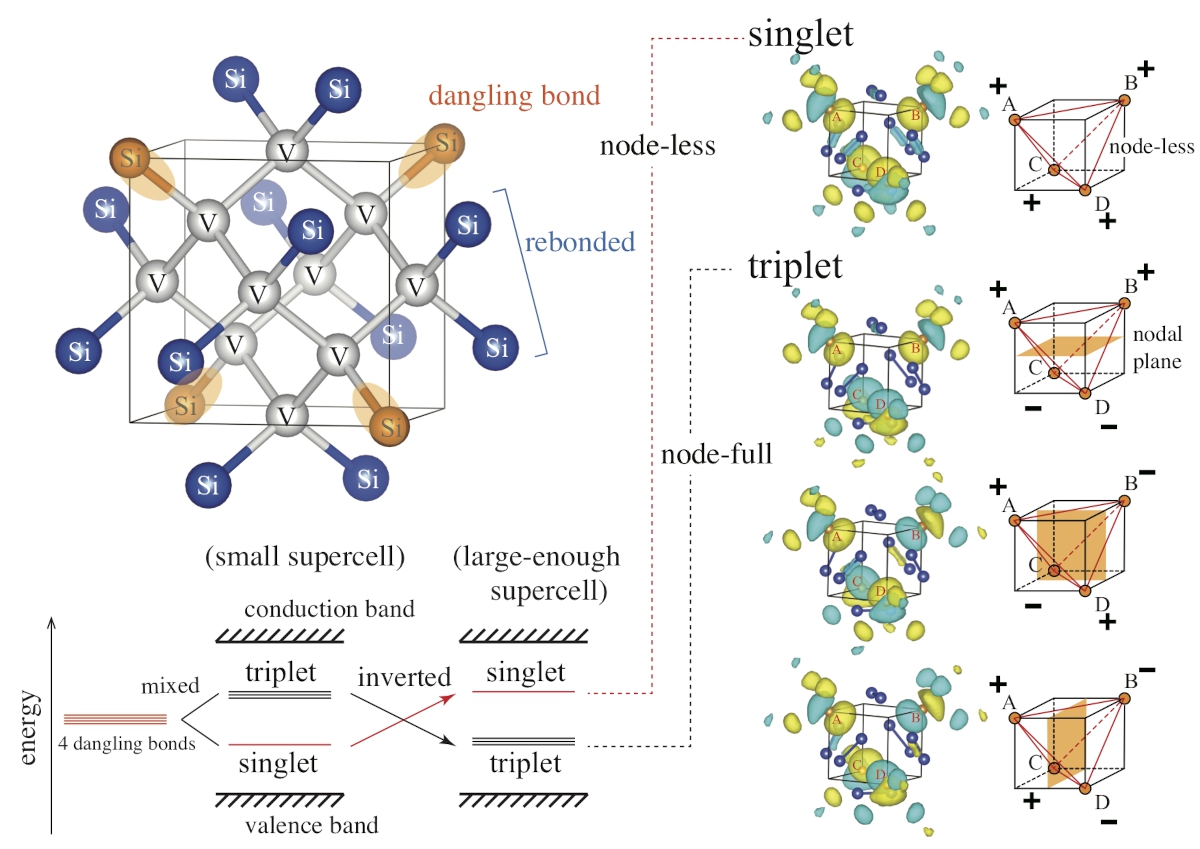
In quantum mechanics textbooks, a node-less wave function is described as having lower energy than that with nodal planes, because the kinetic energy increases with an increasing number of nodes. This statement has been thought to be universal.
However, we have recently found an exceptional case in the decavacancy of Si crystal, where node-less mixing of four dangling-bond orbitals (φA, φB, φC, and φD) in the singlet state leads to a higher energy than node-full mixing in the triplet states. That is,
where
Ψsinglet  (+φA+φB+φC+φD)/2,
Ψtriplet (+φA+φB -φC -φD)/2,
(+φA -φB -φC +φD)/2,
(+φA-φB +φC -φD)/2.
This unexpected energy ordering is the enigma discussed and solved in our study.
Decavacancy V10. is one of the magic number vacancies, obtained by removing a Si10 cluster from an otherwise perfect Si crystal. Although the vacancy is accompanied by 16 dangling bonds, 12 of them are re-bonded with adjacent ones. Thus, we have only four dangling bonds remaining in V10. The four dangling-bond orbitals (φA, φB, φC, and φD) are arranged under the Td symmetry, which mix to generate the singlet and triplet electron states in the band gap, as described by Eq. (2). Our finding in Eq. (1) is surprising, because it seems to contradict a universal rule stated in the textbooks.
To clarify the underlying physics, we constructed a model to reproduce the energy ordering in Eq. (1), and successfully showed that such a non-intuitive electronic structure originates from the slight hybridization of the four dangling-bond states in the band gap with the 12 re-bond states outside the band gap. Here, the “re-bond states” refers to the six bonding states in the valence band and the six anti-bonding states in the conduction band, generated when 12 dangling bonds are paired with adjacent ones. Although such pairing makes the rebond states inactive, we found that the passivation was not perfect. They are slightly hybridized with the four dangling-bond states in the band gap, which make the energy of the node-less singlet higher than that of the node-full triplet.
We argue that this peculiar electronic structure is reflected in the Jahn-Teller instability of the system. We also note that large-scale DFT calculations are paramount for this work, because the supercell size must be large enough for the results of calculations to converge into Eq. (1).
(Written by K. Uchida on behalf of all authors.)
Discovery of Peculiar Electronic Structures of Decavacancy V10 in Silicon Crystal
(JPSJ Editors' Choice)
J. Phys. Soc. Jpn.
91,
064709
(2022)
.
Share this topic


Fields
Related Articles
-
The Thermal Einstein–de Haas Effect: Theoretical Prediction and Observability in Chiral Carbon Nanotubes
Cross-disciplinary physics and related areas of science and technology
Structure and mechanical and thermal properties in condensed matter
2026-6-22
Although the Einstein–de Haas (EdH) effect describes material rotation in a magnetic field, a thermal EdH effect, driven by a temperature gradient, remains unobserved. Recently, chiral carbon nanotubes were theoretically proposed as promising candidates to observe it.
-
Negative Apparent Viscosity in Liquid Crystals
Cross-disciplinary physics and related areas of science and technology
Electromagnetism, optics, acoustics, heat transfer, and classical and fluid mechanics
Structure and mechanical and thermal properties in condensed matter
2026-6-8
Electrically driven liquid-crystal turbulence generates self-sustained flow and negative apparent viscosity. The fluorinated, chemically robust nematic PPDFB shows a substantially larger negative-viscosity effect than Schiff-base nematics.
-
Role of the Diffusion Layer in Energy Devices
Cross-disciplinary physics and related areas of science and technology
Structure and mechanical and thermal properties in condensed matter
2026-5-1
In many energy devices, electron transfer occurs between ions dissolved in the electrolyte and the electrodes. For keep current flowing, new ions must be supplied continuously to the electrode surface from the bulk region. The diffusion layer’s role in diffusive mass transfer was clarified using the rotating disk electrode method.
-
Unveiling the Nodal Topology of the Spin-Triplet Superconductor Candidate UTe2
Structure and mechanical and thermal properties in condensed matter
Superconductivity
2026-4-13
Using high-quality UTe2 (Tc = 2.1 K), we identify its nodal gap structure. Field-angle‑resolved specific‑heat reveals a b-axis singularity, supporting spin-triplet superconductivity with nodes along the b axis.
-
Creation of Chiral Phonons−How Lattice Chirality Imparts Angular Momentum to Phonons?
Structure and mechanical and thermal properties in condensed matter
2026-3-2
Chiral crystals host phonons with intrinsic angular momentum, whose quantization and energy splitting reflect the lattice chirality and reveal the microscopic features of interatomic interactions.