

Inertial Focusing of Red Blood Cells in Square Tube Flows
© The Physical Society of Japan
This article is on
Inertial Focusing of Red Blood Cells Suspended in Square Capillary Tube Flows
(JPSJ Editors' Choice)
J. Phys. Soc. Jpn.
91,
083401
(2022)
.
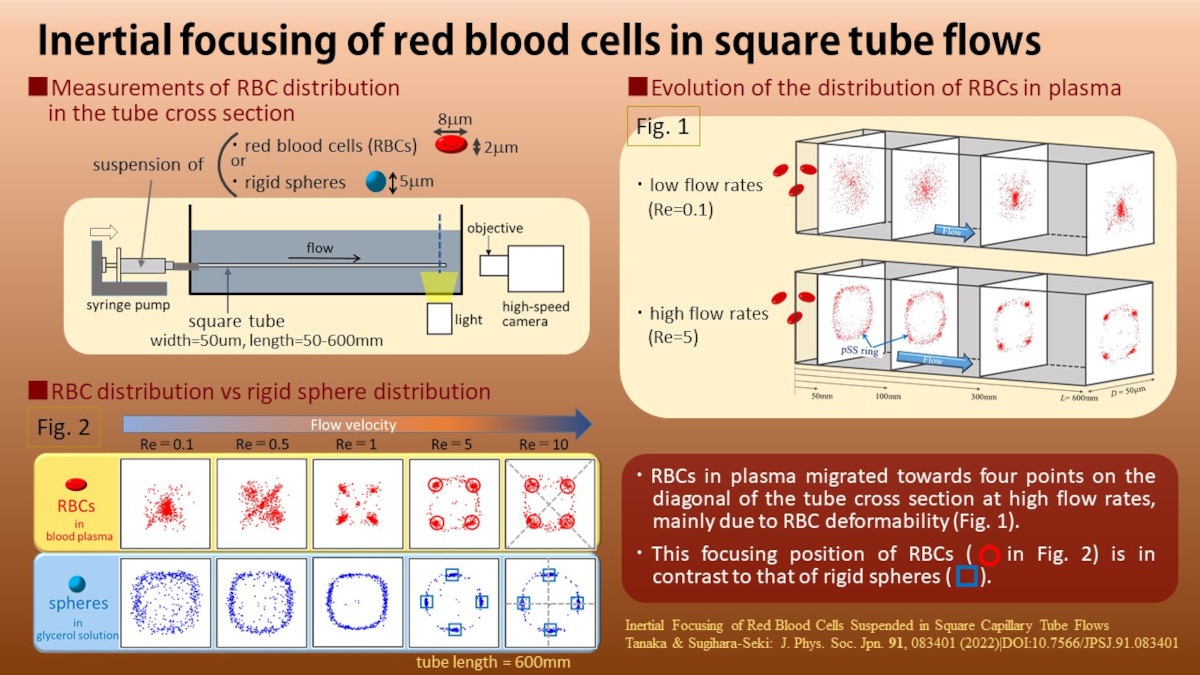
Red blood cells flowing through square capillary tubes were observed to migrate towards four points located on the diagonal in the tube cross-section, owing to their deformability and inertia.
Particles suspended in laminar flows through uniform, straight tubes are expected to move parallel to the tube axis. However, in experiments, particles migrate across streamlines due to the lifts induced by inertia, particle deformability, medium elasticity and so on. As a result, they pass through specific locations in the downstream cross-section. The presence of inertial lift was first reported concerning circular tube flows, where spherical particles suspended in a Newtonian fluid migrated towards an annulus located at approximately 0.6 times the tube radius from the tube centerline, named “inertial focusing”. In rectangular tube flows typically adopted in microfluidics, particles migrate towards several discrete points in the downstream cross-section. Particularly concerning square tube flows, spherical particles suspended in Newtonian fluids become concentrated at four points near the center of the side walls.
Recently, inertial focusing phenomena have gained considerable attention in the field of microfluidics owing to their promising application in separating and filtering biological cells. This flow-based separating technique using microfluidic devices is based on differences in the inertial focusing behavior of cells, depending on their size and deformability. Although biological cells are somewhat deformable, and suspending media usually contain various polymers, it is unclear how cell deformability and medium elasticity affect inertial focusing.
This study experimentally investigated the inertial focusing of red blood cells (RBCs) when suspended in blood plasma flowing through square cross-section capillary tubes. RBCs are known to be highly deformable, and the plasma contains various polymers (approximately 8% by volume). The face-on image of the tube cross-section near the outlet was taken from the downstream side using a high-speed camera, enabling accurate positions of RBC centroids in the cross-section to be obtained. At low flow rates, RBCs were observed to accumulate near the tube centerline, whereas increasing the flow rates caused RBCs to focus near four points located on the diagonal of the downstream cross-section. This focusing behavior significantly contrasts with that of the comparably sized rigid particles. Additional experiments using glutaraldehyde-hardened RBCs confirmed that the RBC focusing on the diagonal is primarily attributed to RBC deformability. A slight contribution of plasma elasticity was also suggested by the difference between the distributions of spherical particles suspended in plasma and those in Newtonian fluids. Based on the experimental results, the properties of deformability- and elasticity-induced lifts were discussed.
(written by M. Sugihara-Seki on behalf of all authors.)
Inertial Focusing of Red Blood Cells Suspended in Square Capillary Tube Flows
(JPSJ Editors' Choice)
J. Phys. Soc. Jpn.
91,
083401
(2022)
.
Share this topic


Fields
Related Articles
-
Giant Brute-Force Simulation to Reveal Nucleation and Growth of Ultrasonic Cavitation Bubbles
Electromagnetism, optics, acoustics, heat transfer, and classical and fluid mechanics
Statistical physics and thermodynamics
2026-7-27
This study reveals the early-stage dynamics of ultrasonic cavitation using a record 100-billion-atom simulation to capture bubble nucleation, growth, clustering, and periodic splitting under nonequilibrium conditions.
-
Negative Apparent Viscosity in Liquid Crystals
Cross-disciplinary physics and related areas of science and technology
Electromagnetism, optics, acoustics, heat transfer, and classical and fluid mechanics
Structure and mechanical and thermal properties in condensed matter
2026-6-8
Electrically driven liquid-crystal turbulence generates self-sustained flow and negative apparent viscosity. The fluorinated, chemically robust nematic PPDFB shows a substantially larger negative-viscosity effect than Schiff-base nematics.
-
Topological Recast of Vortex Structures in Human Heart Blood Flow
Cross-disciplinary physics and related areas of science and technology
Electromagnetism, optics, acoustics, heat transfer, and classical and fluid mechanics
2026-2-16
We developed a new topological data analysis method to objectively identify the cardiac vortex structures. The method provides robust quantitative metrics for advancing cardiovascular diagnostics.
-
The Physics of Light-Spin Interactions: Advances in Photodriven Quantum Spin Systems
Dielectric, optical, and other properties in condensed matter
Electromagnetism, optics, acoustics, heat transfer, and classical and fluid mechanics
Electronic transport in condensed matter
Magnetic properties in condensed matter
Statistical physics and thermodynamics
2025-12-17
This Special Topics edition of the Journal of the Physical Society of Japan discusses the recent progress and future directions for the rapidly progressing field of photodriven quantum spin systems.
-
Topological Photonics: Recent Advances in Controlling Light
Cross-disciplinary physics and related areas of science and technology
Dielectric, optical, and other properties in condensed matter
Electromagnetism, optics, acoustics, heat transfer, and classical and fluid mechanics
Electronic structure and electrical properties of surfaces and nanostructures
Structure and mechanical and thermal properties in condensed matter
2025-12-8
The special topics edition of the Journal of the Physical Society of Japan presents five new review articles offering cutting-edge information on the emerging field of topological photonics.