

Topology-Based Method for Determining the Order Parameter of the Putative Spin-Triplet Superconductor UTe2
© The Physical Society of Japan
This article is on
Intrinsic Anomalous Thermal Hall Effect in the Unconventional Superconductor UTe2
J. Phys. Soc. Jpn.
91,
094710
(2022)
.
The intrinsic anomalous thermal Hall effect can be an effective probe for the order parameters of non-unitary pairing states of the putative spin-triplet superconductor UTe2
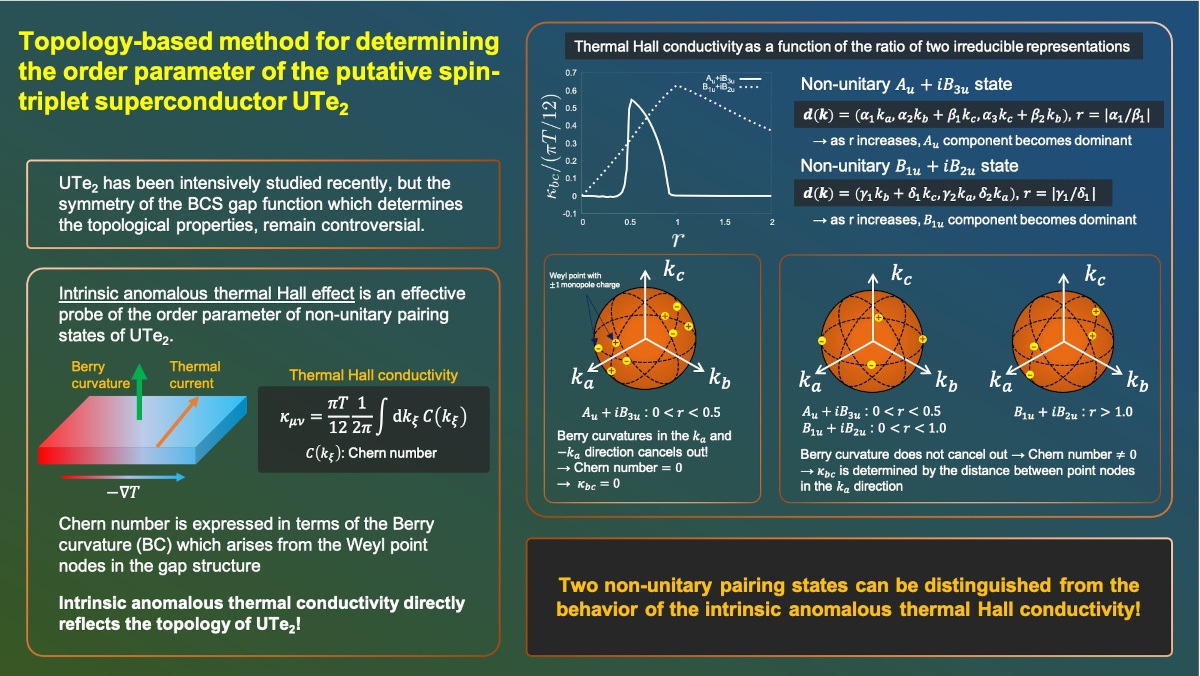
Recently, the actinide compound UTe2 has been intensively studied as a novel candidate material for a spin-triplet superconductor, which is expected to host Majorana particles utilized for quantum computation. The superconductivity of this material without a magnetic order renders it ideal for research on pure spin-triplet superconductors. The possibility of a non-unitary pairing state in UTe2 is also discussed, indicating that UTe2 is a Weyl superconductor that has topologically protected point nodes with monopole charges in the superconducting gap. However, the symmetry and gap structures, which determine its topological properties, remain controversial. Therefore, an effective method for probing the order parameter of UTe2 is lacking.
In this study, the intrinsic anomalous thermal Hall effect, which is a fundamental property of Weyl superconductors, is investigated. The pairing state in the spin-triplet superconductor is characterized by a three-dimensional odd-parity order parameter, referred to as a d-vector. The basis of the d-vector corresponds to the irreducible representations (IRs) of the D2h point group. When symmetry is reduced by the application of an external field, the admixture of these IRs is formed, which results in non-unitary pairing. We calculate the thermal Hall conductivity for the possible non-unitary pairing states in UTe2 as a function of the ratio “r” of the amplitudes of two mixed IRs. The intrinsic anomalous thermal Hall conductivity can be obtained by the integration of the Chern number, which corresponds to an integration of the Berry curvature over the Brillouin zone. Since the Berry curvature arises from the Weyl point nodes with monopole charges, the intrinsic thermal Hall conductivity directly reflects the distribution of the point nodes on the Fermi surfaces.
The relationship between the Hall conductivity and the point node structure is evident in the case of a simple ellipsoid-shaped Fermi surface, which is the minimum model that reflects the orthorhombic crystal structure. The admixture of IRs causes a splitting of the point nodes, because of which they move away from the high-symmetry axis. When one point node splits into two, the split nodes become Weyl points that have monopole charges with opposite signs. In this case, a Berry curvature exists along a certain direction, with a finite Chern number. This results in a finite thermal Hall conductivity, the magnitude of which depends on the distance between the point nodes.
The change in the point node structure due to the admixture of the two IRs is unique for each d-vector and is useful for the distinction of the order parameters based on future thermal conductivity measurements.
(Written by Y. Moriya on behalf of all the authors.)
Intrinsic Anomalous Thermal Hall Effect in the Unconventional Superconductor UTe2
J. Phys. Soc. Jpn.
91,
094710
(2022)
.
Share this topic


Fields
Related Articles
-
Unveiling the Nodal Topology of the Spin-Triplet Superconductor Candidate UTe2
Structure and mechanical and thermal properties in condensed matter
Superconductivity
2026-4-13
Using high-quality UTe2 (Tc = 2.1 K), we identify its nodal gap structure. Field-angle‑resolved specific‑heat reveals a b-axis singularity, supporting spin-triplet superconductivity with nodes along the b axis.
-
Do Superconductors Dream of Tsunamis?
— A Cross-disciplinary Journey of Solitons —
Mathematical methods, classical and quantum physics, relativity, gravitation, numerical simulation, computational modeling
Superconductivity
2026-2-10
Tsunami-like solitons propagating over rocky-desert-like disordered backgrounds have been identified in a novel soliton equation derived from the theory of parity-mixed superconductivity.
-
A Novel Type of Magnetic Band Splitting in a Fe Spin Ladder System
Dielectric, optical, and other properties in condensed matter
Magnetic properties in condensed matter
Superconductivity
2026-1-22
An investigation of a Fe spin ladder system using angle-resolved photoemission spectroscopy revealed a novel type of magnetic band splitting resembling that in altermagnets.
-
Advances in Photoemission Study of Functional Molecular Materials
Dielectric, optical, and other properties in condensed matter
Superconductivity
2025-11-25
This work provides the first observation of the superconducting gap in molecular superconductors and their gap symmetry using photoemission spectroscopy, which will significantly accelerate the study of molecular conductors.
-
Exotic Superconductivity in Altermagnets with Rashba Spin–Orbit Coupling
Superconductivity
2025-8-6
We theoretically demonstrate the emergence of finite-momentum superconductivity in a two-dimensional altermagnet with Rashba-type spin–orbit coupling (RSOC), where anisotropic deformations of the Fermi surfaces stabilize this unconventional superconducting state.