

Thermoelectric Response in Strongly Disordered Systems
© The Physical Society of Japan
This article is on
J. Phys. Soc. Jpn.
91,
044704
(2022)
.
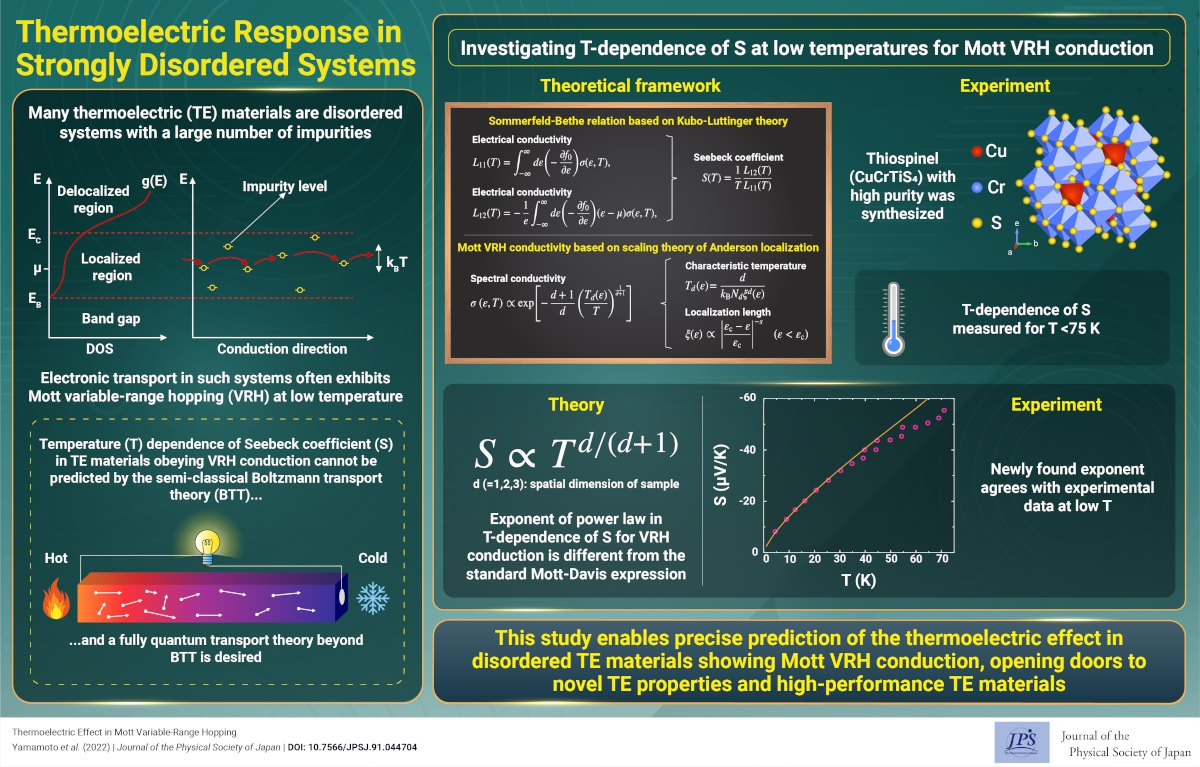
Based on the Kubo–Luttinger linear response theory, we discovered that the low-T Seebeck coefficient for Mott variable-range hopping in a d-dimensional system varies as S ∝ Td/(d+1), which is different from the conventional S ∝ T(d−1)/(d+1). In addition, the experimental data for S of CuCrTiS4 at low T are in excellent agreement with our prediction S ∝ T3/4 (d = 3).
In 1957, Kubo established the linear response theory to kinetic perturbation (e.g., electric or magnetic field). In the following years, based on the combination of the thermal Green's function technique with the Kubo formula, the linear response theory has emerged as a powerful practical tool for analyzing quantum transport and the magnetic response of materials. In contrast, the linear response theory to thermodynamic perturbation (e.g., temperature gradient) was advocated by Luttinger in 1964. Luttinger succeeded in treating the temperature gradient as a kinetic perturbation by introducing a fictitious gravitational field (scalar field). Since 2018, the authors and their co-workers have been developing the Luttinger formula together with the thermal Green's function technique to determine the thermal response (i.e., thermoelectric (TE) effect and thermal transport) of materials from a quantum mechanical perspective. The developed technique has been successfully applied to various materials exhibiting interesting TE effects that cannot be explained in terms of the Boltzmann transport theory (BTT).
In this study, as a typical thermal response beyond the BTT framework, the authors investigated the TE response in Mott variable-range hopping (VRH) using the above-mentioned Kubo–Luttinger (KL) theory together with the thermal Green's function technique. By incorporating the energy dependence of the localization length near the mobility edge based on the scaling theory of Anderson localization, we clarified that the Seebeck coefficient S(T) varies according to S ∝ Td/(d+1) in a d-dimensional system, which is different from the widely used Mott–Davis expression, S ∝ T(d−1)/(d+1), based on the energy-independent localization length. In addition, we demonstrated that the low-T behavior of S(T) for thiospinel CuCrTiS4, which is known as a typical TE material exhibiting Mott VRH at low T, is in complete agreement with our theoretical prediction S ∝ T3/4 (d = 3).
This study enables precise prediction of the performance of disordered TE materials exhibiting Mott VRH. The development of such a complete quantum theory that precisely predicts TE properties will play a role in realizing a sustainable society.
(Written by T. Yamamoto on behalf of all the authors.)
J. Phys. Soc. Jpn.
91,
044704
(2022)
.
Share this topic


Fields
Related Articles
-
What Shapes Electron Distributions in Nonequilibrium Nanowires?
Electronic transport in condensed matter
2026-4-20
A theoretical framework was developed to describe nonequilibrium electron distributions across the ballistic, diffusive, and local equilibrium transport regimes in voltage-biased nanowires in a unified manner.
-
Toward Clarification of Physical Properties of Quasicrystals: Noncollinear Magnetic Orders in Icosahedral Approximants
Cross-disciplinary physics and related areas of science and technology
Electronic transport in condensed matter
Magnetic properties in condensed matter
2026-4-6
An effective model based on magnetic anisotropy arising from a crystalline electric field is constructed for icosahedral approximants, which not only explains measured ferromagnets and antiferromagnets but also reveals new types of noncollinear magnetic orders.
-
The Physics of Light-Spin Interactions: Advances in Photodriven Quantum Spin Systems
Dielectric, optical, and other properties in condensed matter
Electromagnetism, optics, acoustics, heat transfer, and classical and fluid mechanics
Electronic transport in condensed matter
Magnetic properties in condensed matter
Statistical physics and thermodynamics
2025-12-17
This Special Topics edition of the Journal of the Physical Society of Japan discusses the recent progress and future directions for the rapidly progressing field of photodriven quantum spin systems.
-
Role of Orbital Currents in Future Solid-State Devices
Electronic transport in condensed matter
2025-10-6
This review explores recent experimental advances in the emerging field of orbitronics, focusing on orbital current mechanisms and orbitronic phenomena, providing key research directions for developing energy-efficient memory devices.
-
Carrier Scattering by Antisite Defects Reverses Thermoelectric Polarity in Fe₂VAl
Electronic transport in condensed matter
Structure and mechanical and thermal properties in condensed matter
2025-10-2
Antisite defects in Fe₂VAl create resonance states that boost hole scattering, which shifts carrier dominance to electrons and reverses thermoelectric polarity, thereby offering a new path for material design.