

Revealing Electronic Quantum Behavior Masked by Nuclear Heat
© The Physical Society of Japan
This article is on
Eliminating Nuclear Contributions in Low-Temperature Calorimetry Using the Initial Slope Method
(JPSJ Editors' Choice)
J. Phys. Soc. Jpn.
95,
064008
(2026)
.
The initial slope method is used to reveal intrinsic electronic specific heat by eliminating the overwhelming nuclear contributions during low-temperature calorimetry, opening a new window into quantum materials.
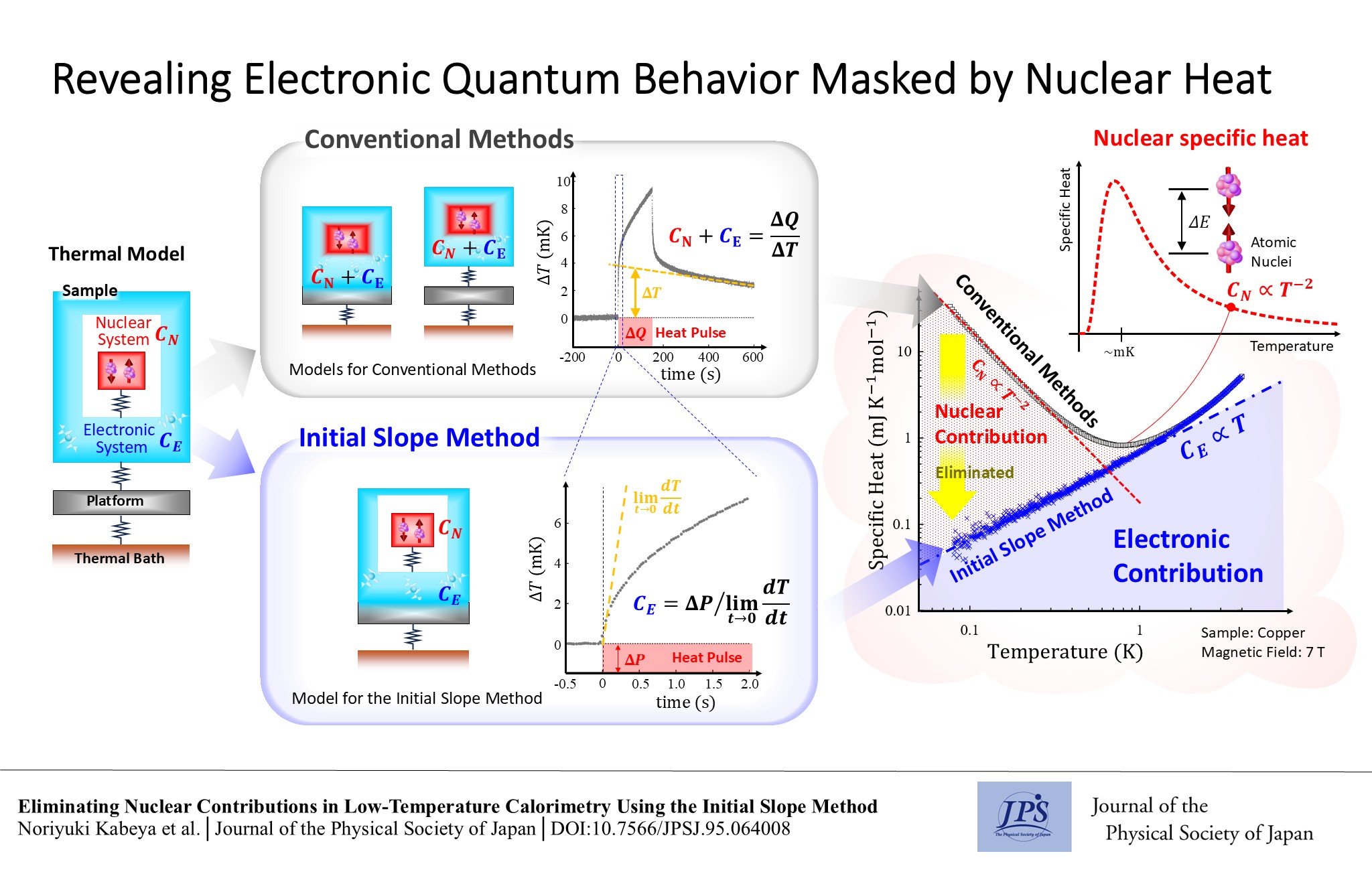
Understanding the quantum behavior of electrons at extremely low temperatures is a central challenge in condensed-matter physics. Many quantum phenomena, including unconventional superconductivity, quantum criticality, frustrated magnetism, and heavy-fermion behavior, emerge only under small thermal fluctuations. Specific-heat measurement is a unique experimental technique that directly probes entropy and low-energy excitations.
Ironically, these measurements are more difficult at low temperatures. At temperatures below approximately 1 K, atomic nuclei contribute nuclear specific heat, which increases approximately as , eventually overwhelming the electronic contributions of interest. In many materials, the nuclear contribution is hundreds of times larger than the electronic one.
The recently developed initial slope method (ISM) calorimetric technique overcomes this long-standing experimental obstacle by using a new thermal model. The conventional thermal model for calorimetric systems consists of a sample comprising two thermally coupled subsystems (nuclear and electron–phonon subsystems), sample platform, and thermal bath.
The nuclear and electron–phonon subsystems are treated as a single thermal component and the specific heat is determined from the complete thermal-relaxation curve, which includes both nuclear and electronic contributions, and is time-consuming.
In contrast, the ISM considers the nuclear and electron–phonon subsystems separately. Rather than measuring the complete thermal-relaxation curve of the sample, the ISM focuses only on the first fraction of a second immediately after the application of a small heat pulse.
This seemingly simple idea exploits a fundamental difference in relaxation times. Electrons and phonons equilibrate almost instantaneously, whereas nuclear spins respond slowly. During the initial stage of relaxation, the nuclei remain frozen; only the electronic and lattice degrees of freedom contribute to the observed temperature change. By analyzing this initial slope, the electronic specific heat can be obtained without subtracting the nuclear contribution.
To verify this method, high-purity copper was measured using the conventional method and ISM under magnetic fields of 0 and 7 T. Under 7 T, the nuclear contribution was more than 250 times larger than the electronic specific heat, at temperatures below 0.1 K. The conventional relaxation measurements under this condition were dominated almost entirely by nuclear contribution. However, the ISM measurements were the same as the electronic specific heat measured at 0 T, demonstrating that the nuclear contribution had been eliminated during measurement.
ISM also dramatically improved the measurement efficiency. Conventional measurements often required waiting for nuclear spins to relax, which could take up to 103 s. In contrast, the ISM typically required less than one second, substantially speeding up measurement.
Beyond improving calorimetry, the ISM opens new opportunities for studying quantum materials. Nuclear specific heat has long hindered thermodynamic studies of quantum phenomena. The ISM provides researchers with direct access to the intrinsic low-energy physics that has long remained hidden behind nuclear heat.
(Written by Noriyuki Kabeya on behalf of all authors.)
Eliminating Nuclear Contributions in Low-Temperature Calorimetry Using the Initial Slope Method
(JPSJ Editors' Choice)
J. Phys. Soc. Jpn.
95,
064008
(2026)
.
Share this topic


Fields
Related Articles
-
Mysterious Critical Phenomena Driven by Role Reversal in Multicomponent Systems: From Normal to Reverse RKKY — Twofold Reversal and Induced Critical Exponent
Electronic transport in condensed matter
Structure and mechanical and thermal properties in condensed matter
2026-10-5
The Reverse RKKY mechanism drives a twofold reversal, yielding an anomalous specific‑heat peak with a large, induced critical exponent.
-
Direct Observation of Piezoelectricity from Electric Toroidal Quadrupole Order
Electron states in condensed matter
Structure and mechanical and thermal properties in condensed matter
2026-9-30
This study reports the direct observation of piezoelectricity in the spin-orbit-coupled metal Cd2Re2O7. The findings reveal how electric toroidal quadrupole order drives successive inversion-symmetry-breaking transitions and anisotropic electromechanical responses.
-
Holonomy Reveals Hidden Strain Incompatibilities in Birefringence Imaging
Dielectric, optical, and other properties in condensed matter
Measurement, instrumentation, and techniques
2026-8-17
Holonomy measures how local optical directions fail to return to their original orientation after a closed loop, revealing hidden electromechanical structures in stress-induced ferroelectric SrTiO3.
-
Unlocking a 40-Year-Old Mystery: Full-gap Spin-Triplet Superconductivity Unveiled in UBe13
Magnetic properties in condensed matter
Superconductivity
2026-8-12
Recent precise NMR measurements on the heavy-fermion superconductor UBe13 provided “smoking-gun” evidence for a fully-gapped spin-triplet superconducting state, opening a new chapter in the field.
-
The Thermal Einstein–de Haas Effect: Theoretical Prediction and Observability in Chiral Carbon Nanotubes
Cross-disciplinary physics and related areas of science and technology
Structure and mechanical and thermal properties in condensed matter
2026-6-22
Although the Einstein–de Haas (EdH) effect describes material rotation in a magnetic field, a thermal EdH effect, driven by a temperature gradient, remains unobserved. Recently, chiral carbon nanotubes were theoretically proposed as promising candidates to observe it.