

Topological Defects as Seeds of Phase Separation: Insights from a Minimal Lattice Model
© The Physical Society of Japan
This article is on
Defect-Mediated Aggregation and Motility-Induced Phase Separation in Self-Propelled Lattice-Gas Active XY Model
(JPSJ Editors' Choice)
J. Phys. Soc. Jpn.
95,
054802
(2026)
.
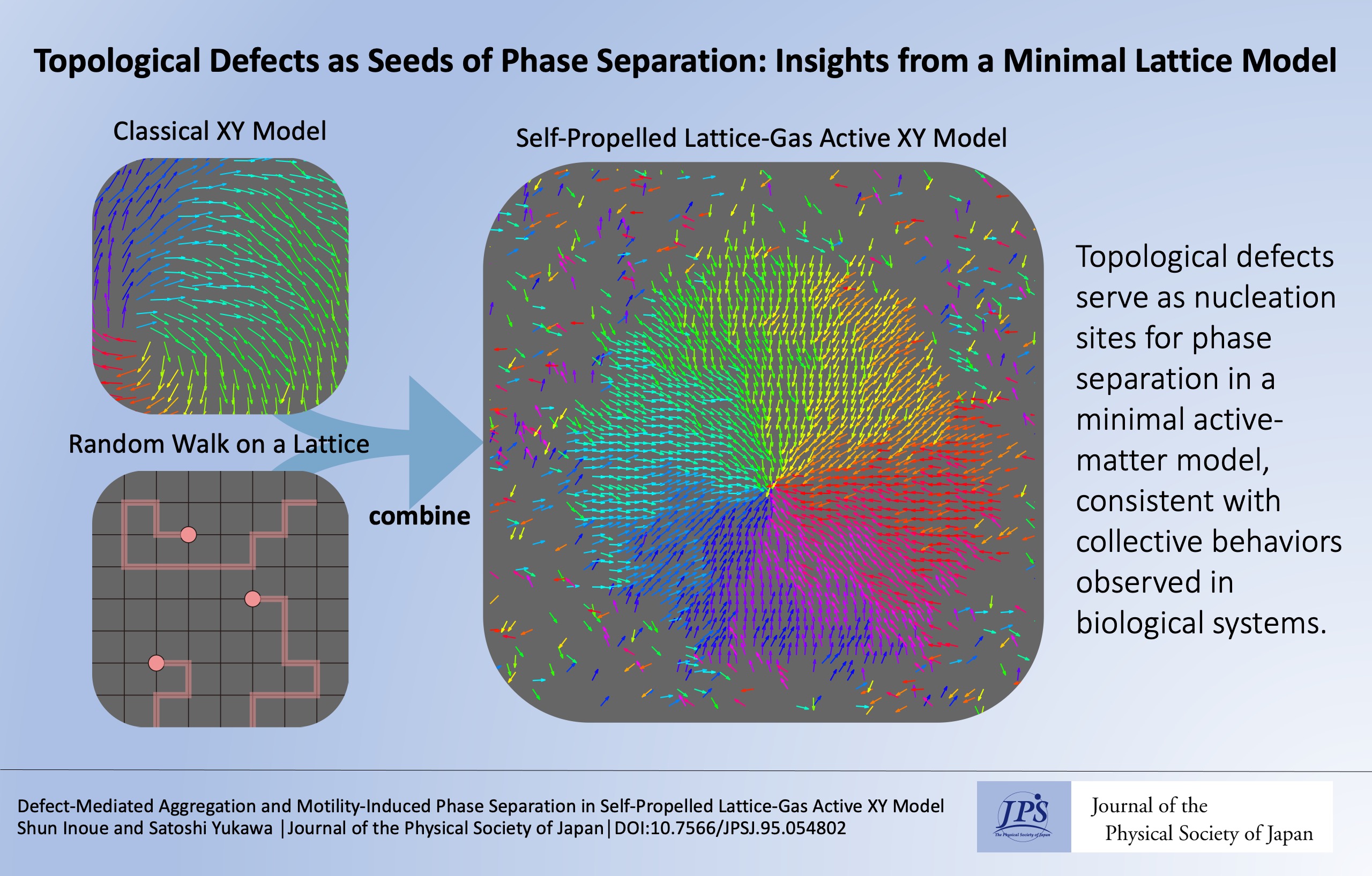
A minimal lattice model revealed that topological defects with winding number +1 serve as nucleation sites for phase separation in active matter systems.
Living organisms, such as bacteria, consume energy to move spontaneously without external input. For this reason, they are referred to as “active matter” in the sense that they differ from ordinary matter in thermal equilibrium. When such active matter assembles, it exhibits diverse and complex collective motions driven by self-propulsion and interactions of individual constituents. The various phenomena arising from this collective motion are inherently nonequilibrium, and advancing our physical understanding of them requires not only the concepts established in equilibrium statistical physics but also the introduction of new concepts and the development of minimal models that capture the essential physics.
Recently, one topic that has attracted particular attention is the relationship between topological defects generated by active matter and its collective motion. This topic is of great interest not only from a theoretical perspective but also because it has been directly observed in biological systems. For example, in neural progenitor cells, collective motion has been shown to give rise to multiple topological defects, and progenitor cells aggregate toward or disperse from these defects depending on their topological winding number. This demonstrates that the nature of topological defects is intimately linked to cell motility and that topological defects play a role in the spatial organization of biological functions. Therefore, clarifying the relationship between collective motion and topological defects in active matter from the perspective of nonequilibrium physics remains an important challenge.
In this study, to investigate the relationship between topological defects and collective motion in active matter, a lattice-based active matter model was constructed by combining a two-dimensional classical ferromagnetic XY model with a lattice random walk with an excluded volume, in which particles interact via XY spin couplings and undergo a biased random walk in the direction of their spin. Computer simulations of this model revealed that the particles aggregated around topological defects with a winding number of +1. This demonstrates that motility-induced phase separation, which is commonly observed in active matter systems, occurs with topological defects acting as nucleation sites. It was also found that topological defects with winding number −1 do not contribute to phase separation.
Furthermore, the model also exhibited first-order-like phase separation behavior and a scaling law for the maximum cluster size, both of which are features shared with established theoretical studies of active matter. These results demonstrate that the proposed model is highly effective for deepening our understanding of the relationship between topological defects and collective motion. Moreover, compared with other models, it can be simulated significantly faster on a computer, enabling large-scale numerical investigations. This property suggests that the proposed model will serve as a foundation for a wide range of future research directions.
(Written by Satoshi Yukawa on behalf of all authors.)
Defect-Mediated Aggregation and Motility-Induced Phase Separation in Self-Propelled Lattice-Gas Active XY Model
(JPSJ Editors' Choice)
J. Phys. Soc. Jpn.
95,
054802
(2026)
.
Share this topic


Fields
Related Articles
-
Only Certain Angles Allow Layer-by-Layer Stacking of Corrugated Rods
Cross-disciplinary physics and related areas of science and technology
2026-10-13
Rods with periodic surface corrugations stack helicoidally at only a discrete set of pitch angles. This rule opens a route for programming the fiber-stacking angle based on fiber surface texture.
-
How Heart Cells Come to Beat Together through an Elastic Substrate
Cross-disciplinary physics and related areas of science and technology
Statistical physics and thermodynamics
2026-8-24
Two isolated cardiomyocytes (heart muscle cells) can synchronize through deformations of a soft substrate. A dynamical theory explains geometry-dependent phase-locking and synchronization time.
-
Rumors Spread Wider Despite Low Transmissibility
Cross-disciplinary physics and related areas of science and technology
2026-8-7
This study proposes an SIS competition model that integrates rumor spread and opinion changes. This analysis reveals novel mechanisms for conflicting rumor coexistence, thus demonstrating that rumors paradoxically survive through low transmissibility.
-
Giant Brute-Force Simulation to Reveal Nucleation and Growth of Ultrasonic Cavitation Bubbles
Electromagnetism, optics, acoustics, heat transfer, and classical and fluid mechanics
Statistical physics and thermodynamics
2026-7-27
This study reveals the early-stage dynamics of ultrasonic cavitation using a record 100-billion-atom simulation to capture bubble nucleation, growth, clustering, and periodic splitting under nonequilibrium conditions.
-
Monitored Quantum Systems and Quantum Trajectories
Mathematical methods, classical and quantum physics, relativity, gravitation, numerical simulation, computational modeling
Statistical physics and thermodynamics
2026-7-21
This review in Progress of Theoretical and Experimental Physics introduces monitored quantum systems and quantum trajectories, emphasizing their spectral properties, typical behaviors such as ergodicity and purification, and measurement-induced phases.