

Higher-Order Topological Phases in Magnetic Materials with Breathing Pyrochlore Structures
© The Physical Society of Japan
This article is on
Topological Properties of the Four-qubit Entangled Phases on the Breathing Pyrochlore Lattice
(JPSJ Editors' Choice)
J. Phys. Soc. Jpn.
94,
044702
(2025)
.
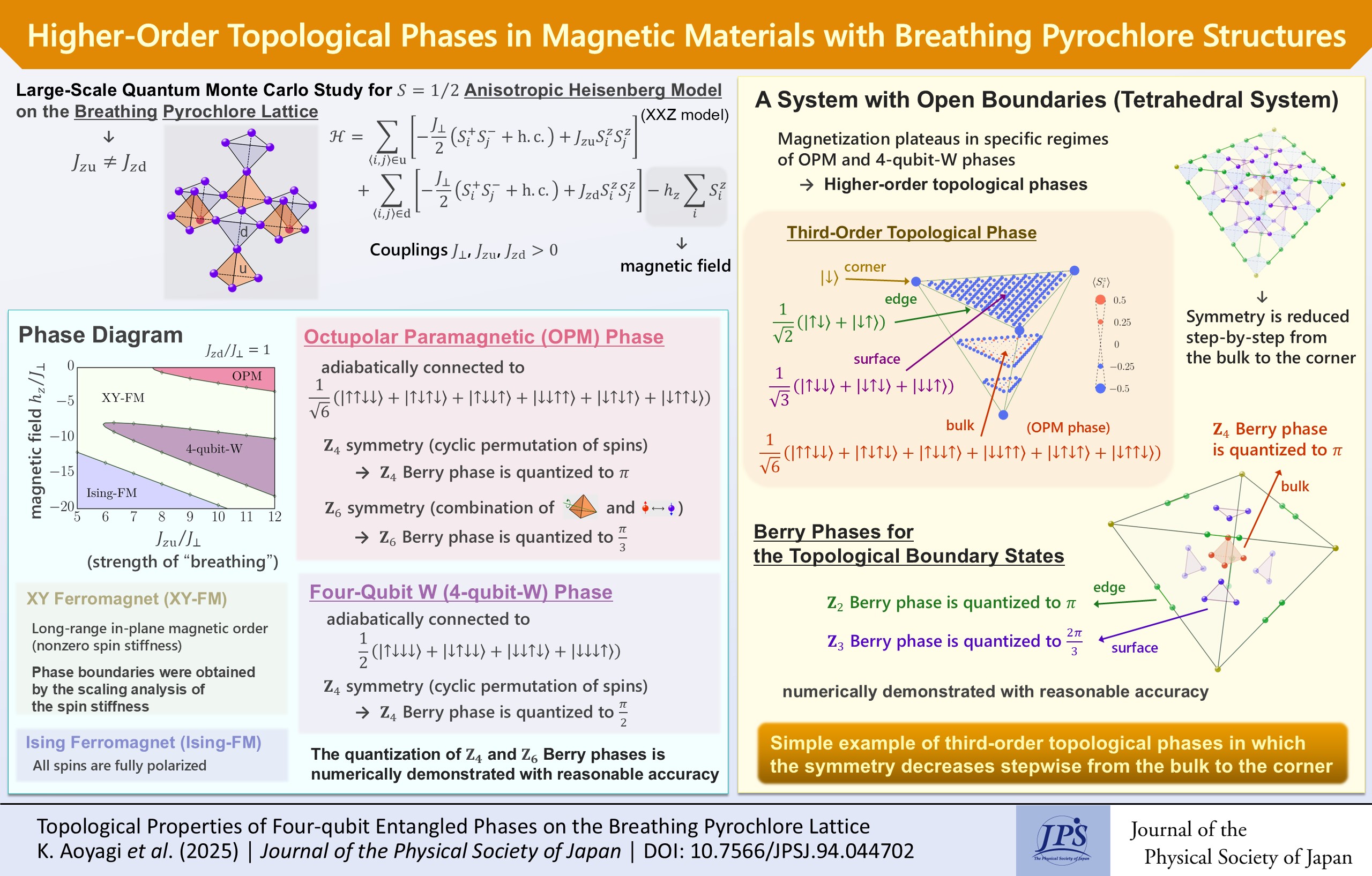
A simple example of a higher-order topological phase, in which the symmetry decreases step-by-step from the bulk to the corner, is realized in a magnetic system with a pyrochlore structure and is characterized by a series of quantized Berry phases defined for the bulk, surface, and edge.
Topology is a useful tool for understanding quantum entanglement in condensed matter physics. In particular, symmetry-protected topological phases, in which complex quantum entanglements can be classified by topological invariants, are attracting significant attention.
When materials with pyrochlore lattice structures have competing interactions, unusual quantum effects emerge. Among the various interesting states, we focus on two phases: the octupolar paramagnetic (OPM) states and the four-qubit W states. These states are characterized by four-qubit entangled states. Owing to the quantum effects, these states do not involve symmetry breaking.
In this study, we investigated the quantitative topological properties of these two phases using a large-scale numerical method called the quantum Monte Carlo method. We performed the scaling analysis of the spin stiffness to obtain the phase boundaries. We then evaluated the quantized Berry phases as topological invariants to characterize these phases, and showed that the quantized Berry phases are quantized to the values expected by the quantum entanglements in these phases.
We further investigated the topological properties of the system with boundaries. In the tetrahedral system, where the two-dimensional kagome lattice structure forms on its surface, we evaluated the local magnetic properties using a large-scale Monte Carlo method. It showed that higher-order topological phases emerge in specific regimes of the OPM and four-qubit W phases. In particular, the gapped surface and edge states of the third-order topological phase were identified within the OPM phase regime.
The Berry phases of the surface and edge states were evaluated to confirm the topological nature of the third-order topological phase. We found that the Berry phases were quantized, reflecting the symmetries and entanglement properties of the surface and edge states. It turns out that the present third-order topological phase is a simple example in which the symmetry is reduced stepwise from the bulk to the corner.
This study suggests that a large-scale numerical approach is a useful tool for analyzing higher-order topological phases in many-body systems in three dimensions.
(written by K. Aoyagi on behalf of all authors.)
Topological Properties of the Four-qubit Entangled Phases on the Breathing Pyrochlore Lattice
(JPSJ Editors' Choice)
J. Phys. Soc. Jpn.
94,
044702
(2025)
.
Share this topic


Fields
Related Articles
-
Monitored Quantum Systems and Quantum Trajectories
General and Mathematical Physics
Mathematical methods, classical and quantum physics, relativity, gravitation, numerical simulation, computational modeling
Statistical physics and thermodynamics
2026-7-21
This review in Progress of Theoretical and Experimental Physics introduces monitored quantum systems and quantum trajectories, emphasizing their spectral properties, typical behaviors such as ergodicity and purification, and measurement-induced phases.
-
Peculiar Magnet Pointing Against an Applied Magnetic Field
Cross-disciplinary physics and related areas of science and technology
Magnetic properties in condensed matter
2026-7-1
TbNiC2 exhibits negative magnetization. A new mechanism, based on the coupling between the charge density wave and the antiferromagnetic order, is proposed to account for this peculiar phenomenon.
-
Path Towards Experimental Exploration of Quantum Gravity
Mathematical methods, classical and quantum physics, relativity, gravitation, numerical simulation, computational modeling
2026-6-15
This study presents a novel route for experimentally realizing the Sachdev–Ye–Kitaev (SYK) model, considered holographically dual to charged black holes, offering the first step towards experimental studies of quantum gravity.
-
Magnetic-Field Driven Switching of Multipolar Order in an f-Electron System
Magnetic properties in condensed matter
2026-5-22
This study investigates high-rank multipole physics in f-electron systems, providing the first clear experimental evidence for field-induced switching of ferro-quadrupole order in a non-Kramer ion system, along with a new conceptual framework
-
Enhancing Accuracy and Reliability Bayesian Framework for Analysis of AR-HAXPES of Hard X-ray Photoelectron Spectroscopy
Dielectric, optical, and other properties in condensed matter
Electronic structure and electrical properties of surfaces and nanostructures
Measurement, instrumentation, and techniques
2026-4-28
We present a Bayesian framework for angle-resolved hard X-ray photoelectron spectroscopy (AR-HAXPES), combining Replica Exchange Monte Carlo with hierarchical integration to objectively and precisely estimate thin-film thickness.