

Existence of Chiral Soliton Lattices (CSLs) in Chiral Helimagnet Yb(Ni1-xCux)3Al9
© The Physical Society of Japan
This article is on
Chiral Soliton Lattice Formation in Monoaxial Helimagnet Yb(Ni1−xCux)3Al9
(The 30th Outstanding Paper Award of the Physical Society of Japan)
J. Phys. Soc. Jpn.
86,
124702
(2017)
.
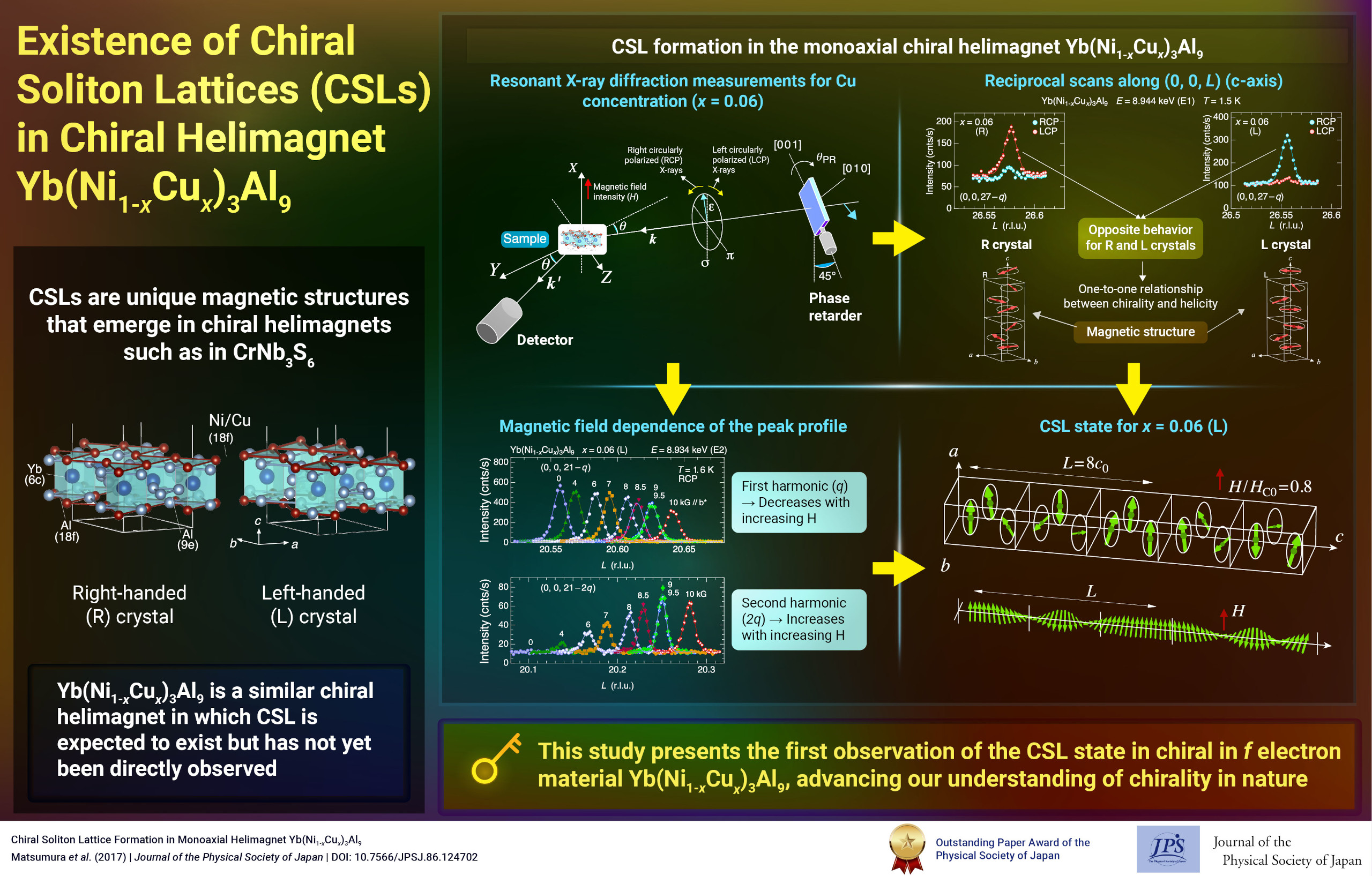
Our study examines the magnetic structure of the monoaxial chiral helimagnet Yb(Ni1-xCux)3Al9, providing first direct evidence of the formation of chiral soliton lattice state.
Chirality is the fundamental property of symmetry in nature that influences the physical properties of both inorganic and organic substances. Consequently, it has gained significant attention in materials science in the last decade.
In magnetic chiral crystals, which lack both inversion and mirror symmetries, the effect of the antisymmetric Dzyaloshinskii–Moriya (DM) interaction leads to a helimagnetic ground state. Applying a magnetic field along the helical axis in such a system transforms this helimagnetic ground state into a topological spin structure, such as magnetic skyrmions and chiral solitons.
The existence of a chiral soliton lattice (CSL) state was first predicted theoretically and later confirmed in the monoaxial chiral helimagnet CrNb3S6, a transition metal compound. Such materials can offer new functionalities by tuning the CSL state, with potential applications in spintronics.
Recently, magnetization measurements of Yb(Ni1-xCux)3Al9—a new monoaxial chiral helical magnet, have indicated the presence of a CSL state. Previous studies have shown that substituting nickel (Ni) with copper (Cu) results in an anomalous magnetization curve. Specifically, at 6% Cu doping, the magnetization resembles a CSL state, though it has not been directly observed.
In this study, we investigated the magnetic structure of Yb(Ni1-xCux)3Al9 through resonant X-ray diffraction (RXD). We performed RXD measurements using both right-circularly polarized (RCP) and left-circularly polarized (LCP) X-rays on the right-handed (R) and left-handed (L) crystal specimens of Yb(Ni1-xCux)3Al9 at different Cu concentrations.
Notably, the helicity of the magnetic structure depended on chirality of the crystal, as evident from the opposite behaviour of RCP and LCP X-rays for the R and L crystals in reciprocal space scans. This confirms the presence of an antisymmetric exchange interaction, i.e. the DM interaction.
Furthermore, when a magnetic field was applied perpendicular to the helical axis, second and third harmonic peaks were detected in the RXD pattern for crystals with 6% Cu doping. On increasing the magnetic field, the intensity of the first harmonic decreased while those of higher harmonic peaks increased. This behaviour, consistent with chiral Sine-Gorden model, provides compelling evidence for CSL state formation.
Remarkably, the period of the CSL is locked to the lattice when it is exactly three turns over eight unit-cells. These insights deepen our understanding of chirality-induced magnetic structures and their potential applications.
Our study is the first to demonstrate the presence of CSL state in Yb(Ni1-xCux)3Al9 and was honoured with the Outstanding Paper Award of the Physical Society of Japan.
Chiral Soliton Lattice Formation in Monoaxial Helimagnet Yb(Ni1−xCux)3Al9
(The 30th Outstanding Paper Award of the Physical Society of Japan)
J. Phys. Soc. Jpn.
86,
124702
(2017)
.
Share this topic


Fields
Related Articles
-
Peculiar Magnet Pointing Against an Applied Magnetic Field
Cross-disciplinary physics and related areas of science and technology
Magnetic properties in condensed matter
2026-7-1
TbNiC2 exhibits negative magnetization. A new mechanism, based on the coupling between the charge density wave and the antiferromagnetic order, is proposed to account for this peculiar phenomenon.
-
Magnetic-Field Driven Switching of Multipolar Order in an f-Electron System
Magnetic properties in condensed matter
2026-5-22
This study investigates high-rank multipole physics in f-electron systems, providing the first clear experimental evidence for field-induced switching of ferro-quadrupole order in a non-Kramer ion system, along with a new conceptual framework
-
Toward Clarification of Physical Properties of Quasicrystals: Noncollinear Magnetic Orders in Icosahedral Approximants
Cross-disciplinary physics and related areas of science and technology
Electronic transport in condensed matter
Magnetic properties in condensed matter
2026-4-6
An effective model based on magnetic anisotropy arising from a crystalline electric field is constructed for icosahedral approximants, which not only explains measured ferromagnets and antiferromagnets but also reveals new types of noncollinear magnetic orders.
-
Definitive Momentum and Spin Imaging Resolves 20-Year Debate on Gold Surface Spin
Electronic structure and electrical properties of surfaces and nanostructures
Magnetic properties in condensed matter
2026-4-1
Researchers at the Institute for Molecular Science (IMS) have utilized a cutting-edge Photoelectron Momentum Microscope (PMM) at the UVSOR Synchrotron Facility to settle a two-decade-long controversy concerning the direction of electron spin on the Au(111) surface. This study provides a definitive, full-map, comprehensive reference for quantum imaging that is essential for advancing spintronics technology.
-
Topological Hall Effect in Praseodymium Diantimonide
Magnetic properties in condensed matter
2026-2-27
The discovery of the topological Hall effect in a praseodymium-based compound is significant because its magnetism is not limited to a simple spin-only configuration as in many previous rare-earth systems.