

Extreme Magnetoresistance Reveals Unexpected Insulating Phase in a Semimetal
© The Physical Society of Japan
This article is on
Insulating Behavior in the Quantum Limit State of Bi1-xSbx (x ∼ 0.04) in the Vicinity of Semimetal-Semiconductor Transition
(JPSJ Editors’ Choice)
J. Phys. Soc. Jpn.
94,
043701
(2025)
.
We discovered an anomalous quantum state in which electric conduction exhibits a gapped behavior exclusively in one direction, in the quantum limit of the BiSb alloy under strong magnetic fields.
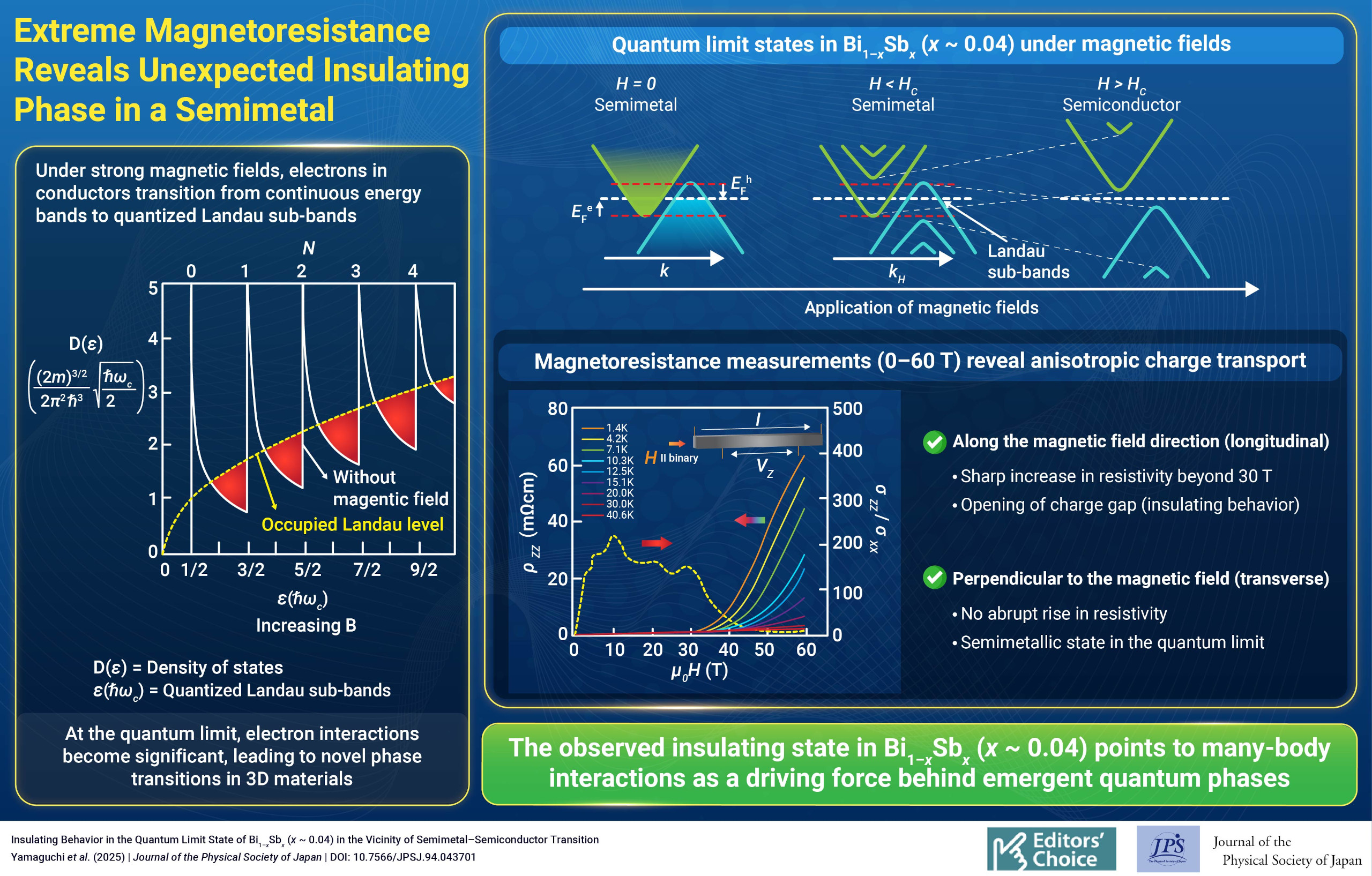
We can realize a quantum limit in extremely strong magnetic fields, where all charge carriers in metals occupy only the lowest-energy quantum state. Further increases in the magnetic field suppress the kinetic degrees of freedom of the carriers and incorporate electron correlation effects. Understanding the types of quantum states emerging from strongly correlated three-dimensional materials in the quantum limit remains a significant challenge, as magnetic fields exceeding 10,000 T are required to reach this state in conventional metals.
We investigated the semimetallic BiSb alloy to explore this novel quantum state in the quantum limit. Applying magnetic fields perpendicular to the three-fold rotational axis of this material reduces the overlap between the conduction and valence bands, inducing a semimetal-semiconductor transition at a specific magnetic field. Consequently, we can delve deeper into the quantum limit in fields slightly below this transition field. Our transverse magnetoresistance measurements (with current perpendicular to the magnetic field) exhibited clear quantum oscillations, indicating that the material remains semimetallic and reaches the quantum limit for both electron and hole carriers in magnetic fields up to 60 T. In contrast, the longitudinal magnetoresistance (with current parallel to the magnetic field) showed steep increase at magnetic fields above 30 T. Analysis of the transport data revealed a gap of a few meV only during conduction along the magnetic field, with no corresponding gap observed in the energy diagram calculated for single-particle states that neglect electron correlation effects.
Further investigations are required to clarify the origin of this anomalous insulating state in the quantum limit. Similar anisotropic insulating behaviors have recently been observed in several topological semimetals under high magnetic fields. It would be interesting to explore the tunable electron correlation effects, influenced by magnetic fields, in topological semimetals.
(Written by Masashi Tokunaga on behalf of all authors.)
Insulating Behavior in the Quantum Limit State of Bi1-xSbx (x ∼ 0.04) in the Vicinity of Semimetal-Semiconductor Transition
(JPSJ Editors’ Choice)
J. Phys. Soc. Jpn.
94,
043701
(2025)
.
Share this topic


Fields
Related Articles
-
What Shapes Electron Distributions in Nonequilibrium Nanowires?
Electronic transport in condensed matter
2026-4-20
A theoretical framework was developed to describe nonequilibrium electron distributions across the ballistic, diffusive, and local equilibrium transport regimes in voltage-biased nanowires in a unified manner.
-
Toward Clarification of Physical Properties of Quasicrystals: Noncollinear Magnetic Orders in Icosahedral Approximants
Cross-disciplinary physics and related areas of science and technology
Electronic transport in condensed matter
Magnetic properties in condensed matter
2026-4-6
An effective model based on magnetic anisotropy arising from a crystalline electric field is constructed for icosahedral approximants, which not only explains measured ferromagnets and antiferromagnets but also reveals new types of noncollinear magnetic orders.
-
The Physics of Light-Spin Interactions: Advances in Photodriven Quantum Spin Systems
Dielectric, optical, and other properties in condensed matter
Electromagnetism, optics, acoustics, heat transfer, and classical and fluid mechanics
Electronic transport in condensed matter
Magnetic properties in condensed matter
Statistical physics and thermodynamics
2025-12-17
This Special Topics edition of the Journal of the Physical Society of Japan discusses the recent progress and future directions for the rapidly progressing field of photodriven quantum spin systems.
-
Role of Orbital Currents in Future Solid-State Devices
Electronic transport in condensed matter
2025-10-6
This review explores recent experimental advances in the emerging field of orbitronics, focusing on orbital current mechanisms and orbitronic phenomena, providing key research directions for developing energy-efficient memory devices.
-
Carrier Scattering by Antisite Defects Reverses Thermoelectric Polarity in Fe₂VAl
Electronic transport in condensed matter
Structure and mechanical and thermal properties in condensed matter
2025-10-2
Antisite defects in Fe₂VAl create resonance states that boost hole scattering, which shifts carrier dominance to electrons and reverses thermoelectric polarity, thereby offering a new path for material design.