

Symmetry and AI: Building the Future of Physics Simulations
© The Physical Society of Japan
This article is on
Self-Learning Monte Carlo with Equivariant Transformer
(JPSJ Editors' Choice)
J. Phys. Soc. Jpn.
93,
114007
(2024)
.
Generative artificial intelligence (AI) has gained considerable attention in scientific fields. By embedding physical symmetry into AI before training, we created a faster and lighter model. Scaling improves the accuracy and unlocks the potential of physics research and applications.
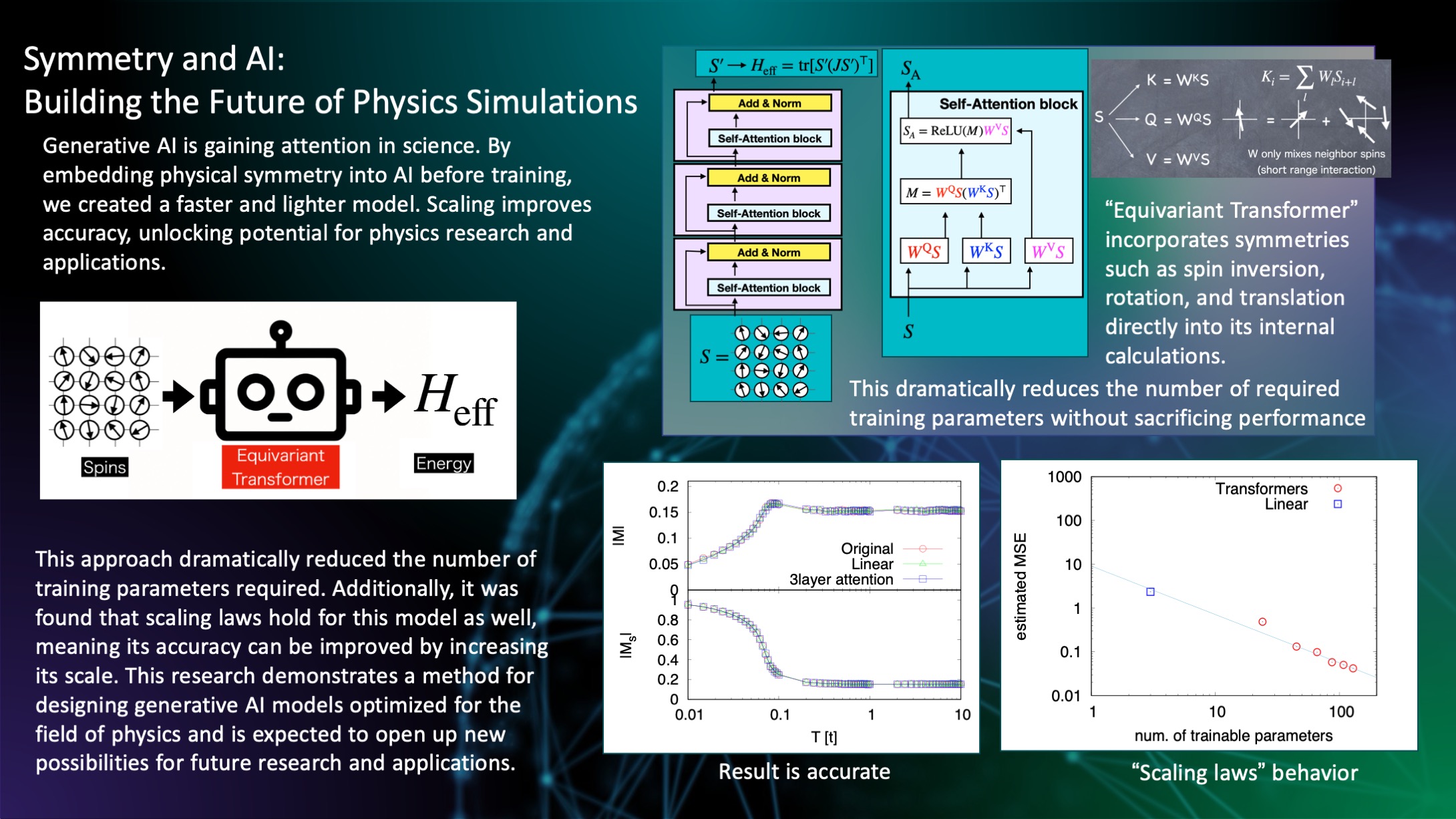
Generative AI automatically creates text, images, and music, converting ideas into tangible outputs. It has become an essential tool for creativity and problem-solving, with applications expanding in everyday life, education, and work. Innovations such as OpenAI’s ChatGPT and Google Gemini have further boosted their popularity. Generative AI and machine learning technologies have seen explosive growth in recent years and are now indispensable in scientific research and development. In physics, AI and machine learning are recognized as revolutionary tools, following traditional methods such as paper, pencil, and computers. For example, molecular dynamics simulations that track the motion of atoms over time often require highly precise calculations that account for quantum mechanical effects. These simulations sometimes take years even when supercomputers are used. However, by replacing computationally heavy parts with neural-network-based machine learning simulations, calculations can be accelerated by more than 1,000 times. This reduced the three-year simulation time to one day. Such advancements allow researchers to screen materials such as new battery components much faster, saving both time and cost during synthesis and experimentation. Generative AI, which is one of the most successful AI technologies, has immense potential for transforming physics. However, conventional generative AI models, such as those used for natural language processing, often contain billions of parameters. Although effective in their domains, they are computationally expensive and unsuitable for direct use in physical simulations. Large models also face the “black box” issue, where their processes are so complex that humans struggle to interpret the underlying physics. However, machine learning models specifically designed for physics are often too simple and lack the complexity required for high-accuracy simulations. Balancing simplicity and complexity is a significant challenge. A solution lies in leveraging symmetry, a key principle in physics, where an object remains unchanged under certain transformations, such as reflection, rotation, or translation. Symmetry explains fundamental principles, such as energy and momentum conservation. We recently developed an “Equivariant Transformer,” an AI model that incorporates these symmetries into its internal structure. By doing so, they drastically reduce the number of training parameters required while maintaining accuracy. Additionally, this model follows “scaling laws,” meaning its performance improves as the model size increases, just like in large language models.
This breakthrough demonstrated how generative AI can be adapted to physics by embedding symmetry principles and creating fast, accurate, and interpretable models. These advancements can lead to more efficient simulations, trustworthy AI systems, and new discoveries in physics, thus paving the way for exciting research opportunities.
(Written by Yuki Nagai on behalf of all authors)
Self-Learning Monte Carlo with Equivariant Transformer
(JPSJ Editors' Choice)
J. Phys. Soc. Jpn.
93,
114007
(2024)
.
Share this topic


Fields
Related Articles
-
Peculiar Magnet Pointing Against an Applied Magnetic Field
Cross-disciplinary physics and related areas of science and technology
Magnetic properties in condensed matter
2026-7-1
TbNiC2 exhibits negative magnetization. A new mechanism, based on the coupling between the charge density wave and the antiferromagnetic order, is proposed to account for this peculiar phenomenon.
-
Magnetic-Field Driven Switching of Multipolar Order in an f-Electron System
Magnetic properties in condensed matter
2026-5-22
This study investigates high-rank multipole physics in f-electron systems, providing the first clear experimental evidence for field-induced switching of ferro-quadrupole order in a non-Kramer ion system, along with a new conceptual framework
-
Enhancing Accuracy and Reliability Bayesian Framework for Analysis of AR-HAXPES of Hard X-ray Photoelectron Spectroscopy
Dielectric, optical, and other properties in condensed matter
Electronic structure and electrical properties of surfaces and nanostructures
Measurement, instrumentation, and techniques
2026-4-28
We present a Bayesian framework for angle-resolved hard X-ray photoelectron spectroscopy (AR-HAXPES), combining Replica Exchange Monte Carlo with hierarchical integration to objectively and precisely estimate thin-film thickness.
-
Toward Clarification of Physical Properties of Quasicrystals: Noncollinear Magnetic Orders in Icosahedral Approximants
Cross-disciplinary physics and related areas of science and technology
Electronic transport in condensed matter
Magnetic properties in condensed matter
2026-4-6
An effective model based on magnetic anisotropy arising from a crystalline electric field is constructed for icosahedral approximants, which not only explains measured ferromagnets and antiferromagnets but also reveals new types of noncollinear magnetic orders.
-
Definitive Momentum and Spin Imaging Resolves 20-Year Debate on Gold Surface Spin
Electronic structure and electrical properties of surfaces and nanostructures
Magnetic properties in condensed matter
2026-4-1
Researchers at the Institute for Molecular Science (IMS) have utilized a cutting-edge Photoelectron Momentum Microscope (PMM) at the UVSOR Synchrotron Facility to settle a two-decade-long controversy concerning the direction of electron spin on the Au(111) surface. This study provides a definitive, full-map, comprehensive reference for quantum imaging that is essential for advancing spintronics technology.