

Spin-Spin Interaction Mediated by Rotational Lattice Vibrations
© The Physical Society of Japan
This article is on
Spin-Spin Interaction Mediated by Chiral Phonons
(JPSJ Editors' Choice)
J. Phys. Soc. Jpn.
93,
123705
(2024)
.
This study predicts the presence of spin-spin interactions mediated by the angular momentum of lattice vibrations, which can be long-range.
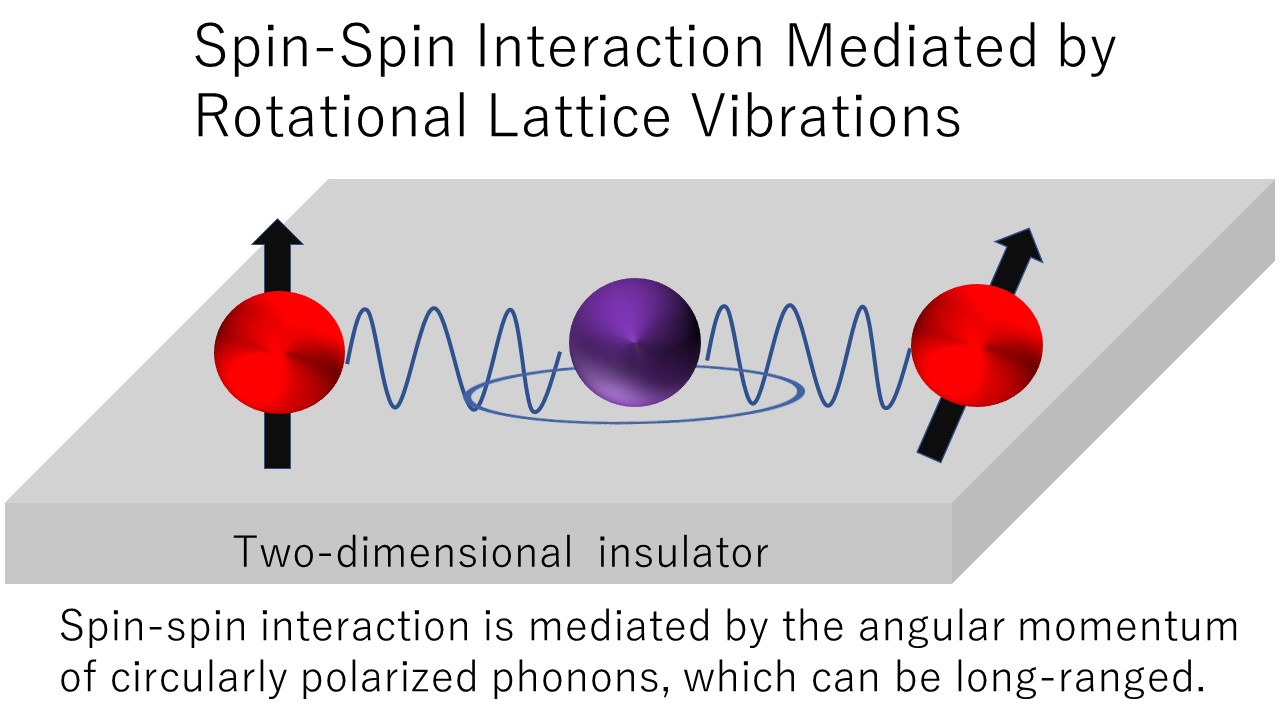
In solids, atoms are arranged in a regular pattern; however, atoms can vibrate from their equilibrium positions through vibrational modes known as phonons. In particular, the circularly polarized vibrational motions of ions are called chiral phonons (note that there is another definition for chiral phonons. In this study, we refer to two-dimensional (2D) rotational phonons as chiral phonons).
Chiral phonons exhibit angular and magnetic moments owing to the rotational motion of the ions. The rotation of the ions also induces effective magnetic fields that can be relatively large (of the order of 1 T). Chiral phonons can couple with spins through the Zeeman effect of these magnetic fields.
Recent experimental reports have suggested that the spin–spin interaction through an insulator is mediated by chiral phonons, which cannot be explained by electronic mechanisms. However, although this interaction may be attributed to chiral phonons, the microscopic mechanism remains unclear. The electronic origins of the mechanisms of spin–spin interactions have been extensively investigated. Thus, one fundamental question is: What is the signature of boson-mediated spin–spin interactions?
To address these problems, we investigated the interaction between two localized spins on top of a 2D insulator in the presence of chiral phonons. We demonstrated that this interaction was mediated by chiral phonons through spin-chiral phonon coupling. The exchange interactions were always positive because of the bosonic nature of phonons. We found that the exchange interactions for acoustic and optical phonons (i.e., in-phase and out-of-phase motions of neighboring atoms) exhibited a power-law decay with respect to the distance between two localized spins and were proportional to the temperature of the system at high temperatures. Furthermore, the chiral phonon-induced spin-spin interaction exhibited a power-law decay, corresponding to the propagation of phonons in insulators. Therefore, this interaction can become the dominant mechanism for spin-spin interactions in magnetic insulators.
Further, an extremely small rotation of atoms can induce a strong magnetic field (on the order of 1 T); therefore, chiral phonons can be regarded as tiny magnets. The interaction between chiral phonons and spin (or magnetization), such as the magnetization reversal induced by chiral phonons, has been actively researched in recent years. Applications to new device principles are anticipated in combination with studies on spintronics.
(Written by T. Yokoyama)
Spin-Spin Interaction Mediated by Chiral Phonons
(JPSJ Editors' Choice)
J. Phys. Soc. Jpn.
93,
123705
(2024)
.
Share this topic


Fields
Related Articles
-
Peculiar Magnet Pointing Against an Applied Magnetic Field
Cross-disciplinary physics and related areas of science and technology
Magnetic properties in condensed matter
2026-7-1
TbNiC2 exhibits negative magnetization. A new mechanism, based on the coupling between the charge density wave and the antiferromagnetic order, is proposed to account for this peculiar phenomenon.
-
The Thermal Einstein–de Haas Effect: Theoretical Prediction and Observability in Chiral Carbon Nanotubes
Cross-disciplinary physics and related areas of science and technology
Structure and mechanical and thermal properties in condensed matter
2026-6-22
Although the Einstein–de Haas (EdH) effect describes material rotation in a magnetic field, a thermal EdH effect, driven by a temperature gradient, remains unobserved. Recently, chiral carbon nanotubes were theoretically proposed as promising candidates to observe it.
-
Negative Apparent Viscosity in Liquid Crystals
Cross-disciplinary physics and related areas of science and technology
Electromagnetism, optics, acoustics, heat transfer, and classical and fluid mechanics
Structure and mechanical and thermal properties in condensed matter
2026-6-8
Electrically driven liquid-crystal turbulence generates self-sustained flow and negative apparent viscosity. The fluorinated, chemically robust nematic PPDFB shows a substantially larger negative-viscosity effect than Schiff-base nematics.
-
Magnetic-Field Driven Switching of Multipolar Order in an f-Electron System
Magnetic properties in condensed matter
2026-5-22
This study investigates high-rank multipole physics in f-electron systems, providing the first clear experimental evidence for field-induced switching of ferro-quadrupole order in a non-Kramer ion system, along with a new conceptual framework
-
Role of the Diffusion Layer in Energy Devices
Cross-disciplinary physics and related areas of science and technology
Structure and mechanical and thermal properties in condensed matter
2026-5-1
In many energy devices, electron transfer occurs between ions dissolved in the electrolyte and the electrodes. For keep current flowing, new ions must be supplied continuously to the electrode surface from the bulk region. The diffusion layer’s role in diffusive mass transfer was clarified using the rotating disk electrode method.