

Chiral Gauge Field and Topological Magnetoelectric Response in Fully Spin-Polarized Magnetic Weyl Semimetal Co3Sn2S2
© The Physical Society of Japan
This article is on
Chiral Gauge Field in Fully Spin-Polarized Magnetic Weyl Semimetal with Magnetic Domain Walls
(JPSJ Editors' Choice)
J. Phys. Soc. Jpn.
93,
094704
(2024)
.
This study clarifies the relationship between magnetic ordering and chiral gauge fields in the ferromagnetic Weyl semimetal Co3Sn2S2, highlighting its spintronic potential using the topological magnetoelectric responses of Weyl fermions.
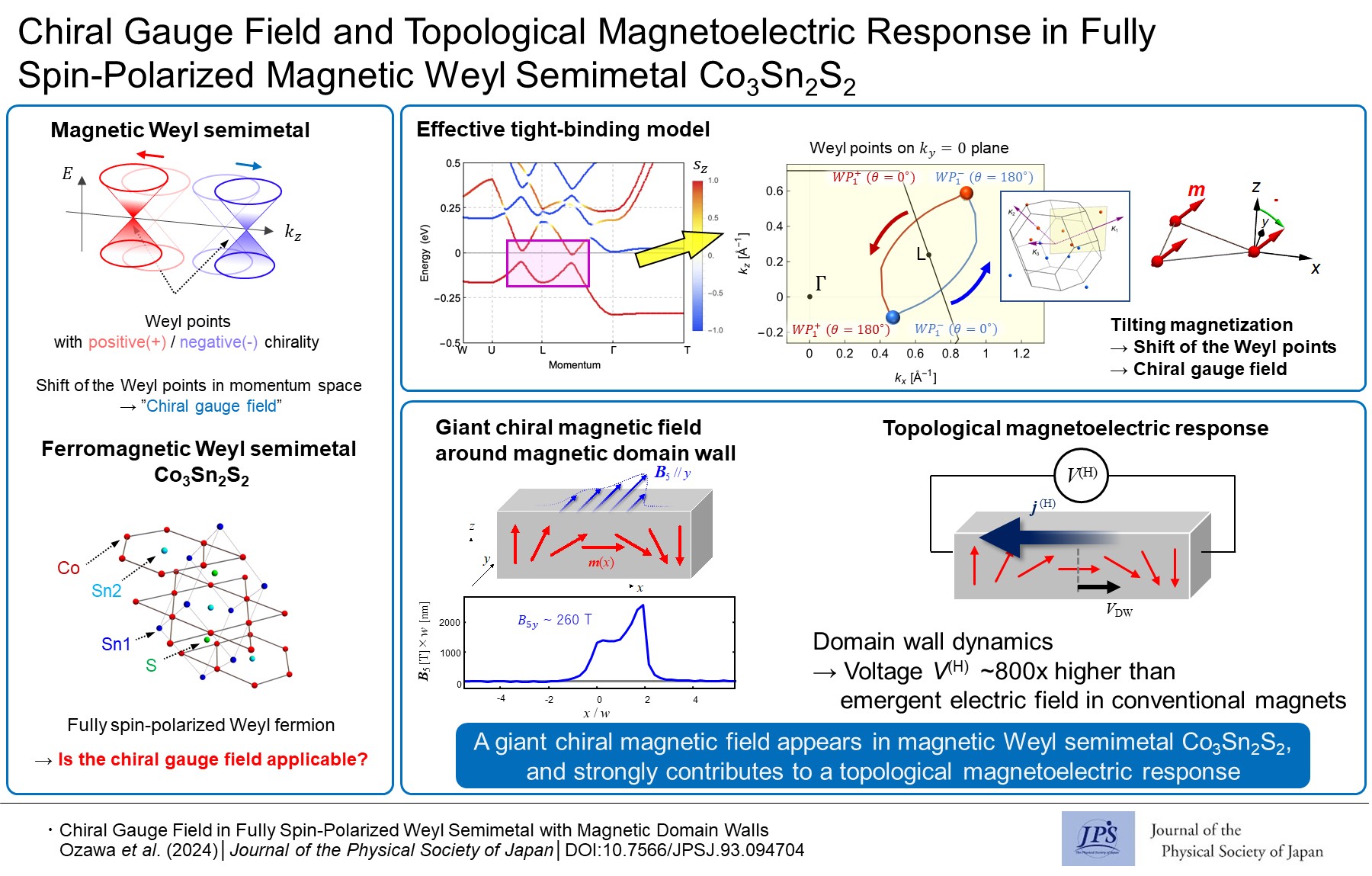
Weyl semimetals are a class of materials characterized by the presence of Weyl points where the valence and conduction bands touch linearly. Electrons near these points behave as relativistic fermions called Weyl fermions, contributing to topological magnetoelectric responses, such as the anomalous Hall effect. The concept of chiral gauge field was introduced to understand these topological effects. This fictitious gauge field describes the shifts in the Weyl points in the momentum space. Previous studies have shown that a chiral gauge field can be generated by external perturbations, such as light and lattice strain. This enables one to understand their effects, similar to ordinary electromagnetic fields appearing in Maxwell’s equations.
In magnetic Weyl semimetals, the interplay between the magnetic ordering and the topological magnetoelectric responses is of particular interest. When spin–momentum locking is present, where the spin and momentum of Weyl fermions are parallel or antiparallel, the magnetization can be directly mapped to the chiral gauge field. This correspondence has led to the development of various magnetoelectric responses with potential spintronic functionalities. However, the spin–momentum locking structure depends on both spin–orbit coupling and spin polarization. This hinders the understanding of the topological magnetoelectric responses in realistic magnetic Weyl semimetals based on a chiral gauge field.
This study investigated the chiral gauge field in relation to the magnetization in the Weyl ferromagnet Co3Sn2S2. The electrons in Co3Sn2S2 are nearly fully spin-polarized, leading to the absence of spin–momentum locking around the Weyl points. The effective model calculations in this study demonstrated that the positions of the Weyl points are significantly influenced by magnetization modulation, which can be described by the chiral gauge field. This result attributes the temporal and spatial variations in the magnetization within Co3Sn2S2 to the chiral electric and magnetic fields. The calculations demonstrated that a magnetic domain wall with a width of 10 nm generates a large chiral magnetic field of 260 T, leading to topological magnetoelectric responses. One consequence is the charge pumping driven by domain wall dynamics, which is analogous to the quantum Hall effect induced by chiral electromagnetic fields. This effect results in an electric voltage up to 800 times higher than the spin motive force observed in conventional ferromagnetic metals. This makes Co3Sn2S2 a promising material for detecting domain wall dynamics in spintronic devices, such as magnetic memories.
The insights gained from this study on the chiral gauge field in magnetic Weyl semimetals are expected to stimulate further exploration of novel topological magnetoelectric responses associated with magnetic textures and dynamics.
(Written by A. Ozawa and Y. Araki on behalf of all the authors)
Chiral Gauge Field in Fully Spin-Polarized Magnetic Weyl Semimetal with Magnetic Domain Walls
(JPSJ Editors' Choice)
J. Phys. Soc. Jpn.
93,
094704
(2024)
.
Share this topic


Fields
Related Articles
-
Magnetic-Field Driven Switching of Multipolar Order in an f-Electron System
Magnetic properties in condensed matter
2026-5-22
This study investigates high-rank multipole physics in f-electron systems, providing the first clear experimental evidence for field-induced switching of ferro-quadrupole order in a non-Kramer ion system, along with a new conceptual framework
-
What Shapes Electron Distributions in Nonequilibrium Nanowires?
Electronic transport in condensed matter
2026-4-20
A theoretical framework was developed to describe nonequilibrium electron distributions across the ballistic, diffusive, and local equilibrium transport regimes in voltage-biased nanowires in a unified manner.
-
Toward Clarification of Physical Properties of Quasicrystals: Noncollinear Magnetic Orders in Icosahedral Approximants
Cross-disciplinary physics and related areas of science and technology
Electronic transport in condensed matter
Magnetic properties in condensed matter
2026-4-6
An effective model based on magnetic anisotropy arising from a crystalline electric field is constructed for icosahedral approximants, which not only explains measured ferromagnets and antiferromagnets but also reveals new types of noncollinear magnetic orders.
-
Definitive Momentum and Spin Imaging Resolves 20-Year Debate on Gold Surface Spin
Electronic structure and electrical properties of surfaces and nanostructures
Magnetic properties in condensed matter
2026-4-1
Researchers at the Institute for Molecular Science (IMS) have utilized a cutting-edge Photoelectron Momentum Microscope (PMM) at the UVSOR Synchrotron Facility to settle a two-decade-long controversy concerning the direction of electron spin on the Au(111) surface. This study provides a definitive, full-map, comprehensive reference for quantum imaging that is essential for advancing spintronics technology.
-
Topological Hall Effect in Praseodymium Diantimonide
Magnetic properties in condensed matter
2026-2-27
The discovery of the topological Hall effect in a praseodymium-based compound is significant because its magnetism is not limited to a simple spin-only configuration as in many previous rare-earth systems.