

Chiral Anomalies in Organic Dirac Semimetals
© The Physical Society of Japan
This article is on
Evidence for Three-dimensional Dirac Semimetal State in Strongly Correlated Organic Quasi-two-Dimensional Material
(JPSJ Editors' Choice)
J. Phys. Soc. Jpn.
92,
123702
(2023)
.
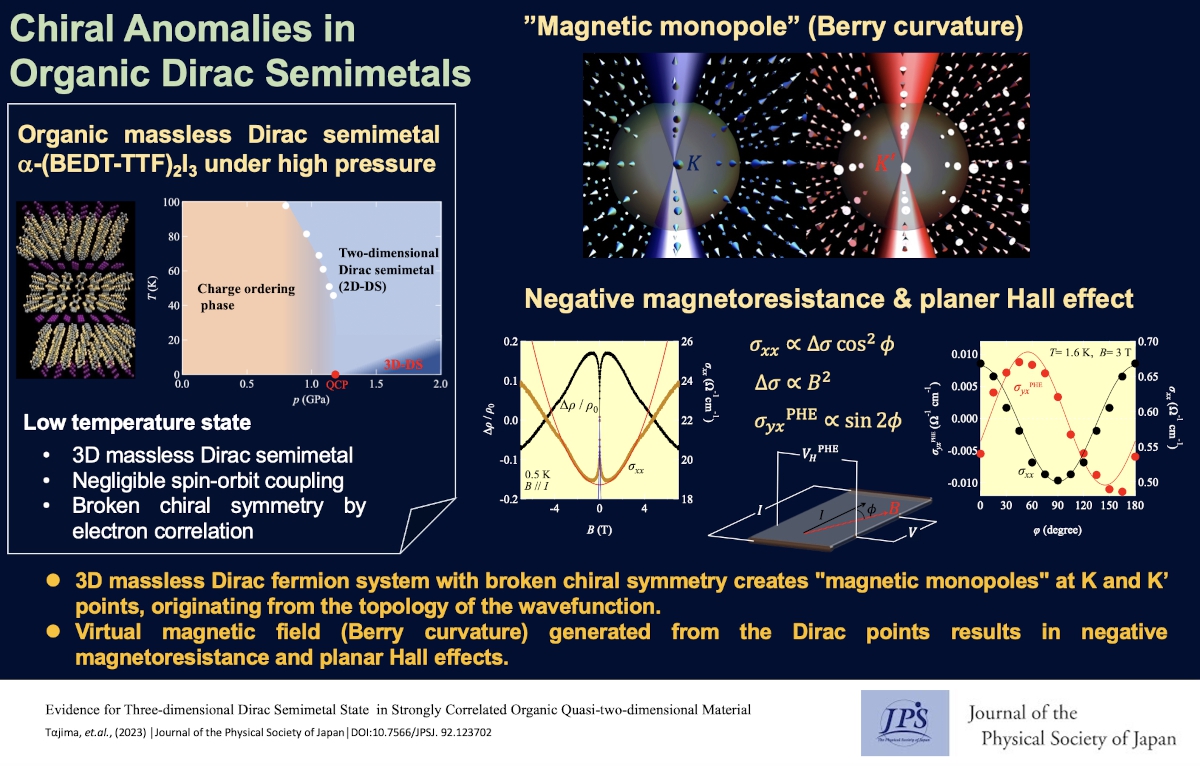
A three-dimensional massless Dirac fermion system exhibiting broken chiral symmetry was successfully realized in organic conductor α-(BEDT-TTF)2I3 under high pressures. Our study detected the chiral anomaly-induced negative magnetoresistance and planar Hall effects and opened new avenues for further advancements in the field.
Conservation laws that hold in classical theory can be violated in quantum mechanics, a phenomenon known as the “chiral anomaly.” This intriguing violation of the conservation laws has been the focal point of research in particle physics and astrophysics for many years. However, recently, physical phenomena stemming from chiral anomalies have been observed in topological materials, revealing that chiral anomalies are a universal phenomenon that also manifest in solid-state systems.
Chiral anomaly effects in solids result in pronounced responses, including transport phenomena without scattering, such as negative magnetoresistance, planar Hall effects, and anomalous Hall effects. Consequently, topological materials that exhibit chiral anomalies have garnered significant interest for potential device applications.
Broken chiral symmetry is crucial for the occurrence of chiral anomalies, and the dimensionality of electron motion is another key factor. According to quantum field theory, chiral anomalies are present in three-dimensional (3D) systems but absent in two-dimensional (2D) systems. Typically, Dirac semimetals are categorized as either 2D or 3D, with no materials bridging these dimensions yet. To explore the physics behind chiral anomaly effects, candidate materials capable of transitioning between 2D and 3D dimensionalities have been searched.
We propose that organic conductor α-(BEDT-TTF)2I3under high pressures emerges as a prime candidate material. This is the first bulk (multilayered) massless Dirac fermion system identified. Although various physical phenomena within this system have traditionally been interpreted through a 2D framework, the evidence of coherent interlayer tunneling at low temperatures reveals its intrinsic 3D nature. Theoretical insights indicate that this system functions as a 3D Dirac semimetal with chiral symmetry broken by electron correlation.
In the 3D Dirac semimetal with broken chiral symmetry, a “magnetic monopole”—stemming from the topology of the wave function—is formed at the two Dirac points, K and K', analogous to the N and S poles. The observation of negative magnetoresistance and planar Hall effects, driven by a virtual magnetic field (known as the Berry curvature) emanating from the Dirac points, confirms the realization of a 3D Dirac semimetal with chiral anomalies in α-(BEDT-TTF)2I3 under high pressures at low temperatures. This system provides a pivotal platform for probing chiral anomalies.
(Written by N. Tajima on behalf of all authors)
Evidence for Three-dimensional Dirac Semimetal State in Strongly Correlated Organic Quasi-two-Dimensional Material
(JPSJ Editors' Choice)
J. Phys. Soc. Jpn.
92,
123702
(2023)
.
Share this topic


Fields
Related Articles
-
What Shapes Electron Distributions in Nonequilibrium Nanowires?
Electronic transport in condensed matter
2026-4-20
A theoretical framework was developed to describe nonequilibrium electron distributions across the ballistic, diffusive, and local equilibrium transport regimes in voltage-biased nanowires in a unified manner.
-
Toward Clarification of Physical Properties of Quasicrystals: Noncollinear Magnetic Orders in Icosahedral Approximants
Cross-disciplinary physics and related areas of science and technology
Electronic transport in condensed matter
Magnetic properties in condensed matter
2026-4-6
An effective model based on magnetic anisotropy arising from a crystalline electric field is constructed for icosahedral approximants, which not only explains measured ferromagnets and antiferromagnets but also reveals new types of noncollinear magnetic orders.
-
The Physics of Light-Spin Interactions: Advances in Photodriven Quantum Spin Systems
Dielectric, optical, and other properties in condensed matter
Electromagnetism, optics, acoustics, heat transfer, and classical and fluid mechanics
Electronic transport in condensed matter
Magnetic properties in condensed matter
Statistical physics and thermodynamics
2025-12-17
This Special Topics edition of the Journal of the Physical Society of Japan discusses the recent progress and future directions for the rapidly progressing field of photodriven quantum spin systems.
-
Role of Orbital Currents in Future Solid-State Devices
Electronic transport in condensed matter
2025-10-6
This review explores recent experimental advances in the emerging field of orbitronics, focusing on orbital current mechanisms and orbitronic phenomena, providing key research directions for developing energy-efficient memory devices.
-
Carrier Scattering by Antisite Defects Reverses Thermoelectric Polarity in Fe₂VAl
Electronic transport in condensed matter
Structure and mechanical and thermal properties in condensed matter
2025-10-2
Antisite defects in Fe₂VAl create resonance states that boost hole scattering, which shifts carrier dominance to electrons and reverses thermoelectric polarity, thereby offering a new path for material design.