

Relation between Mean-Field Theory and Atomic Structures in Chalcogenide Glasses
© The Physical Society of Japan
This article is on
J. Phys. Soc. Jpn.
93,
014601
(2024)
.
The authors conducted various of X-ray and neutron scattering experiments on typical chalcogenide glasses and clarified the relationship between the atomic structure and simple rigidity percolation theory.
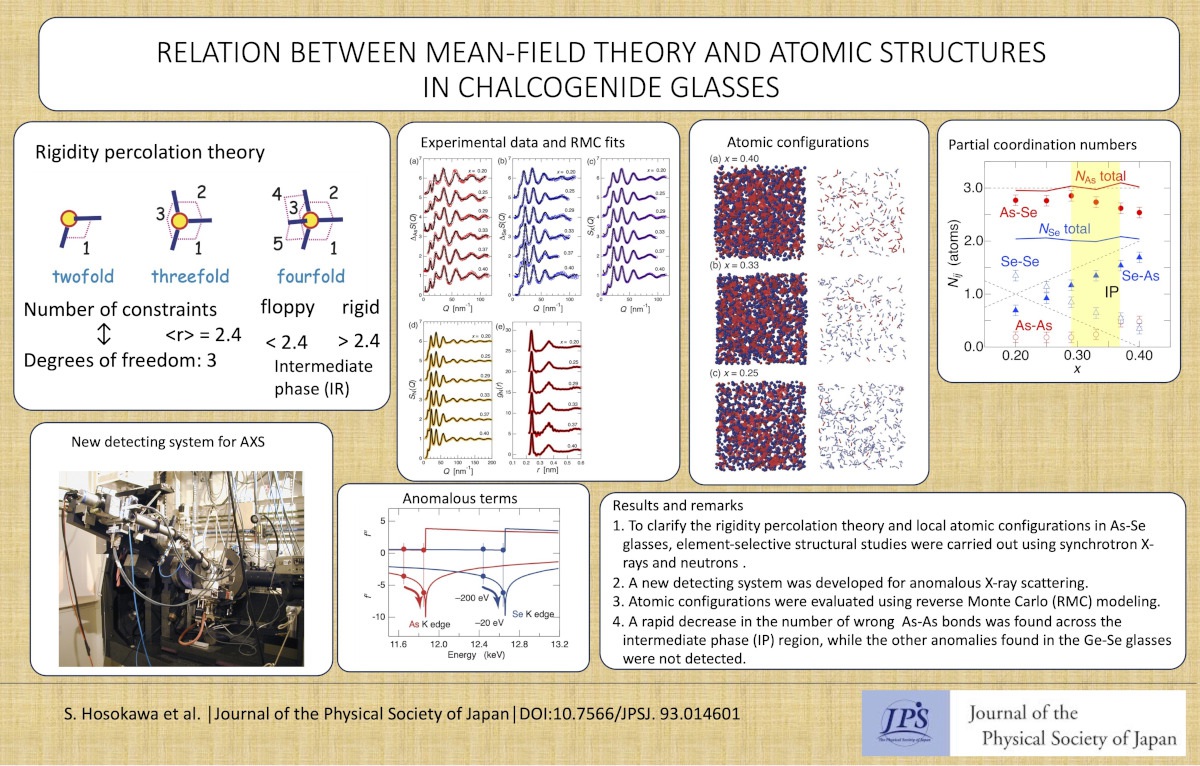
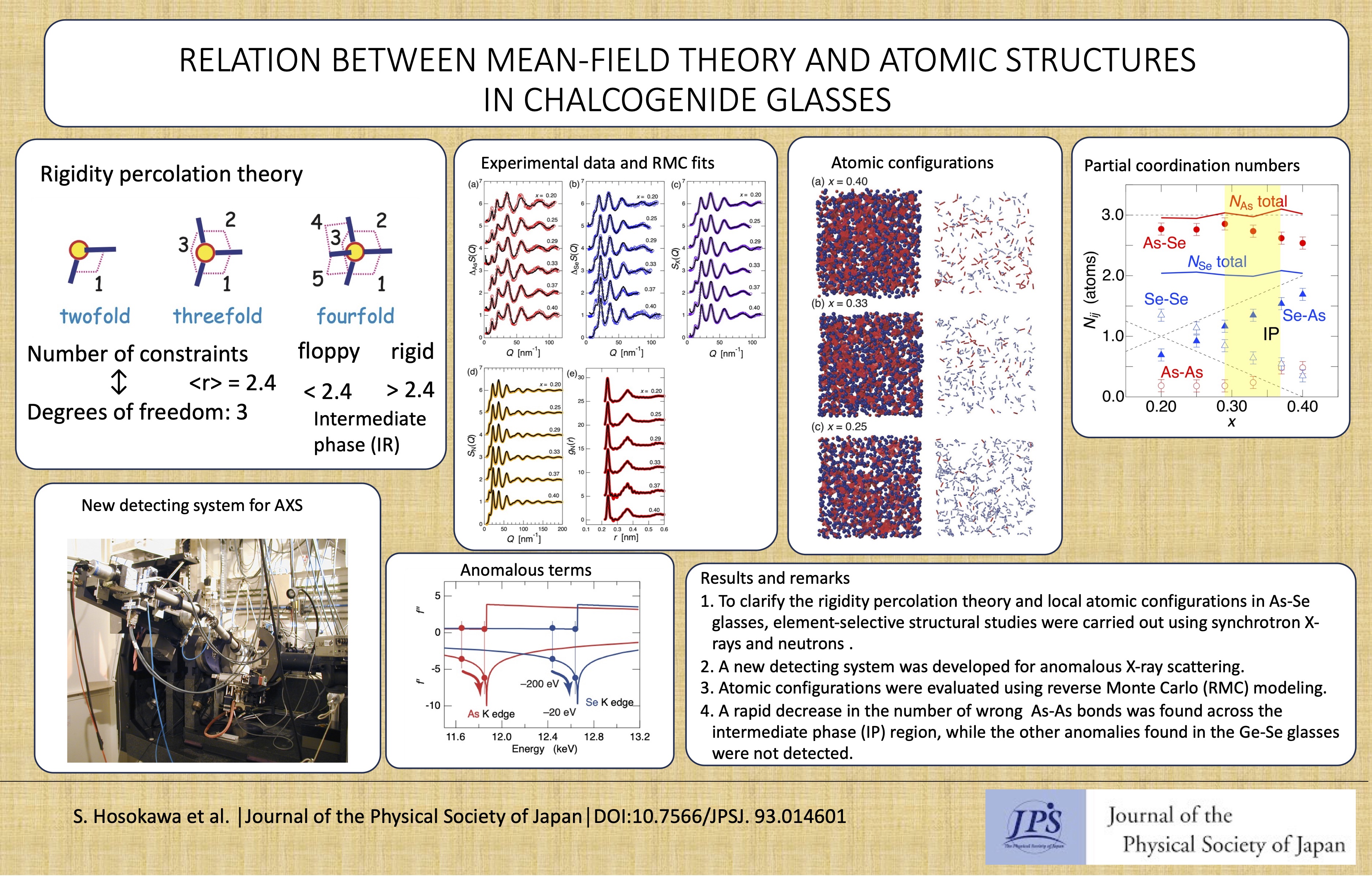
Rigidity percolation (mean-field) theory is a simple theory that can explain several anomalies in the thermodynamic properties of covalently bonded glasses such as chalcogenides. According to this theory, the atoms in covalent glasses are constrained by either bonds or bond angles. When the constituent atom has coordination number r, the bond constraint and bond angle constraint are r/2 and 2r-3 per atom, respectively. If the averaged sum of these constraints is equal to the degree of freedom of three in three dimensions, i.e., r = 2.4 at x = 0.40 for AsxSe1-x glasses and x = 0.20 for GexSe1-x glasses, the glasses show excellent glass forming ability separated between rigid (r > 2.4) and floppy (r < 2.4) glasses. Further, calorimetric and Raman scattering experiments revealed that the transition occurred within a certain composition range of the intermediate phase (IP) of the unstressed rigid phase.
This article presents a series of structural studies using element-selective diffraction techniques with synchrotron X-rays and high-flux neutron sources to investigate the structural changes across the IP transition phase in chalcogenide glasses. Technical improvements were achieved by developing a new detection system with a curved graphite analyzer crystal and a 1-m-long detector arm at the beamline BM02 of the European Synchrotron Radiation Facility (ESRF). Experimental X-ray and neutron diffraction data and anomalous X-ray scattering (AXS) results close to the absorption edges of the constituent elements were analyzed using reverse Monte Carlo modeling to reveal changes in intermediate-range atomic configurations across the IP range from rigid to floppy. The AsxSe1-xglasses have an IP range of x = 0.29-0.37, where a rapid decrease in the number of wrong As-As bonds is observed. However, other anomalies found in Ge-Se glasses were not clearly observed, such as a rapid decrease in the pre-shoulder positions in the Se-Se partial structure factor, SSeSe(Q), a rapid decrease in the number of edge-sharing connections, and an exclusion tendency of the connections between the As (Ge) atoms sharing two Se atoms. These differences may be related to the anisotropic pyramidal AsSe3 units in the As-Se glasses, in contrast to the isotropic tetrahedral GeSe4 units around the Ge atoms in the Ge-Se glasses. This study was supported by a JSPS Grant-in-Aid for Transformative Research Areas (A) Hyper-Ordered Structures Science.
(Written by S. Hosokawa on behalf of all the authors.)
J. Phys. Soc. Jpn.
93,
014601
(2024)
.
Share this topic


Fields
Related Articles
-
The Thermal Einstein–de Haas Effect: Theoretical Prediction and Observability in Chiral Carbon Nanotubes
Cross-disciplinary physics and related areas of science and technology
Structure and mechanical and thermal properties in condensed matter
2026-6-22
Although the Einstein–de Haas (EdH) effect describes material rotation in a magnetic field, a thermal EdH effect, driven by a temperature gradient, remains unobserved. Recently, chiral carbon nanotubes were theoretically proposed as promising candidates to observe it.
-
Negative Apparent Viscosity in Liquid Crystals
Cross-disciplinary physics and related areas of science and technology
Electromagnetism, optics, acoustics, heat transfer, and classical and fluid mechanics
Structure and mechanical and thermal properties in condensed matter
2026-6-8
Electrically driven liquid-crystal turbulence generates self-sustained flow and negative apparent viscosity. The fluorinated, chemically robust nematic PPDFB shows a substantially larger negative-viscosity effect than Schiff-base nematics.
-
Role of the Diffusion Layer in Energy Devices
Cross-disciplinary physics and related areas of science and technology
Structure and mechanical and thermal properties in condensed matter
2026-5-1
In many energy devices, electron transfer occurs between ions dissolved in the electrolyte and the electrodes. For keep current flowing, new ions must be supplied continuously to the electrode surface from the bulk region. The diffusion layer’s role in diffusive mass transfer was clarified using the rotating disk electrode method.
-
Unveiling the Nodal Topology of the Spin-Triplet Superconductor Candidate UTe2
Structure and mechanical and thermal properties in condensed matter
Superconductivity
2026-4-13
Using high-quality UTe2 (Tc = 2.1 K), we identify its nodal gap structure. Field-angle‑resolved specific‑heat reveals a b-axis singularity, supporting spin-triplet superconductivity with nodes along the b axis.
-
Creation of Chiral Phonons−How Lattice Chirality Imparts Angular Momentum to Phonons?
Structure and mechanical and thermal properties in condensed matter
2026-3-2
Chiral crystals host phonons with intrinsic angular momentum, whose quantization and energy splitting reflect the lattice chirality and reveal the microscopic features of interatomic interactions.