

Thermodynamic Property of a CMOS Device beyond Landauer Limit
© The Physical Society of Japan
This article is on
J. Phys. Soc. Jpn.
92,
124004
(2023)
.
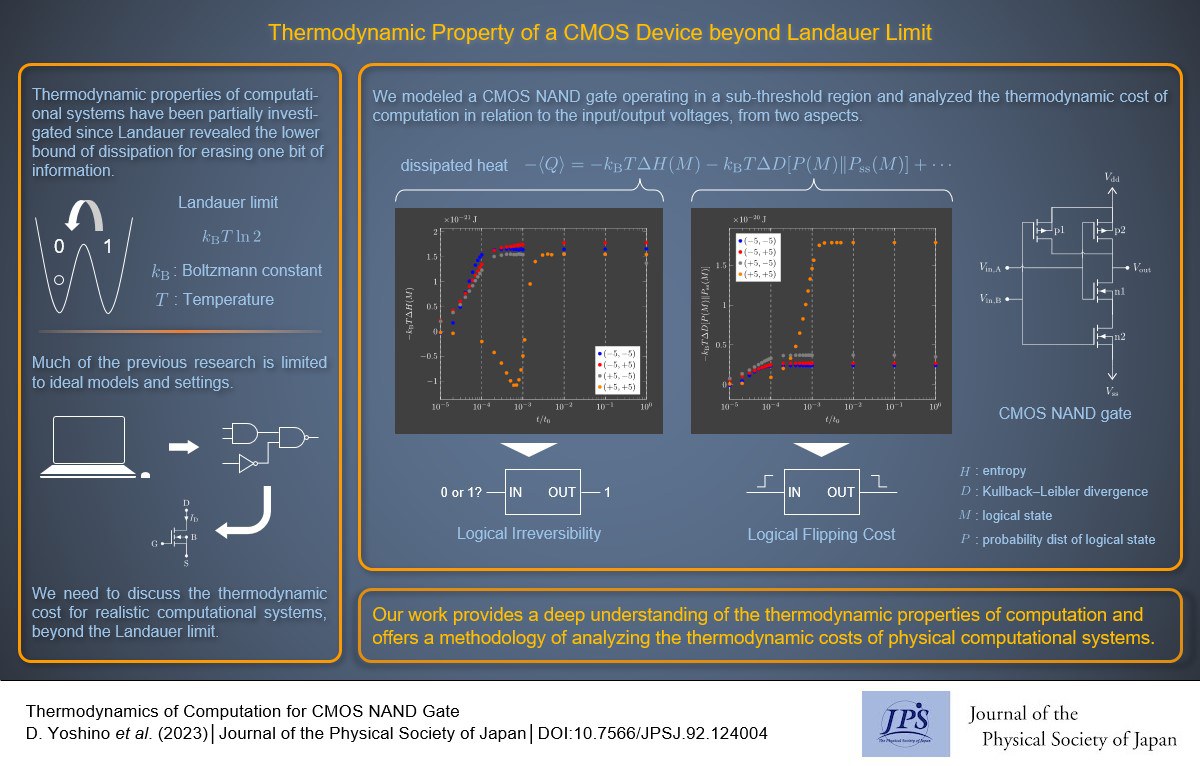
Focusing on a CMOS NAND GATE operating in a sub-threshold region, the thermodynamic cost of computation was analyzed in relation to input/output voltages surpassing the Landauer limit.
Understanding the thermodynamic properties of computation is not only physically interesting but also holds significant practical implications.
In 1961, Rolf Landauer from IBM introduced the Landauer principle, establishing a lower bound for the dissipation of energy required to reliably erasing one bit of information. The bound is expressed as kBT ln 2, where kB is the Boltzmann constant, and T is the temperature of a thermal reservoir. This value is approximately 3.0✕10-21 J at room temperature. Although extremely small, achieving this limit is feasible through the quasi-static erasure process of memory. However, practical implementation may result in increased energy dissipation. Beyond serving as mere memory systems, computers execute complex mathematical operations through logic circuits composed of numerous logic gates. Hence, discussing the thermodynamic properties of this system is interesting.
Recent advancements in nonequilibrium statistical mechanics have unveiled instances of dissipation surpassing the Landauer bound in practical applications. In addition to memory systems, the thermodynamic analysis of more complex computers, such as logic circuits, Brownian computers, and models proposed in computer science, has become possible. However, existing studies are limited to ideal models and settings. For physically implemented computers, only a few studies have analyzed the relationship between computational processes and their thermodynamic properties.
This study focuses on a specific logic gate and analyzes the thermodynamic properties in terms of the extended Landauer bound. NAND gates, comprising CMOS transistors operating in sub-threshold regions, exhibit additional dissipation due to dynamic changes in the logical states encoded in the output voltage. These findings have been quantitatively revealed.
The Landauer bound stems from logical irreversibility and the inability to accurately infer the input from the output state after computation. This reduces the number of logical states (M) to be realized before and after the computation, thus increasing the corresponding entropy (H), up to ln 2 in the case of a 1-bit complete information erasure. In this study, alongside the dissipation associated with this logical irreversibility, an additional dissipation, contingent on the initial system distribution, was identified through an investigation of the Kullback-Leibler divergence. While no difference was observed in the former dissipation under varying input voltage conditions, the latter exhibited greater dissipation under certain conditions. We interpret this factor as a consequence of logic state flipping.
The relevance of thermodynamic properties for more complex physical computers has not been completely understood, and further research is required.
(Written by D. Yoshino on behalf of all authors)
J. Phys. Soc. Jpn.
92,
124004
(2023)
.
Share this topic


Fields
Related Articles
-
Giant Brute-Force Simulation to Reveal Nucleation and Growth of Ultrasonic Cavitation Bubbles
Electromagnetism, optics, acoustics, heat transfer, and classical and fluid mechanics
Statistical physics and thermodynamics
2026-7-27
This study reveals the early-stage dynamics of ultrasonic cavitation using a record 100-billion-atom simulation to capture bubble nucleation, growth, clustering, and periodic splitting under nonequilibrium conditions.
-
Monitored Quantum Systems and Quantum Trajectories
General and Mathematical Physics
Mathematical methods, classical and quantum physics, relativity, gravitation, numerical simulation, computational modeling
Statistical physics and thermodynamics
2026-7-21
This review in Progress of Theoretical and Experimental Physics introduces monitored quantum systems and quantum trajectories, emphasizing their spectral properties, typical behaviors such as ergodicity and purification, and measurement-induced phases.
-
Topological Defects as Seeds of Phase Separation: Insights from a Minimal Lattice Model
Cross-disciplinary physics and related areas of science and technology
Statistical physics and thermodynamics
2026-7-13
A minimal lattice model revealed that topological defects with winding number +1 serve as nucleation sites for phase separation in active matter systems.
-
A Deep Dive Into AI-Driven Materials Science
Cross-disciplinary physics and related areas of science and technology
2026-7-6
This review from the Journal of the Physical Society of Japan examines how artificial intelligence overcomes traditional materials science bottlenecks, highlighting the shift from intuition-based discovery to data-driven innovation.
-
Peculiar Magnet Pointing Against an Applied Magnetic Field
Cross-disciplinary physics and related areas of science and technology
Magnetic properties in condensed matter
2026-7-1
TbNiC2 exhibits negative magnetization. A new mechanism, based on the coupling between the charge density wave and the antiferromagnetic order, is proposed to account for this peculiar phenomenon.