

Antisymmetric Exchange Interaction Selects the Cycloidal Helicity: Observation by Resonant X-ray Diffraction
© The Physical Society of Japan
This article is on
Helicity Selection of the Cycloidal Order in Noncentrosymmetric EuIrGe3
J. Phys. Soc. Jpn.
92,
083701
(2023)
.
The unique sense of rotation of the cycloidal magnetic order was clarified in noncentrosymmetric EuIrGe3 by using circularly polarized resonant x-ray diffraction.
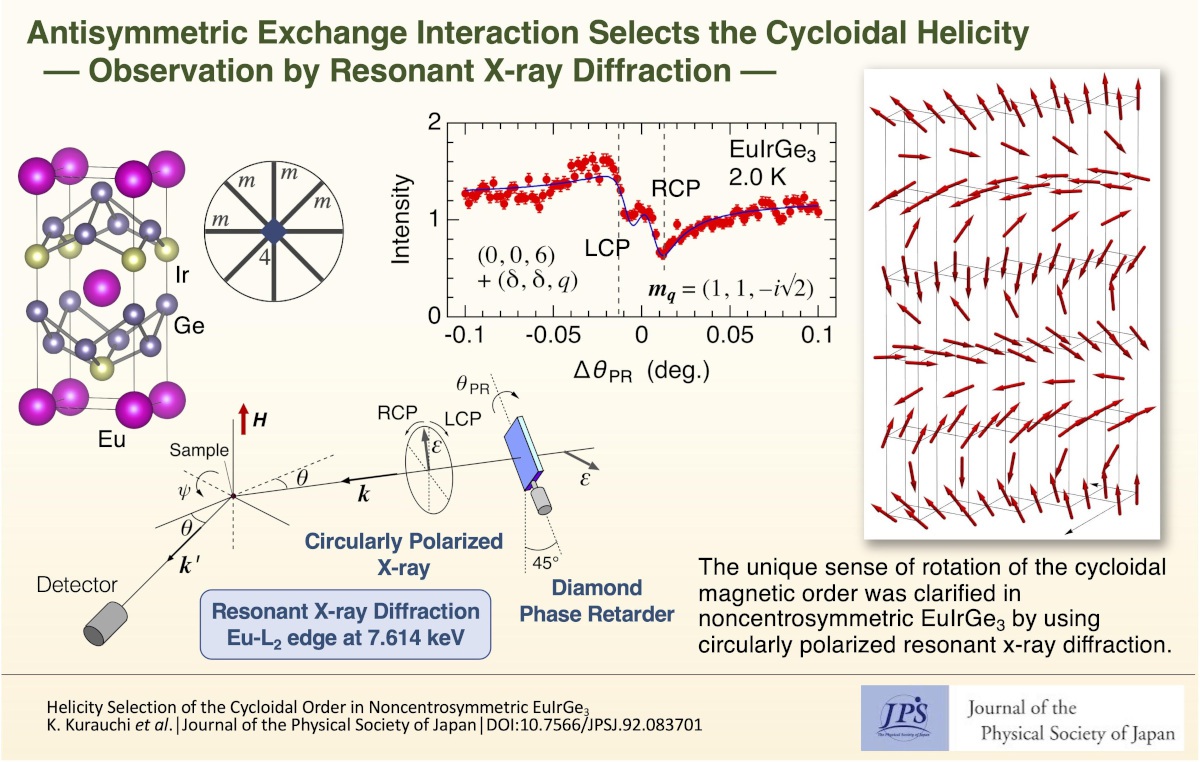
In crystals lacking space inversion symmetry, antisymmetric exchange interactions can arise, which are generally expressed in the form of D • (Si x Sj). In normal magnetic ordering by symmetric exchange interactions of the form J Si•Sj, the magnetic moments are aligned parallel or antiparallel to each other into a collinear structure. However, when the antisymmetric exchange is active, the magnetic moments experience a twisting force, resulting in various types of spiral magnetic orderings. The twisting nature of exchange interactions has recently attracted considerable attention because it often generates nontrivial emergent magnetic structures such as chiral soliton lattices and magnetic skyrmion lattices. They are the crystallization of particle-like spin-swirling objects composed of spiral magnetic modulation waves with a single sense of rotation (helicity), which is considered to be the source of topological stability. Therefore, it is important to observe the helicity of the component waves.
The experimental observation of the magnetic helicity is challenging. Although polarized neutron diffraction is a powerful technique, it requires a delicate instrumental setup. In addition, it is unsuitable for samples that contain neutron-absorbing elements such as Eu and Gd. In this study, we employed resonant X-ray diffraction using a synchrotron radiation photon source. We used a diamond phase-retarder system inserted in the incident beam path to manipulate the incident polarization to left- and right-handed circularly polarized states, which have direct sensitivity to the magnetic helicity through different scattering cross-sections for the opposite sense of rotation. We applied a phase-retarder scan to observe the cycloidal ordering in the noncentrosymmetric magnet EuIrGe3, with four mirror reflection planes including the four-fold c-axis.
The cycloidal ordering is characterized by a propagation vector (δ, δ, 0.8), where δ=0.012 at 2.0 K. The Fourier component for this structure is either (1, 1, i√2) or (1, 1, - i √2), where the sign is related to the cycloidal helicity. Furthermore, there arise four magnetic domains described by (δ, δ, 0.8), (-δ, δ, 0.8), (-δ, -δ, 0.8), and (δ, -δ, 0.8). The helicities of all the four domains were measured.
The helicities perfectly reflected the C4v symmetry of the crystal structure. All four Fourier components were related by the 90° rotations and by the mirror reflections. This result clearly shows that the helicity of the cycloid is uniquely selected by the antisymmetric interactions. We believe that this method can be widely applied to the helicity measurements of various types of spiral magnetic systems.
(Written by T. Matsumura on behalf of all the authors.)
Helicity Selection of the Cycloidal Order in Noncentrosymmetric EuIrGe3
J. Phys. Soc. Jpn.
92,
083701
(2023)
.
Share this topic


Fields
Related Articles
-
Frustrated Sawtooth Yb Chain Yielding Ferromagnetic Order with Reduced Magnetic Moments
Magnetic properties in condensed matter
2026-9-1
The ytterbium-based semiconductor ZnYb2S4 exhibits ferromagnetic order with contracted Yb moments, representing a novel quantum ground state attributed to competing exchange interactions in an effective spin-1/2 frustrated sawtooth chain.
-
Unlocking a 40-Year-Old Mystery: Full-gap Spin-Triplet Superconductivity Unveiled in UBe13
Magnetic properties in condensed matter
Superconductivity
2026-8-12
Recent precise NMR measurements on the heavy-fermion superconductor UBe13 provided “smoking-gun” evidence for a fully-gapped spin-triplet superconducting state, opening a new chapter in the field.
-
Peculiar Magnet Pointing Against an Applied Magnetic Field
Cross-disciplinary physics and related areas of science and technology
Magnetic properties in condensed matter
2026-7-1
TbNiC2 exhibits negative magnetization. A new mechanism, based on the coupling between the charge density wave and the antiferromagnetic order, is proposed to account for this peculiar phenomenon.
-
Magnetic-Field Driven Switching of Multipolar Order in an f-Electron System
Magnetic properties in condensed matter
2026-5-22
This study investigates high-rank multipole physics in f-electron systems, providing the first clear experimental evidence for field-induced switching of ferro-quadrupole order in a non-Kramer ion system, along with a new conceptual framework
-
Toward Clarification of Physical Properties of Quasicrystals: Noncollinear Magnetic Orders in Icosahedral Approximants
Cross-disciplinary physics and related areas of science and technology
Electronic transport in condensed matter
Magnetic properties in condensed matter
2026-4-6
An effective model based on magnetic anisotropy arising from a crystalline electric field is constructed for icosahedral approximants, which not only explains measured ferromagnets and antiferromagnets but also reveals new types of noncollinear magnetic orders.