

How Many Excitons Can Combine?
© The Physical Society of Japan
This article is on
Polyexcitons in Two Dimensions
(JPSJ Editors' Choice)
J. Phys. Soc. Jpn.
92,
073702
(2023)
.
Quantum diffusion Monte Carlo simulation demonstrated the formation of polyexcitons in two-dimensional multi-valley semiconductor systems, where all exciton pairs were energetically bound by equal-strength “chemical bonds.”
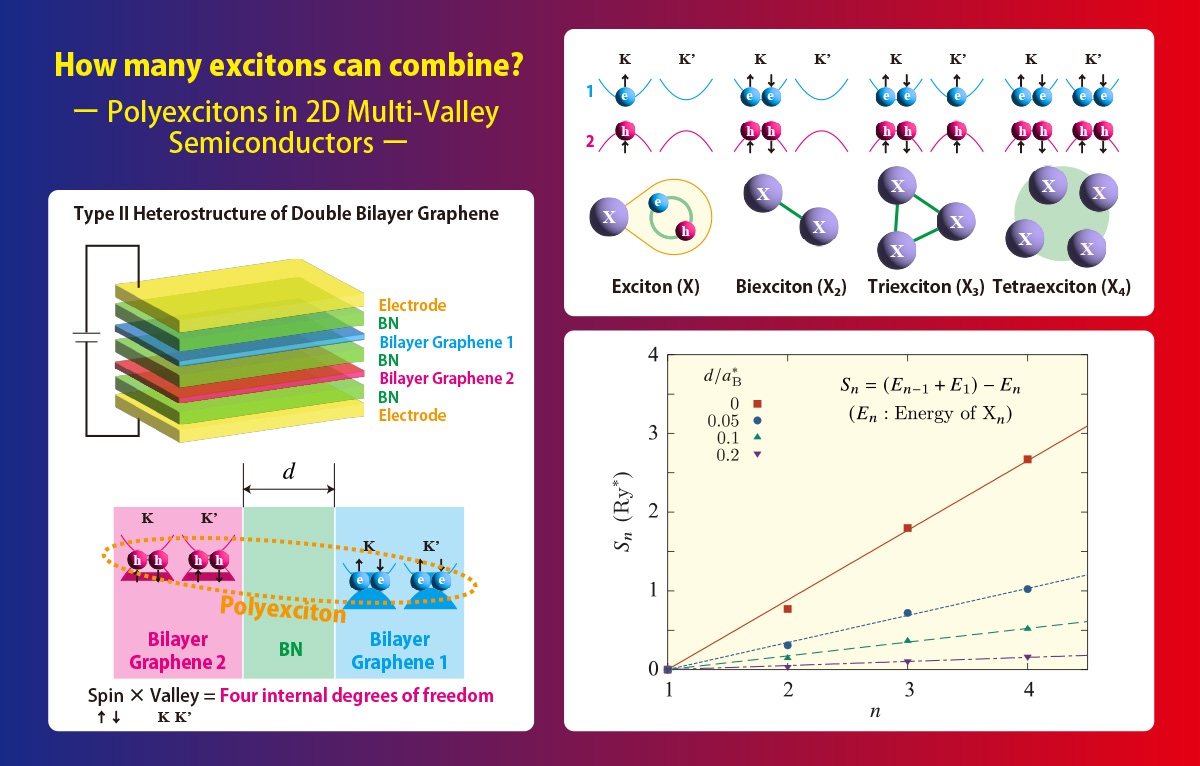
Polyexcitons are composites of multiple electron-hole pairs. In strongly photoexcited intrinsic semiconductors or type II semiconductor heterostructures, an electron in conduction bands and a hole in valence bands naturally form an exciton, and further, a pair of excitons coalesces into a biexciton. These composites have been studied in an analogy to hydrogen atoms or molecules. A common expectation is that excitons cannot form triexcitons, similar to hydrogen atoms that cannot form trimers. However, in multi-valley semiconductors, more than two excitons can be bound, because electrons and holes acquire the additional valley degrees of freedom that, combined with the spins, allow more than two electrons and holes to occupy the same position. This possibility was first identified by Wang and Kittel in 1972 and has been experimentally observed in pure bulk samples of silicon and diamond as the photoluminescence (PL) peaks almost equally spaced at energy intervals.
We consider the two-dimensional simplified model of the type II double-bilayer graphene heterostructures. The electrons and holes stay on different layers separated by a distance and interact with each other via Coulomb potentials. They also acquire four internal degrees of freedom because they have two spin and two valley degrees of freedom. This implies that our system can afford triexcitons and tetraexcitons, and that the quantum diffusion Monte Carlo simulation is free of the negative sign problem and can precisely evaluate the energies.
Notably, the separation energy required to pull out one exciton from the polyexciton grows almost exactly linearly with the exciton number. This behavior resembles the aforementioned PL peaks, indicating that the underlying physics is common between two and three dimensions. This further implies that all pairs of excitons inside the polyexciton are energetically bound by “chemical bonds” of equal strength, irrespective of the bound exciton numbers or the details of the system, for example, the interlayer distances.
(Written by K. Asano on behalf of all the authors)
"Polyexcitons in Two Dimensions
(JPSJ Editors' Choice)
J. Phys. Soc. Jpn.
92,
073702
(2023)
.
Share this topic


Fields
Related Articles
-
Holonomy Reveals Hidden Strain Incompatibilities in Birefringence Imaging
Dielectric, optical, and other properties in condensed matter
Measurement, instrumentation, and techniques
2026-8-17
Holonomy measures how local optical directions fail to return to their original orientation after a closed loop, revealing hidden electromechanical structures in stress-induced ferroelectric SrTiO3.
-
Enhancing Accuracy and Reliability Bayesian Framework for Analysis of AR-HAXPES of Hard X-ray Photoelectron Spectroscopy
Dielectric, optical, and other properties in condensed matter
Electronic structure and electrical properties of surfaces and nanostructures
Measurement, instrumentation, and techniques
2026-4-28
We present a Bayesian framework for angle-resolved hard X-ray photoelectron spectroscopy (AR-HAXPES), combining Replica Exchange Monte Carlo with hierarchical integration to objectively and precisely estimate thin-film thickness.
-
Definitive Momentum and Spin Imaging Resolves 20-Year Debate on Gold Surface Spin
Electronic structure and electrical properties of surfaces and nanostructures
Magnetic properties in condensed matter
2026-4-1
Researchers at the Institute for Molecular Science (IMS) have utilized a cutting-edge Photoelectron Momentum Microscope (PMM) at the UVSOR Synchrotron Facility to settle a two-decade-long controversy concerning the direction of electron spin on the Au(111) surface. This study provides a definitive, full-map, comprehensive reference for quantum imaging that is essential for advancing spintronics technology.
-
Oxide Superionic Conductivity of a-Axis-Oriented Ce0.75Sm0.25O2−δ Thin Film
Electronic structure and electrical properties of surfaces and nanostructures
2026-2-2
Highly a-axis oriented Ce0.75Sm0.25O2-δ thin film fabricated on a yttria-stabilized zirconia substrate achieved oxide superionic conductivity, which can apply as an electrolyte in solid oxide fuel cells operating at medium temperature.
-
A Novel Type of Magnetic Band Splitting in a Fe Spin Ladder System
Dielectric, optical, and other properties in condensed matter
Magnetic properties in condensed matter
Superconductivity
2026-1-22
An investigation of a Fe spin ladder system using angle-resolved photoemission spectroscopy revealed a novel type of magnetic band splitting resembling that in altermagnets.